Top Skills for Aesthetic Clinic Roles
Aesthetic clinic success depends on teams who combine clinical skill, patient communication, and business know-how across staff, nurses, aestheticians, and managers.


Running an aesthetic clinic requires more than just medical expertise. Every role, from front desk staff to clinic managers, contributes to patient safety, satisfaction, and clinic success. Here’s a quick breakdown of the key skills needed for each role:
- Front Desk Staff: Strong communication, scheduling, and customer service skills. Knowledge of medical terminology and HIPAA regulations is vital for managing patient records and ensuring smooth operations.
- Aestheticians: Expertise in skin treatments (e.g., lasers, chemical peels) and personalized care based on patient needs. Clear communication and realistic expectation-setting are essential.
- Aesthetic Nurses: Advanced knowledge of facial anatomy for procedures like Botox and fillers. Precision, patient trust, and compliance with safety standards are critical.
- Clinic Managers: Leadership, financial management, and operational efficiency. They ensure compliance with regulations and drive clinic growth.
Key Takeaway: Success in aesthetics depends on a balance of technical skills, patient communication, and business knowledge tailored to each role. Training and tools like integrated CRM/EMR systems can enhance team performance and patient care.
1. Front Desk and Administrative Staff
Role-Specific Expertise
Your front desk team is the first impression of your aesthetic clinic and the last touchpoint before patients leave. They bridge the gap between patients and the clinical team, making their role essential to daily operations. These staff members should confidently articulate the qualifications of your medical providers and have a solid understanding of the clinic’s products and treatments. They also need to communicate effectively with clinical staff and manage patient records with precision, including a working knowledge of medical terminology to ensure smooth coordination across departments.
Patient Interaction and Communication
When it comes to patient communication, the LAER model - Listen, Acknowledge, Explore, and Respond - is a proven framework. It helps front desk staff fully grasp patient concerns before recommending services. Terri Ross, Founder of Terri Ross Consulting, highlights the importance of positivity in patient interactions:
A positive attitude is infectious and an important element of success in any business.
Timely follow-up is just as crucial. Responding to new inquiries within 1–3 hours (and no later than 24 hours) shows attentiveness and builds trust. If a patient asks about a service the clinic doesn’t offer, staff should confidently suggest an alternative. Additionally, with over 75% of U.S. office-based clinicians now using electronic health record (EHR) systems, technical proficiency is non-negotiable for managing patient data and scheduling.
Business and Operational Knowledge
Front desk staff do more than greet patients - they’re also key players in keeping the clinic running smoothly. They handle the financial operations of the business, including processing payments, managing billing and coding, verifying insurance, and coordinating treatment plans. A strong grasp of HIPAA regulations is essential to protect patient confidentiality. Efficient schedule management using practice software can minimize no-shows and last-minute cancellations, which directly affect revenue. Platforms like Prospyr simplify these tasks with tools such as integrated CRM/EMR systems, smart scheduling, digital intake forms, and payment processing, all while ensuring HIPAA compliance.
When hiring, consider candidates with experience in premium customer service roles - think Nordstrom or Starbucks - where a patient-first mindset is ingrained. These combined skills ensure the administrative team provides a solid foundation for the clinic’s success.
sbb-itb-02f5876
2. Aesthetic Therapists and Medical Aestheticians
Role-Specific Expertise
Medical aestheticians play a central role in delivering non-invasive cosmetic procedures. They specialize in treatments like laser hair removal, chemical peels, microdermabrasion, and facial resurfacing. According to the AAAMS Industry Guide, they are often regarded as "jacks of all trades", excelling in laser procedures, injections, and skin resurfacing techniques. As demand for skilled professionals continues to grow, their expertise becomes even more valuable.
One of the most critical areas of their work involves laser technologies. These professionals must be adept at using different light wavelengths to address a variety of skin concerns. For example, CO2 lasers are ideal for treating sun damage, Fractional lasers work well for fine lines and scars, and YAG lasers are effective for deeper issues like spider veins and tattoo removal. To achieve optimal results, aestheticians need a solid understanding of facial anatomy and skin types, enabling them to create tailored treatment plans for each patient. This combination of technical skill and personalized care is key to successful outcomes.
Patient Interaction and Communication
Strong communication is what separates a great aesthetician from an average one. Jake Sebert from Method Aesthetics highlights the importance of discussing care plans, understanding patient goals, setting realistic expectations, and maintaining follow-ups. The consultation phase, in particular, is vital. It allows aestheticians to identify skin types, address concerns, and determine if a patient is a suitable candidate for a specific treatment.
Managing expectations is especially important for treatments like Botox, where results take time to appear. Dr. Tristan Mehta, Founder of Harley Academy, underscores the importance of intuition in patient care:
Having solid intuition can help you most when it comes to patient selection. It can be particularly useful when sounding the alarm for patients you perhaps shouldn't be treating.
This kind of instinct, honed over years of experience, helps practitioners anticipate patient responses and make informed decisions.
Technical and Clinical Proficiency
Beyond their technical skills, aestheticians must also comply with OSHA and HIPAA standards, ensuring patient safety and privacy. Using EMR systems with digital intake to track treatment progress and manage documentation is another critical aspect of their role. Additionally, careful post-operative care is essential for identifying potential medical concerns early and preventing complications. These practices not only enhance patient safety but also reinforce trust in the clinic's services.
Business and Operational Knowledge
Aesthetic therapists also contribute significantly to the financial success of clinics. Injectables, for instance, account for nearly 40% of the average medspa's revenue, often with profit margins exceeding 50%. Combining clinical skills with business acumen helps drive patient satisfaction and sustainable growth. Cross-promoting services - such as pairing injectables with skin rejuvenation treatments - and incorporating retail product recommendations into patient care are effective ways to enhance outcomes while boosting revenue. Skincare product sales alone can yield profit margins above 50% and contribute up to 25% of revenue in top-performing clinics.
Terri Ross, Founder of Terri Ross Consulting, emphasizes the competitive nature of the medical aesthetics industry:
The medical aesthetics space is very competitive... your ability to articulate with conviction by credentialing the business, the medical providers, and knowing the products and treatments you offer over the competition is paramount.
3. Aesthetic Nurses
Role-Specific Expertise
Aesthetic nurses combine medical precision with an artistic touch. Their role requires a deep understanding of anatomy that goes well beyond standard nursing education. As Incredible Health highlights:
Injecting toxins into someone's face requires expert knowledge. Your anatomy training goes beyond the basics to include the nerves and vessels below the skin.
This advanced knowledge of facial nerves, muscles, and blood vessels is critical when administering neurotoxins like Botox or dermal fillers. These skills are not only vital for patient safety but also for ensuring top-notch results in clinical settings. Achieving certifications such as CANS or CPSN demands over 1,000 hours of practical experience. Beyond injectables, their expertise spans a variety of procedures, including chemical peels, microneedling, sclerotherapy, and body contouring treatments like Coolsculpting. With the aesthetic injectables market projected to grow by at least 12% annually through 2027, these specialized skills are becoming increasingly sought after.
Patient Interaction and Communication
Trust is the cornerstone of an aesthetic nurse's relationship with their patients, and it begins well before any procedure. These nurses conduct detailed patient interviews and thorough medical assessments to create tailored treatment plans that align with each individual's goals. Managing expectations is a key part of their role - patients must understand recovery timelines, realistic outcomes, and potential risks. A compassionate approach that addresses both physical results and emotional concerns strengthens these relationships. As one industry guide explains:
Your bedside manner must be personable and professional. Since you're consulting with patients before their procedure and hopefully building a long-term relationship, they need to feel like they can trust you.
In some cases, earning trust means advising patients against treatments that may not be in their best interest. This honest and empathetic approach lays the groundwork for successful outcomes and enduring patient loyalty.
Technical and Clinical Proficiency
Precision is what separates good aesthetic nurses from exceptional ones. Administering injections requires a steady hand, sharp attention to detail, and sound clinical judgment - especially in sensitive areas like the eyes and lips. The American Association of Aesthetic Medicine and Surgery (AAAMS) notes:
Attention to detail helps avoid medical mistakes, notice medical concerns during post-operative care, and prevent long-term damage or issues for patients.
Aesthetic nurses also maintain meticulous HIPAA-compliant documentation, including accurate SOAP notes. Staying up-to-date with new techniques and devices through continuous education is essential, not just for patient safety but also to maintain their professional reputation.
Business and Operational Knowledge
Operational expertise is just as important as clinical skills for aesthetic nurses. Their efficiency directly impacts a clinic’s profitability. For example, they manage expensive supplies like injectables using inventory management tools. In 2021, aesthetic nurse practitioners in California earned an average salary of $102,571, reflecting their significant contribution to the business side of practices. Proper documentation, effective patient flow management, and the ability to cross-promote complementary services are all key to balancing clinical excellence with financial success. Platforms like Prospyr help streamline these administrative tasks, further enhancing operational efficiency.
Reading about the problem? See how Prospyr solves it in one platform.
Book a Demo4. Aesthetic Clinic Owners and Practice Managers
Role-Specific Expertise
Running an aesthetic clinic is no small feat - it requires a mix of business savvy and healthcare know-how. These clinics operate at the intersection of medical care and business, offering elective treatments that rely heavily on effective marketing to generate revenue. Practice managers play a key role here, acting as the go-between for physicians and daily operations. They tackle HR challenges, resolve staff conflicts, and handle administrative tasks, freeing up medical professionals to focus on patient care. As Dr. Heidi Waldorf, MD, FAAD, aptly puts it:
The saying, 'It takes a village,' applies rather well to growing and maintaining a successful aesthetic practice.
For clinic owners, staying on top of ever-evolving state regulations is another critical responsibility. For instance, California requires that only physicians or registered nurses perform certain chemical peels, while Texas mandates specific certifications for laser hair removal technicians. Keeping up with these rules - as well as employment laws and licensing requirements - ensures the clinic operates within the bounds of the law. Successfully balancing clinical expertise with operational management paves the way for a thriving practice.
Patient Interaction and Communication
The way a clinic interacts with its patients can make or break its reputation, and owners and managers are at the heart of shaping this experience. Building a patient-first culture starts with hiring staff who excel in soft skills like empathy, curiosity, and friendliness - qualities that are much harder to teach than technical skills. Skyla Jones, CNA, highlights this point:
When in doubt, hire for soft skills.
This hiring philosophy ensures that every team member prioritizes the patient experience from day one. Managers also act as key communicators, presenting issues to physicians in a clear and concise manner while fostering a professional environment where patients feel “seen, heard, valued, and understood” throughout their care journey.
Business and Operational Knowledge
Beyond patient care, the financial and operational aspects of running an aesthetic clinic are just as critical. With 18 million Americans opting for cosmetic procedures in 2018, the industry continues to grow. For example, in 2024, Dr. Sarah Thompson tackled stagnant growth at her mid-sized clinic by introducing automated scheduling, standardized treatment protocols, and a structured patient feedback system. These changes led to a 25% revenue increase and significantly improved patient satisfaction within six months.
Technology plays a big role in boosting efficiency. Platforms like Prospyr streamline operations by automating scheduling, using digital intake forms, and integrating CRM/EMR systems. Digital intake forms alone can save staff an average of 16 hours, and patients are 60% more likely to complete them before their appointment. Additionally, integrated systems reduce data entry errors by threefold compared to manual processes. By monitoring key performance indicators (KPIs) - like revenue per hour, no-show rates, and patient conversion metrics - managers can make data-driven decisions to improve both clinical outcomes and the bottom line.
Operational strategies like cross-training staff to handle multiple roles during busy periods or staff absences help maintain service quality. Taking deposits at the time of booking can cut no-show rates by 34%, while responding to leads within the first minute can boost conversion rates nearly fourfold. Finally, proactive reputation management - such as responding thoughtfully to online reviews - can sway 56% of potential customers toward viewing the clinic positively. Together, these measures give clinics a strong edge in an increasingly competitive market.
5. Cross-Role Clinical Skills
Developing consistent skills across various roles strengthens a clinic's holistic approach to patient care, reinforcing the importance of specialized training discussed earlier.
Patient Interaction and Communication
In an aesthetic clinic, every team member - whether they’re answering calls, setting up treatment rooms, or administering injections - needs to excel in communication. The LAER Model (Listen, Acknowledge, Explore, Respond) provides a helpful framework for understanding patient needs before offering solutions. Terri Ross, Founder of Terri Ross Consulting, explains:
The LAER Model that I teach stands for Listen, Acknowledge, Explore, Respond. Most often, people tend to Listen and Respond without really understanding patient needs.
Instead of turning patients away when a specific service or product isn’t available, staff should shift the focus to the patient’s goals and present alternative options. Research also highlights the importance of quick follow-ups - contacting leads within the first minute can boost conversion rates by 3.9x. These communication fundamentals help staff adapt effectively to different roles within the clinic.
Technical and Clinical Proficiency
A solid foundation in clinical knowledge ensures both patient safety and high-quality care. New staff should rely on protocols provided by the physician until they fully grasp the procedures. Dr. Heidi Waldorf, MD, FAAD, emphasizes:
People who understand concepts rather than just memorize facts are also better prepared to manage the unusual and to build on their knowledge base.
Cross-training on specific procedures and the preferences of each provider - what Dr. Waldorf calls the "dance" - allows team members to step in seamlessly when needed, ensuring care quality isn’t compromised. Additionally, when front office staff learn technical terminology, they improve their communication with both patients and the clinical team. This shared understanding of clinical protocols naturally results in smoother operations.
Business and Operational Knowledge
When clinical staff understand the business side of the practice, they contribute more effectively to the team. For instance, implementing digital intake forms and telehealth can reduce appointment no-shows by 34%. Employees trained in business operations can apply their cross-role skills to identify and act on opportunities to improve service. Familiarity with tools like scheduling software, billing codes, and patient intake processes helps avoid bottlenecks that could slow down the clinic’s workflow.
Platforms like Prospyr integrate CRM/EMR systems, automated scheduling, and digital intake forms, enabling staff to handle both clinical and administrative tasks more efficiently, no matter their role.
6. Staff Training and Skill Development
Start with a detailed onboarding program that sets the tone for consistent service quality. This should cover essential areas like HIPAA compliance, sanitation protocols, and standardized service procedures. Pairing new hires with experienced mentors can also help bridge the gap between training and real-world application. A well-structured training manual is invaluable here, offering a go-to resource for maintaining high standards in patient care and interactions.
Move away from the traditional annual performance reviews. Instead, adopt a continuous performance management approach. Regular check-ins, hands-on workshops, and certification programs can keep your team engaged and aligned with clinic goals. Encourage ongoing education by offering certifications in emerging technologies, like lasers or PRP, and supporting attendance at industry conferences. This approach ensures your team stays current and reinforces the clinical and operational standards previously outlined.
Don’t overlook software training, as it’s just as critical as clinical skills. Tailor this training to specific roles - front desk staff should focus on mastering scheduling tools, while providers need proficiency in managing clinical records. Use hands-on practice sessions in a secure environment, supported by 24/7 access to video tutorials and task-specific guides. Tools like Prospyr make this process easier by combining CRM/EMR systems, automated scheduling, and digital intake forms into a single platform that's intuitive for all team members.
Roleplay scenarios are another effective way to prepare staff for real-life challenges. Practice addressing common client concerns, like “I’m afraid of looking fake,” and refine upselling techniques and strategies for handling difficult interactions. Secret shopper evaluations can provide valuable insights into how well staff engage with clients and conduct consultations. Recognize strong performance publicly while addressing areas for improvement privately - this approach builds confidence and encourages growth.
Finally, invest in cross-training your team. Offering additional certifications not only streamlines operations but also creates a more adaptable and capable workforce.
Skills Comparison by Role
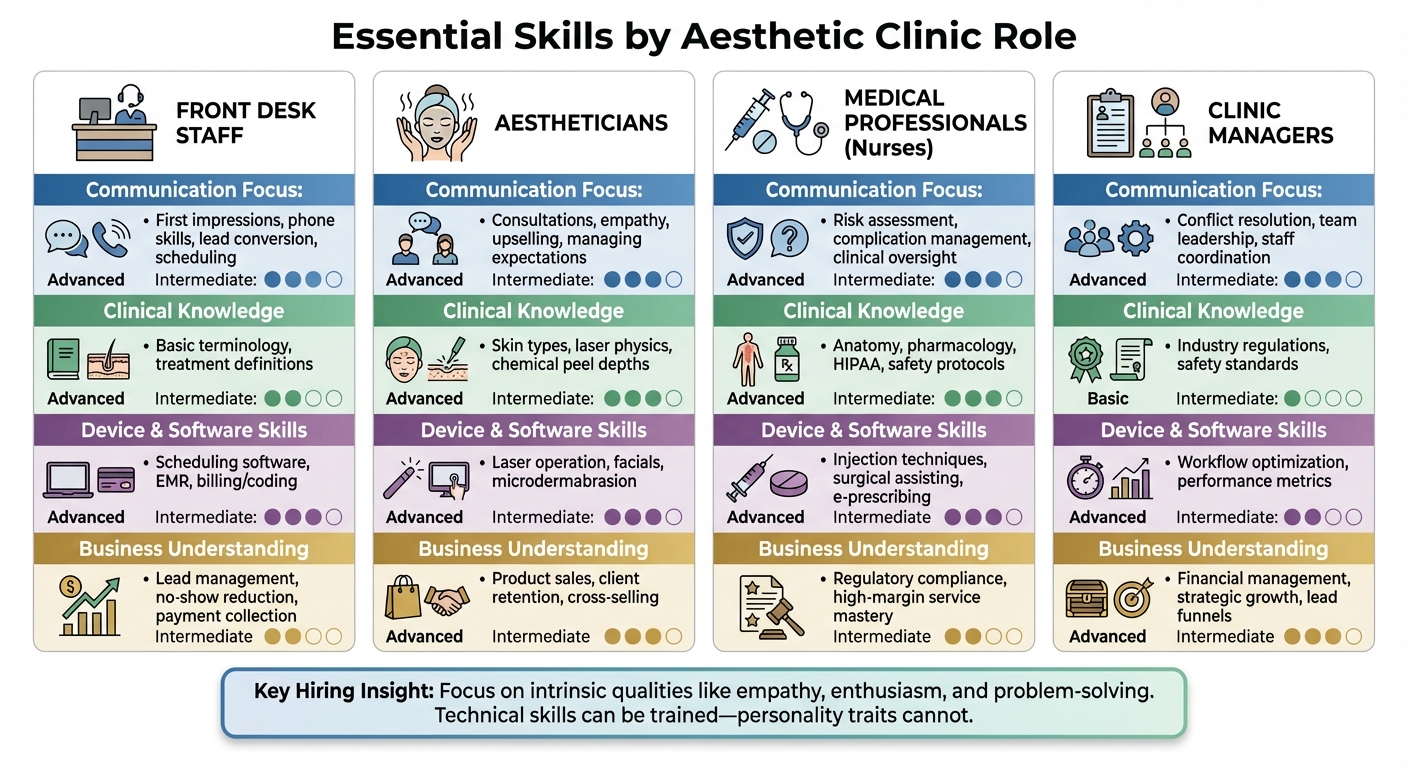
Essential Skills Comparison for Aesthetic Clinic Roles
The table below breaks down the essential skills required for different roles within a clinic, highlighting their unique focus areas.
| Role | Communication Focus | Clinical Knowledge | Device & Software Skills | Business Understanding |
|---|---|---|---|---|
| Front Desk | First impressions, phone skills, lead conversion, healthcare scheduling | Basic terminology and treatment definitions | Scheduling software, EMR, billing/coding | Lead management, no-show reduction, payment collection |
| Aestheticians | Consultations, empathy, upselling, managing expectations | Skin types, laser physics, chemical peel depths | Laser operation, facials, microdermabrasion | Product sales, client retention, cross-selling |
| Medical Professionals | Risk assessment, complication management, clinical oversight | Anatomy, pharmacology, HIPAA, safety protocols | Injection techniques, surgical assisting, e-prescribing | Regulatory compliance, high-margin service mastery |
| Clinic Managers | Conflict resolution, team leadership, staff coordination | Industry regulations and safety standards | Workflow optimization, performance metrics | Financial management, strategic growth, lead funnels |
Each role demands a unique balance of communication, clinical expertise, technical proficiency, and business insight. For instance, front desk staff excel in creating positive first impressions and converting leads, while their clinical knowledge remains basic. Aestheticians and medical professionals require more advanced technical and clinical expertise, with medical professionals also tasked with translating complex medical concepts into simpler terms for patients. Meanwhile, clinic managers juggle leadership duties, financial strategy, and operational oversight, acting as a bridge between clinical protocols and business growth.
"The front office is often a patient's first glimpse into the workings of a practice... if a patient has a positive experience with your front office staff, it sets the stage for a positive experience overall." - Terri Ross, Founder, Terri Ross Consulting
Key takeaway: When hiring, focus on intrinsic qualities like empathy, enthusiasm, and problem-solving. These traits are difficult to teach, whereas technical skills can be developed through training. Build your team by aligning candidates’ natural strengths with the communication needs of their role, and then invest in enhancing their technical and clinical abilities. This approach ensures every team member contributes effectively to your clinic’s success.
Conclusion
Running a successful aesthetic clinic goes far beyond clinical expertise - it requires a strong mix of communication skills, technical know-how, and business savvy at every level. Each role, from front desk to clinic management, plays a vital part in ensuring patient satisfaction and driving revenue.
The aesthetics industry moves quickly, making ongoing training a must to stay competitive and maintain patient safety. As Modern Beauty Con puts it, "The aesthetics industry evolves fast. Your staff should, too". A well-trained team doesn’t just improve patient retention and reduce no-shows - they also create a polished, professional experience that keeps clients coming back. Incorporating technology into staff development can make this process even more effective.
Platforms like Prospyr simplify clinic operations, giving staff more time to focus on patient care and skill-building. With features like an integrated CRM/EMR system, automated scheduling, and AI-powered tools, administrative tasks are minimized. Plus, clinic managers can use the platform's 24/7 training resources and real-time performance tracking to provide targeted, data-driven feedback that helps their teams grow.
FAQs
What skills are essential for front desk staff at an aesthetic clinic?
Front desk staff at an aesthetic clinic need a mix of people skills, organizational know-how, and tech-savviness to create a welcoming and efficient environment for patients. Clear and friendly communication is at the heart of their role - whether it’s greeting patients, answering questions, or scheduling appointments, professionalism and warmth go a long way. Since many patients might feel anxious or unsure, showing empathy and patience is just as important.
Being organized is another must. This includes handling paperwork accurately, keeping the front desk area neat, and staying on top of multiple responsibilities without letting anything slip through the cracks. On the technical side, being comfortable with practice management software - like tools for scheduling, managing digital forms, and updating patient records - can make daily operations smoother and more efficient. Together, these skills help ensure patients feel cared for and the clinic stays on track.
What steps do aesthetic nurses take to ensure patient safety during treatments?
Aesthetic nurses place patient safety at the forefront of their practice by combining advanced training, strict clinical protocols, and open communication. Their in-depth knowledge of facial anatomy and cosmetic procedures, such as Botox and dermal fillers, enables them to reduce risks like improper injections or unexpected reactions.
Before any treatment, they conduct detailed patient assessments to uncover potential medical conditions or contraindications. This helps them craft tailored treatment plans that suit each individual’s needs. During procedures, they maintain a sterile environment to prevent complications and ensure everything runs smoothly. Certifications, including Botox training, further sharpen their skills and expertise.
By keeping a close eye on patients during and after treatments, aesthetic nurses provide not only a safe experience but also one that is as comfortable as possible. Their attention to detail and commitment to care make all the difference.
Why is business knowledge important for running a successful aesthetic clinic?
Business know-how is a must for running a thriving aesthetic clinic. It’s what keeps operations smooth, finances stable, and growth on track. By understanding core business principles, clinic owners and managers can set up systems that work - whether it’s for staffing, marketing, patient care, or financial planning.
Take staffing, for instance. Solid business skills help clinics create competitive pay packages, build a positive work culture, and keep their top talent onboard. On top of that, staying business-savvy allows clinics to adapt to industry shifts, comply with regulations, and make the most of tools like practice management software to simplify daily operations. When clinical expertise meets smart business strategies, the result is a well-run clinic that not only provides outstanding patient care but also thrives for the long haul.