
When clients stop booking, it can cost your clinic more than you think. Acquiring a new client is 5–25 times more expensive than retaining an existing one. The good news? Winning back inactive clients is easier than starting fresh. Most disengaged clients leave because they feel forgotten, and a personalized, well-timed message can bring them back. Reactivating even a small percentage of clients can boost your revenue significantly, with retention-focused businesses seeing profit margins increase by 25–95%.
Here’s how to do it in four steps:
- Identify inactive clients: Define inactivity based on treatment schedules and group clients by how long they’ve been inactive.
- Personalize outreach: Reference past treatments and tailor messages to individual preferences.
- Launch win-back campaigns: Use multi-step communication with incentives like discounts or free add-ons.
- Track and refine: Monitor open rates, response rates, and bookings to improve future campaigns.
Step 1: Identify and Categorize Inactive Clients

Client Reactivation Rates by Inactivity Duration for Aesthetic Clinics
Define What Counts as Inactive
Understanding when a client becomes inactive depends heavily on the type of service they receive. For example, most clinics consider a client inactive after about six months. But this can vary: Botox clients, who often book every 3–4 months, might be considered overdue after 5–6 months. On the other hand, body contouring clients, who space their appointments further apart, may only be classified as inactive later. Clearly defining these thresholds is key to crafting effective reactivation strategies.
A good rule of thumb is to use a 50% threshold. If a client’s last visit exceeds their typical booking interval by at least 50%, they’re a candidate for reactivation. For instance, if a client usually books every three months and it’s been 4.5 months since their last visit, they’re now inactive. Weekly service clients might fall into this category after just 3–4 weeks, while quarterly clients hit that point around 5–6 months.
Group Clients by Status
Once you’ve identified inactive clients, it’s time to organize them into categories based on how long they’ve been inactive and their lifetime value. Start by dividing them into three main groups:
- Recently lapsed: Clients inactive for 6–12 months
- Long lapsed: Clients inactive for 12–24 months
- Very long lapsed: Clients inactive for 24+ months
Each group has different reactivation rates and requires tailored strategies. For example, recently lapsed clients typically have an 8–15% reactivation rate, while long-lapsed clients drop to 4–8%, and very long-lapsed clients have just a 2–4% chance of returning.
Lifetime value is just as important as recency. Clients who’ve visited three or more times and spent over $1,000 should be prioritized - they’re 2–3 times more likely to reactivate compared to one-time visitors. The top 10% of clients by lifetime value deserve extra attention, such as a personal phone call instead of an automated email. On the flip side, clients with low satisfaction scores or negative feedback should be excluded from automated campaigns altogether to avoid harming your brand’s reputation.
| Client Status | Inactivity Duration | Expected Reactivation Rate | Recommended Strategy |
|---|---|---|---|
| Recently Lapsed | 6–12 months | 8–15% | Rebooking bonuses / Maintenance education |
| Long Lapsed | 12–24 months | 4–8% | New technology showcase / Re-consultation |
| Very Long Lapsed | 24+ months | 2–4% | New client-level incentives |
These categories provide the foundation for precise, targeted outreach.
Use Patient Data to Inform Outreach
With your clients grouped, it’s time to use their data to personalize your reactivation campaigns. Leverage information from your CRM or EMR systems, including the client’s last treatment, the provider who performed it, and the time elapsed since their last visit. This data allows you to craft messages that feel tailored and relevant. For instance, if a client received fillers a year ago, you could remind them that their results may be fading and suggest a maintenance appointment to protect their investment. If their original provider is still with your clinic, sending the message from them can make it feel more personal and less like a mass email.
Automate this process by using embedded marketing tools to trigger win-back sequences as soon as a client crosses your inactivity threshold. This ensures no one is overlooked. Personalized reminders based on patient data are far more effective than generic messages - boosting results by 48%. Specificity makes all the difference.
sbb-itb-02f5876
Step 2: Personalize Your Communication
Reference Past Treatments
Tap into your client records to create messages that feel personal and relevant. Using your HIPAA-compliant EMR system, pull details like the treatment they received, when they visited, and any positive outcomes noted in their chart. For example, a message such as, "Hi Sarah, we loved seeing your radiant glow after your HydraFacial in March 2024 - it's been a year, and we'd love to book your complimentary touch-up!" not only reminds Sarah of her positive experience but also strengthens trust and highlights the value of returning to your clinic.
Real-world success backs this approach. The Aesthetic Dermatology Group in Miami saw impressive results when they referenced past Botox treatments in win-back emails during Q1 2024. Their efforts led to a 32% open rate and a 12% rebooking rate among 2,500 inactive clients, compared to their usual 5% baseline. By segmenting clients based on service history and offering a 20% discount for refreshes, Marketing Director Lisa Rivera helped generate $45,000 in recovered revenue within just 90 days [Klaviyo Case Studies, 2024].
Customize Your Messages
Generic messages often fall flat. Instead, tailor your communication to reflect each client's preferences and past interactions. For instance, if a client expressed concerns about downtime during their last visit, mention your new no-downtime laser treatment. If they loved a specific vegan product line, let them know it's still available. And if they missed out on your summer lip filler promotion, offer them an exclusive 10% discount extension. Personalized emails like these can lead to 6x higher transaction rates compared to generic ones. In healthcare marketing specifically, personalization boosts open rates by 26% and re-engagement by 18%.
A good rule of thumb is to use a 3:1 value-to-pitch ratio. Share helpful skincare tips or insights before suggesting a booking. Keep subject lines short - under 50 characters - and include the recipient's first name to increase open rates. Timing also matters; for many aesthetic clinics, sending emails on Tuesdays at 10:00 AM EST tends to perform best.
To make this process smoother, consider automating these personalized touches.
Automate Personalized Outreach
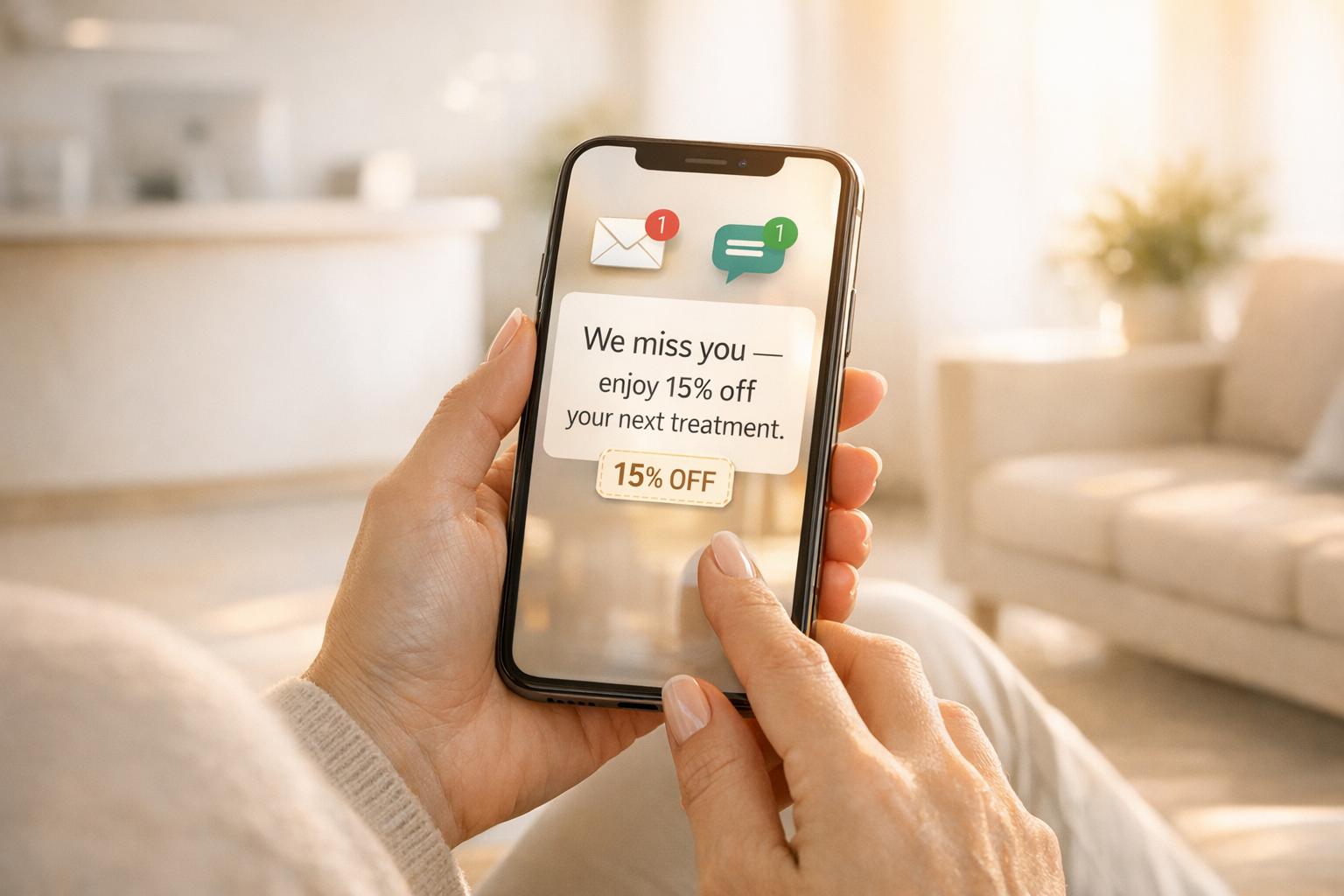
Scaling personalized communication is easier with automation tools like Prospyr, which are HIPAA-compliant. Prospyr's email and SMS features let you automate messages with patient data tags like {{first_name}}, {{last_treatment}}, and {{preferred_service}}. For example, you could send a message like, "Hi {{first_name}}, refresh your {{last_treatment}} with 20% off." Multi-touch sequences - such as a Day 1 email followed by a Day 7 SMS - ensure consistent follow-ups. You can also segment your lists by how long clients have been inactive (e.g., 6–12 months or 12–24 months), use merge fields to build templates, and test small batches before rolling out the campaign. Always monitor opt-outs to stay within the 0.5% CAN-SPAM violation threshold.
This approach has proven effective. In 2023, Rejuvenate MedSpa in California used Attentive to automate SMS campaigns targeting 1,800 lapsed clients with personalized messages referencing their past chemical peel results. Led by Clinic Owner Dr. Emily Hart, the campaign achieved a 28% response rate and 15% conversions over six months, resulting in a 41% revenue increase [Attentive Healthcare Wins, 2023].
Step 3: Create and Launch Win-Back Campaigns
Once you've laid the groundwork with personalized outreach, it's time to roll out a focused win-back campaign to re-engage inactive clients.
Set Up Multi-Touch Campaigns
Design a three-step communication sequence. Start with a message framed as medical advice, such as a reminder about maintaining treatment results. Data shows that messages resembling professional advice from a provider outperform generic discount offers. A week later, introduce a new treatment or technology to spark interest and encourage action. Conclude the sequence with an exclusive incentive to seal the deal.
Timing is critical - win-back rates plummet from 40% at 30 days to just 2% after a year. Tailor your outreach to the specific treatment schedule: reach out to Botox clients after four months, facial clients after two months, and filler clients after 14 months.
Add Special Offers and Incentives
Instead of slashing prices, focus on value-added incentives that maintain your brand's premium image. For example, offering a complimentary hydrating add-on (costing $15–$25) can enhance perceived value without undercutting your pricing. Percentage discounts (10–20%) or free add-on services tend to perform better than flat-dollar discounts in reactivation efforts.
Position these offers as essential for maintaining results. For instance, a message like, "Your filler results from last year deserve a refresh - book now and receive a complimentary skin consultation," frames the visit as a necessary follow-up rather than a simple promotion. Reactivated clients typically spend over $4,500 in the following year, making even small incentives a smart investment. At checkout, you can also pitch a membership program to encourage ongoing loyalty - membership sales in the aesthetic industry grew by 24% in 2024.
Use Prospyr's Marketing Automation
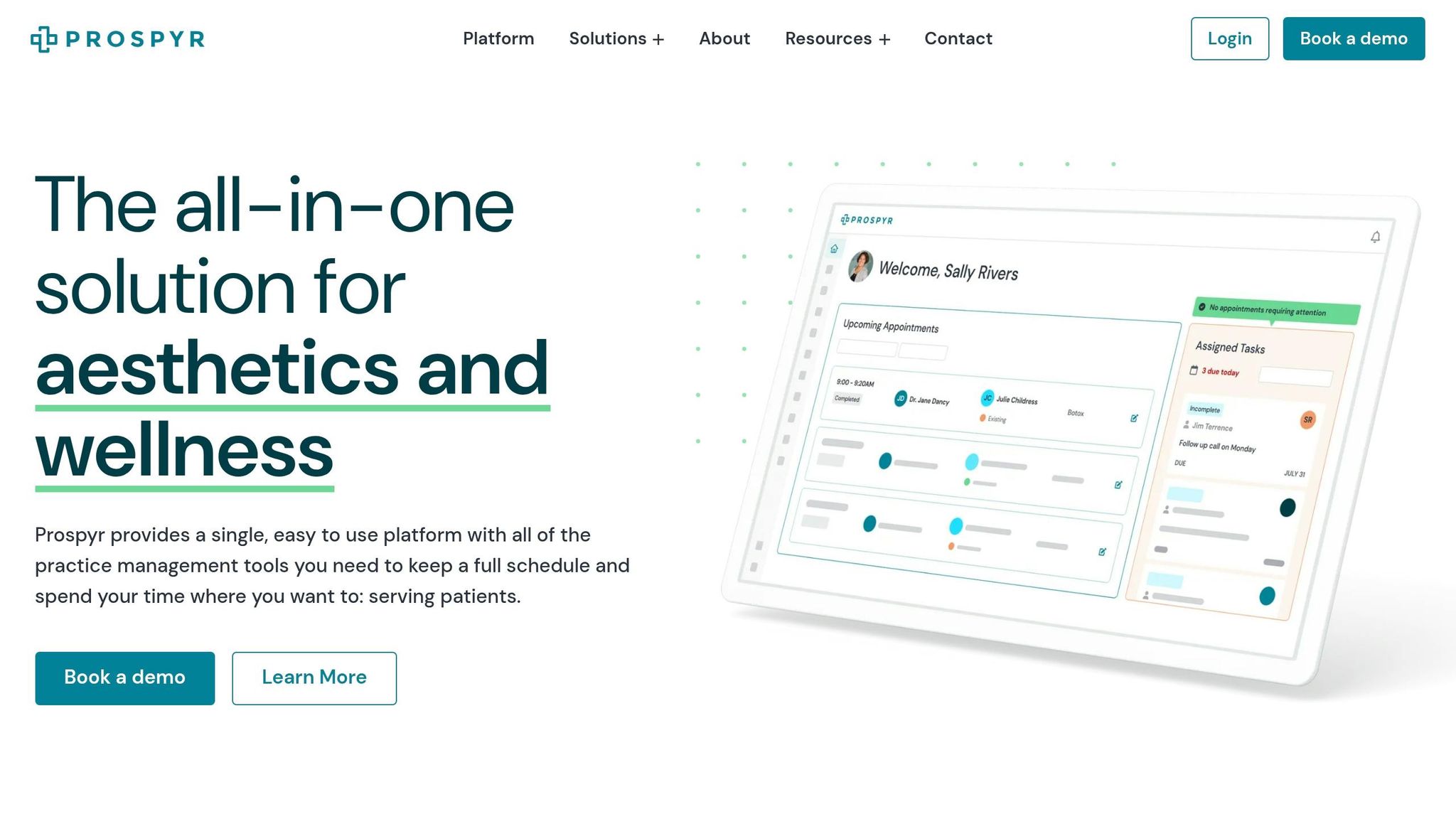
Prospyr's automation tools make scaling your win-back campaigns effortless. The platform's HIPAA-compliant system automatically triggers your three-step sequence when a client becomes inactive, saving you from manual tracking. It handles email and SMS communications, complete with one-click booking links for convenience.
With Prospyr’s segmentation tools, you can customize messages based on a client’s last service, lifetime value, or visit frequency. For your top 10% of clients by lifetime value, consider supplementing automated messages with a personal phone call to maximize results. To avoid missteps, Prospyr also flags clients who left negative feedback, ensuring they aren't included in promotional outreach.
Step 4: Track Results and Adjust Your Approach
Once your campaigns are live, the next step is to measure how they're performing and make adjustments as needed. To wrap up your win-back campaign effectively, focus on key metrics like open rates (15–20%), click-through rates (2–4%), and booking conversions (10–15%). Calculating ROI is essential to confirm the campaign's success.
Monitor Campaign Performance
Leverage Prospyr's practice analytics to track your campaign's performance in real time using a HIPAA-compliant dashboard. This tool lets you see which messages are driving bookings and the revenue generated by each campaign. Set automated alerts for open rates that fall below 10%, so you can quickly tweak subject lines to boost engagement. During the initial stages, frequent reviews are critical - then, as patterns emerge, you can transition to monthly performance checks.
Adjust Based on Results
After gathering initial data, fine-tune your approach by testing one variable at a time to identify what drives better results. For example, if an email achieves a 14% open rate but only a 1% booking rate, it might mean your subject line is effective, but the offer needs improvement. You could try enhancing the incentive or making the call-to-action more compelling. Additionally, segment your audience to analyze performance by group. If Botox clients respond at an 8% rate while facial clients only reach 2%, tailor your messaging or offer to better appeal to the underperforming group. Allow 7–10 days for email responses and 3–5 days for SMS results before implementing changes.
Expand What Works
Once you've identified what’s working, use those insights to scale your efforts. If a test with 500 inactive clients results in a 6% booking conversion rate, apply the same strategy to your entire inactive client database. Document the elements that contributed to success - whether it’s the subject line, timing, offer, or tone - so you can replicate them in future campaigns. To further boost engagement, consider expanding to additional channels. For instance, if email campaigns perform well, incorporating SMS might enhance results even more. Finally, create a monthly workflow that automatically identifies new inactive clients and enrolls them in your optimized win-back sequence.
Conclusion
Bringing inactive clients back to your clinic calls for a structured approach centered on three key elements: personalized communication, multi-touch campaigns, and data-based decisions. By identifying inactive clients, referencing their previous treatments (like Botox or laser procedures), and launching targeted campaigns, clinics can achieve reactivation rates of 15–30%, leading to noticeable revenue growth.
This isn’t a one-time fix - it’s an ongoing process. Clinics that segment their client base, tailor their outreach, and fine-tune their strategies can see conversion rates up to five times higher compared to generic campaigns. These efforts also deliver an impressive return on investment, with some campaigns turning $1,250 into $5,000 in bookings - a 4:1 ROI.
Prospyr simplifies this process with its HIPAA-compliant platform. Its integrated CRM/EMR system makes segmenting clients by treatment history and inactivity period seamless. Meanwhile, marketing automation handles personalized follow-up messages via email and SMS sequences, cutting manual work by 50%. Real-time analytics show which messages are driving bookings, and tools like membership management and AI booking agents help boost client lifetime value by 20–40%. This system supports the personalized, data-focused strategy that drives successful reactivation.
To get started, audit your client list today to find those who’ve been inactive for six months or longer. Launch a tailored campaign this week, track the results, and refine your approach based on what works. With consistent effort, you can turn client reactivation into a reliable growth strategy, tapping into one of your clinic’s most overlooked revenue opportunities.
FAQs
How do I decide when a client is “inactive” for each treatment type?
When determining if a client is “inactive,” it often depends on the time elapsed since their last visit and their specific treatment schedule. For instance, a Botox patient who typically comes in every 3–4 months might be considered inactive if six months pass without an appointment. On the other hand, patients receiving annual treatments may fall into the inactive category after 15–18 months. Tailor these thresholds based on the type of treatment and each patient’s history to pinpoint those who may need re-engagement.
What’s the best win-back message to send without violating HIPAA?
The key to a great HIPAA-compliant win-back message lies in keeping it personal yet respectful of patient privacy. Steer clear of referencing specific health conditions or treatments. Instead, focus on reconnecting by emphasizing their positive past experiences with your practice.
Want to make your message even more engaging? Consider offering an incentive, like a discount or a special promotion. It’s a simple way to encourage patients to return.
Using multiple outreach channels, such as email or SMS, can also boost your efforts. Pair this with automated follow-up tools to maintain consistent, privacy-conscious communication.
Which metrics actually prove a reactivation campaign is profitable?
Tracking the success of a reactivation campaign comes down to a few key numbers. One of the most telling metrics is the reactivation rate, which often sees a noticeable boost when consistent, multi-channel follow-ups (think 4-5 attempts) are used. Beyond that, you'll want to monitor the number of reactivated clients, their spending habits, and how these efforts affect repeat visits and treatment revenue.
To get the full picture of profitability, look at how these efforts influence overall revenue and client lifetime value (CLV). Together, these metrics paint a clear picture of how well your reactivation campaign is performing financially.