If you run a clinic in Washington, the big number for 2026 is $80,168.40. Starting January 1, 2026, employees who do not meet the exempt pay level and duties test will usually be nonexempt, which means they must get 1.5x pay after 40 hours in a workweek.
Here’s the short version: I’d check five things right away - weekly hours, job classification, salary threshold, break tracking, and time records. That’s because even small time entries - like charting after hours, replying to patient messages from home, or working through lunch - can turn into paid time and push someone into overtime.
What this guide covers:
- Weekly overtime: Over 40 hours in one workweek triggers overtime for nonexempt staff.
- Roles often affected: Front desk staff, patient coordinators, medical assistants, receptionists, and technicians are often nonexempt.
- Exempt status: Salary alone does not decide it. The employee must meet the pay test and the duties test.
- 2026 pay floor: Washington’s exempt threshold is $1,541.70 per week or $80,168.40 per year.
- Break risk: Missed or interrupted meal and rest breaks can count as paid time and push totals past 40 hours.
- Records: Clinics should track daily hours, meal periods, missed breaks, schedule changes, and after-hours work.
A simple example shows the risk fast: if someone paid $22.00/hour works 44 hours, the extra 4 hours must be paid at $33.00/hour. And if unpaid meal time has to be added back, the overtime total can grow.
For some clinics, there’s one more issue: Washington also limits when certain healthcare workers can be required to work past scheduled hours, including cases over 12 hours in 24 hours or 80 hours in 14 days, depending on the setting and role.
| Topic | What to know for 2026 |
|---|---|
| Overtime trigger | Over 40 hours in a workweek |
| Overtime rate | 1.5x regular rate |
| Exempt salary threshold | $1,541.70/week or $80,168.40/year |
| Common nonexempt roles | Front desk, MAs, coordinators, reception, technicians |
| Break issue | Missed breaks may become paid time |
| Recordkeeping | Keep daily time and break records for at least 3 years |
If I had to put the whole article into one sentence, it would be this: Washington clinic overtime compliance in 2026 comes down to classifying staff the right way, counting all hours worked, paying for missed-break time, and keeping records that show exactly how payroll was built.
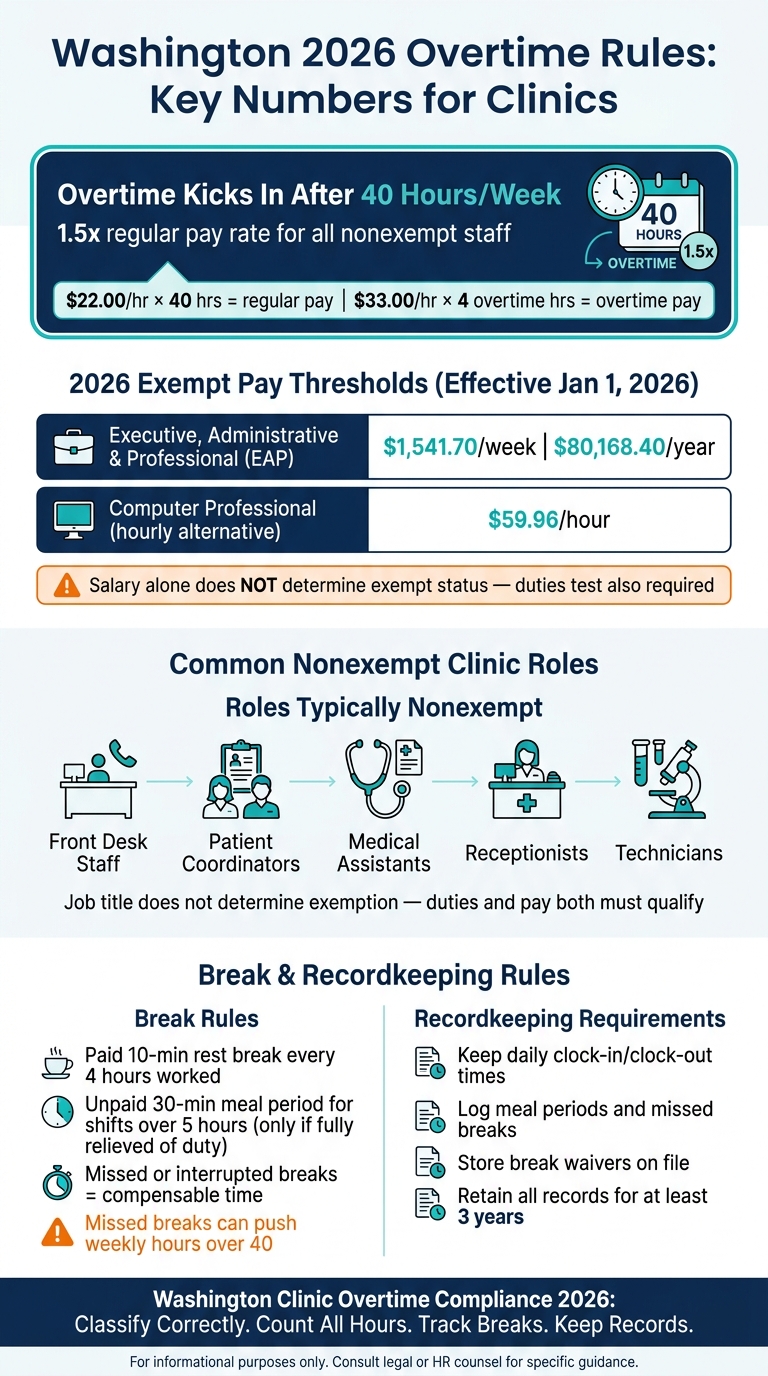
Washington 2026 Overtime Rules: Key Numbers & Compliance Checklist for Clinics
Washington weekly overtime rules for clinic staff
For clinics in Washington, overtime comes down to total hours in the workweek, not whether a shift felt long.
That point trips people up all the time. Someone can work five 9-hour days, which may look normal on the schedule, and still end up at 45 hours for the week. In that case, the employee is owed 5 hours of overtime pay. No single shift has to be unusually long for overtime to apply.
That’s where clinic managers can get caught off guard. If they only scan the schedule and think, “These shifts look fine,” they can miss overtime that already happened. Once you know weekly hours are the trigger, the next thing to check is whether the employee is exempt or nonexempt.
Which aesthetic clinic roles are usually nonexempt
After that, the key issue is which roles are nonexempt. In most clinics, hourly team members such as front desk employees, patient coordinators, medical assistants, receptionists, and technicians are nonexempt. That means they must receive overtime pay when they work more than 40 hours in a workweek.
These are often the same employees who move between patients, rooms, and shift blocks during the week. Because of that, clean time tracking matters a lot.
Titles can be misleading here. A clinic might call someone a “manager” or “specialist,” but that label by itself doesn’t decide exempt status. If the person’s pay setup and day-to-day duties do not meet the legal test for exemption, overtime rules still apply.
How exempt status works in Washington
Washington’s 2026 salary threshold does not mean a salaried employee is automatically exempt. To qualify as exempt, the employee must meet both parts of the test:
- The salary must meet Washington’s threshold.
- The employee’s job duties must satisfy the matching exemption test.
If the employee’s actual day-to-day work does not meet the duties test, they stay nonexempt no matter what their title is or how they are paid. Put simply, salary by itself does not erase overtime duties. The duties test is the part that decides exempt status, not the job title and not the pay format.
Here’s a quick example. If an employee earns $22.00 per hour and works 44 hours in one week, they are paid $22.00 per hour for the first 40 hours and $33.00 per hour for the extra 4 hours. If the employee also receives a nondiscretionary bonus, that bonus can increase the regular rate before overtime is figured.
sbb-itb-02f5876
2026 exempt salary thresholds and healthcare overtime limits
2026 salary threshold for exempt employees
Once you’ve confirmed that a role passes the duties test, the next step is pay. In Washington, as of January 1, 2026, exempt executive, administrative, and professional employees must earn at least $1,541.70 per week or $80,168.40 per year, no matter how large or small the employer is. That amount equals 2.25 times the 2026 state minimum wage.
Here’s what that looks like in practice: a practice manager paid $75,000 per year is still nonexempt unless the clinic increases pay to $80,168.40 and the job meets the duties test.
Washington also gives computer professionals an hourly option of at least $59.96 per hour. But there’s a catch. That hourly computer-professional rule applies only if the employee’s main duties meet the state test. Front-desk or office staff who use scheduling software as part of daily work usually would not qualify.
| Category | 2026 Weekly Threshold | 2026 Annual Threshold |
|---|---|---|
| Executive, Administrative, Professional (EAP) | $1,541.70 | $80,168.40 |
| Computer Professional (hourly alternative) | $59.96/hr | N/A |
Pay by itself doesn’t settle exempt status. Clinics with clinical staff also need to pay close attention to healthcare scheduling limits.
Healthcare mandatory-overtime restrictions clinics should review
If your clinic employs nurses or other covered clinical staff, Washington’s mandatory-overtime limits deserve a close look. These rules sit apart from exempt-pay standards. In plain terms, they limit when some healthcare workers can be forced to stay beyond their scheduled hours.
For covered health care facilities, the law restricts when certain employees can be required to work beyond their agreed, predetermined, regularly scheduled shift. Mandatory overtime means hours added past the scheduled shift that push work beyond 12 hours in a 24-hour period or 80 hours in a consecutive 14-day period. The point here is simple: the rules do not erase overtime pay. They limit when an employer can require those extra hours.
Whether the law applies depends on both the facility type and the employee’s role. Hospitals and some licensed clinics may fall under these rules, while purely cosmetic or non-medical wellness centers may not. Workers covered by these limits cannot be disciplined or face adverse action for refusing overtime beyond the caps.
When an exception does apply, paperwork matters. Document the event, the staffing steps taken, and why the overtime happened. That includes records of the emergent event, on-call schedules, and notes showing why the extra hours could not be avoided.
After pay and scheduling rules, break tracking becomes the next overtime risk.
Meal and rest breaks that can increase overtime risk
Even when you classify nonexempt staff correctly, break problems can still trigger overtime. A missed lunch or skipped rest break can quietly push a weekly total over 40 hours, which is why break tracking is such a common trouble spot for clinic managers.
Washington break rules clinic managers should track
In Washington, employees must receive a paid 10-minute rest break for every 4 hours worked and an unpaid 30-minute meal period for shifts longer than 5 hours. That meal period is unpaid ONLY when the employee is fully relieved of duty.
How missed breaks create wage and overtime problems
A medical assistant who misses lunch, a front desk coordinator who eats while answering phones, or a provider who works through a rest break is all adding compensable time. In plain terms, if someone is still working, that time must be paid. That is why break errors need to be fixed in the same pay period.
Missed or interrupted breaks count as hours worked. Add that time back into the week, then pay overtime if the corrected total goes over 40 hours. For an employee already scheduled close to 40 hours, even 90 minutes of meal time reclassified across three days can tip the week into overtime.
The dollar impact can be steep. A class action against hospitals in the Tri-Cities and Olympia areas led to a $4.4 million settlement for caregivers who worked or stayed on call during unpaid meal breaks. The case covered about 1,966 hourly employees, with average net payouts of about $1,732.
When a break is missed or interrupted, add that time back to hours worked, recalculate the week, and pay overtime if the corrected total exceeds 40 hours. Fix missed breaks before payroll closes.
While online scheduling helps manage coverage, The next control point is daily break logs and manager approval of any missed time.
Recordkeeping and manager controls for compliant payroll
After classification, pay rules, and break tracking, records become your last line of defense in an audit. They need to show hours worked, breaks, and approvals. Just as important, they need to rebuild the full workweek, not simply show the final pay amount.
Daily records and approval workflows to maintain
Washington requires records of actual daily hours, not only pay-period totals. That means each record should include clock-in and clock-out times, meal periods, missed breaks, schedule changes, and any after-hours work.
For overtime control, a simple two-step review tends to work well:
- Employees submit time each day
- Managers review exceptions before payroll runs
One point matters here: record all overtime, whether it was approved or not.
It also helps to keep a log of missed meal and rest breaks. If your clinic uses break waivers, store those written or electronic waivers on file. And don’t stop at payroll summaries. Keep timecards, schedules, break logs, and waiver records for at least three years, because a summary alone may not show schedule changes or missed-break corrections.
Using Prospyr to support scheduling and documentation
Once these records are in place, managers need one system to keep everything straight. Prospyr helps clinics organize scheduling, task management, communication logs, and analytics. That gives managers a clearer view of scheduled coverage versus actual shifts, overtime risk, and approvals and time records in one place.
Prospyr is an operational tool, not legal or HR advice.
Conclusion: Key overtime checks for Washington clinics in 2026
For Washington aesthetic clinics in 2026, the core checks are pretty simple: track actual weekly hours for every nonexempt employee, confirm exempt classifications against both the salary threshold and the duties test, treat meal and rest breaks as a payroll-risk item, review healthcare-specific overtime limits before setting schedules, and keep records that can rebuild hours worked, break compliance, and overtime calculations if a wage claim or audit comes up.
Weekly hours, exempt status, salary thresholds, breaks, and records all feed the same payroll result.
FAQs
How do I know if an employee is exempt or nonexempt?
Classify employees under federal and state rules - not by job title or salary alone. A salary by itself does not make someone exempt.
To be exempt, an employee has to pass all three tests:
- Be paid on a fixed salary basis
- Meet the minimum salary threshold of $684 per week under federal law
- Perform qualifying executive, administrative, or professional duties
If even one of those tests isn't met, the employee is nonexempt. That usually means they must receive overtime pay for hours worked over 40 in a workweek.
Do missed meal or rest breaks count toward overtime?
It depends on whether the break counts as paid work time.
Under federal law, short breaks of 20 minutes or less must be paid. They also count toward the 40-hour threshold for overtime.
Meal periods of 30 minutes or more are usually unpaid, but only if the employee is fully relieved of all duties. If the employee does any work during an unpaid break, that time must be paid and included in the total hours for weekly overtime.
What records should my clinic keep for overtime compliance?
Keep clear, centralized records for all nonexempt staff. Track daily and weekly hours, exact clock-in and clock-out times, unpaid meal breaks, and all work time.
That includes time spent on:
- Prep
- Cleanup
- After-hours charting
- Client communication
- Training
- Work-related travel
Keep payroll records for three years and timecards for two years. If a time entry needs to be fixed, document the correction and include an explanation signed by both the employee and the supervisor.