
If your med spa offers sedation or surgery, accreditation may move from optional to required. The short version: licensure covers who can practice, accreditation checks how the facility runs, and the right accreditor depends on your highest-risk service.
Here’s the plain-English takeaway:
- QUAD A (AAAASF) fits procedure-heavy med spas and office-based surgery settings.
- AAAHC is a match for ASC-style and office-based surgery practices.
- The Joint Commission is often used by larger, multi-site, or system-linked outpatient groups.
- ACHC fits office-based procedure sites and ASC models, depending on the program.
- NABH is mainly for India and cross-border clinic groups, not U.S. compliance.
A few points matter most:
- Accreditation does not replace state licensure
- Training certificates do not change scope of practice
- CMS deeming mostly matters for ASCs that bill Medicare
- State rules can change the answer fast, especially for moderate sedation, deep sedation, and general anesthesia
I’d use one filter first: look at the highest-risk thing your practice does today. If you only offer injectables, lasers, facials, or basic IV hydration, accreditation is often voluntary. If you add liposuction, surgical blepharoplasty, or sedation-based procedures, the rules can change.
Quick Comparison
| Accreditor | Best fit | Sedation/surgery focus | CMS deeming | Best for most non-surgical med spas? |
|---|---|---|---|---|
| QUAD A (AAAASF) | Procedure-focused med spas, office-based surgery | Yes | Yes, for ASCs | Usually no |
| AAAHC | ASC-style and office-based surgery practices | Yes | Yes | Usually no |
| The Joint Commission | Larger outpatient groups, hospital-linked sites | Yes | Yes | Rare |
| ACHC | Office-based procedure sites and ASCs | Yes | Yes for ASC program | Usually no |
| NABH | India or cross-border clinic groups | Yes, under its own standards | No | No |
My bottom line: don’t pick the biggest name first. Pick the smallest accepted accreditor that still covers your top-risk service and your state’s rules. That is the part that keeps the decision clear.
sbb-itb-02f5876
Facility Accreditation vs. Provider Licensing and Certification
Before comparing accreditors, it helps to separate three terms that med spa owners often mix up. They are not the same thing. Licensure is legal permission for a person or facility to operate, certification shows training, and accreditation is an outside review of the facility itself.
Here’s what that looks like in practice. A nurse injector who performs Botox treatments must hold an active RN license and give injections under state supervision rules. A course certificate only shows that the person completed training. It does not change scope of practice or replace state supervision rules.
The same idea applies to a medical director. That person must hold an active state license and meet the supervision rules in that state, including written protocols and documented oversight. If someone is listed as a medical director without meeting those rules, that’s a compliance issue no matter how many certifications they have.
This gap becomes most important when the service carries more procedural risk. Facility accreditation matters when a med spa offers office-based surgery or procedures that use moderate or deep sedation or general anesthesia. Several states, including New York, Georgia, and South Carolina, directly require accreditation or similar state licensure when moderate or deep sedation is used.
Put simply, accreditation and licensure cover different things. One controls who may provide care. The other checks whether the facility meets safety standards for higher-risk services.
With that distinction in place, the five accreditors below are much easier to compare.
1. QUAD A (AAAASF)
For med spas that are stepping into higher-risk procedures, QUAD A is one of the main facility accreditations to look at.
QUAD A is the current name used by the American Association for Accreditation of Ambulatory Surgery Facilities (AAAASF). It accredits outpatient surgical and procedural facilities.
Facility types covered
QUAD A fits med spas that go beyond basic noninvasive care. That includes injectables, lasers, IV therapy, and office-based surgery. It can also fit mixed procedural clinics that operate part of the business as a med spa and part as an office-based surgery site.
Procedure and anesthesia scope
AAAASF classifies facilities based on the highest level of anesthesia used.
| Class | Anesthesia Level Allowed |
|---|---|
| Class A | Topical or local anesthesia only |
| Class B | IV or injected sedation, regional anesthesia, or dissociative medications; no intubation or inhaled general anesthesia |
| Class C | Endotracheal or laryngeal mask intubation and/or inhalation anesthesia, administered by an anesthesiologist or CRNA |
Your facility’s class decides which standards apply. So if a clinic starts offering sedation-assisted cosmetic procedures, it would need to meet Class B or Class C rules, depending on the anesthesia used.
State recognition and CMS deeming relevance
State approval is a big deal here. Accreditation only becomes useful in practice when state or local rules recognize it. AAAASF is CMS-approved for deemed status in ambulatory surgery centers, and several states recognize it for office-based surgery. Before you present accredited status as a compliance edge, check your state’s rules first.
What accreditation does not replace
AAAASF accreditation applies to the facility. It does not replace provider licensure, scope-of-practice rules, board certification, or other state approvals.
QUAD A tends to be the best fit for procedural med spas. The next accreditor is better known for broader outpatient clinic models.
2. AAAHC
The Accreditation Association for Ambulatory Health Care (AAAHC) has accredited outpatient organizations since 1979 and now covers more than 6,800 facilities across the U.S. Its lane is ambulatory care. If QUAD A is geared toward procedural centers, AAAHC is the broader ambulatory path.
Facility types covered
AAAHC tends to make sense for med spas that have grown into office-based surgery and ASC models. That includes cosmetic and reconstructive surgery practices, along with dermatology and plastic surgery groups that run procedural suites.
By contrast, a simple noninvasive med spa usually won't fall under AAAHC unless it starts offering procedural care or services that involve anesthesia.
Procedure and anesthesia scope
Treatments like neuromodulators, fillers, and basic laser or energy-based services that use only topical or local anesthesia can sit within a general outpatient or office-based clinic setup.
That changes when a practice starts using moderate sedation, deep sedation, or general anesthesia. The same goes for procedures that count as surgery, such as liposuction or surgical blepharoplasty. At that point, the practice moves into office-based surgery center or ASC accreditation territory.
A simple way to think about it: if the practice cuts tissue, enters a body cavity, or uses moderate or deep sedation, AAAHC's surgical programs are the better fit.
State recognition and CMS deeming relevance
AAAHC has CMS deemed status for ASCs. In plain English, that means an AAAHC-accredited ASC can meet Medicare's Conditions for Coverage without going through a separate CMS survey.
For cash-pay med spas, that status doesn't help with reimbursement. It matters far more for ASCs that bill Medicare.
At the state level, AAAHC also carries weight. Several states recognize it as an approved accreditor for office-based surgery, and some let AAAHC surveys meet certain state inspection rules.
What accreditation does not replace
AAAHC accredits the facility, not the clinician's personal credentials. It also does not replace state licensure, scope-of-practice rules, or local facility requirements.
The Joint Commission goes broader still, with hospital-level recognition that some larger practices prefer.
3. The Joint Commission
If AAAHC gives practices a broad ambulatory route, The Joint Commission feels more like the hospital-style path. Its ambulatory care programs cover outpatient and office-based settings, including surgery centers, cosmetic surgery sites, pain clinics, and group practices.
Facility types covered
The Joint Commission sets a pretty clear line between two outpatient settings. For larger outpatient facilities, this standard applies when four or more patients are under general anesthesia or unable to self-protect at the same time. Office-based surgery applies to smaller practices with three or fewer such patients at once.
For med spas with a smaller procedural footprint, office-based surgery is often the more practical fit.
Procedure and anesthesia scope
The Joint Commission’s ambulatory standards include requirements for pre-anesthesia assessment, intra-procedure monitoring, and documentation of sedation services. That makes this accreditation a fit for practices using moderate sedation, deep sedation, or general anesthesia.
State recognition and CMS deeming relevance
CMS renewed The Joint Commission’s recognized status for ambulatory surgery centers in September 2024 through September 1, 2030 - the maximum six-year term CMS grants. In plain English, a Joint Commission–accredited ASC can meet Medicare survey requirements without going through a separate CMS survey.
State rules matter too. 22 states require accreditation as a condition for operating an office-based surgery center. So if a practice sits in one of those states, The Joint Commission’s status can matter a lot.
What accreditation does not replace
The Joint Commission accredits the facility, not the clinicians. Each provider still needs an active state license, and state facility licensure still applies.
For practices that want ambulatory oversight without a hospital-style survey, ACHC is the next body to compare.
4. ACHC
ACHC’s Office-Based Surgery (OBS) and Ambulatory Surgery Center (ASC) programs tend to matter most for med spas that do procedural care. The two ACHC programs that usually come up are Office-Based Surgery (OBS) and Ambulatory Surgery Center (ASC). Here’s where ACHC fits.
Facility types covered
ACHC’s OBS program is built for physician offices, dental offices, and clinics that perform procedures in an office setting. In plain English, this is meant for office-based procedural spaces, not large surgical setups.
OBS fits office settings where no more than three patients at a time cannot self-evacuate. That makes it a match for smaller procedural suites, rather than larger multi-patient anesthesia settings.
Procedure and anesthesia scope
ACHC OBS can apply to procedures performed under local anesthesia, minimal sedation, moderate sedation, deep sedation, or general anesthesia, depending on the practice model and state rules. That range is a big deal for med spas that go beyond simple cosmetic services and move into procedures that call for tighter records, emergency planning, and complication response.
The accreditation process runs on a three-year cycle and includes a policy review before the onsite survey. So the survey itself isn’t the first step. ACHC looks at your policies before anyone walks through the door.
State recognition and CMS deeming relevance
ACHC’s ASC program has CMS deeming authority. OBS does not. That split matters. If a med spa is trying to sort out whether ACHC lines up with CMS-related facility goals, the answer depends on which ACHC program is in play.
State recognition also varies. New York and Oregon are among the states that recognize ACHC for certain office-based procedures.
What accreditation does not replace
ACHC adds facility oversight, but it does not replace state licensure, supervision rules, or scope-of-practice limits. That’s the part practices can’t afford to gloss over. Accreditation can support your setup, but it doesn’t override state law.
Before survey, ACHC expects the practice to already have state licensure underway, along with core facility policies and leadership in place. In other words, ACHC isn’t there to build the operation from scratch. The groundwork needs to be there first.
Use the comparison table next to see where ACHC sits against QUAD A, AAAHC, The Joint Commission, and NABH.
5. NABH
NABH is India’s national accreditor for hospitals, clinics, and wellness centers. For U.S. med spa leaders, its role is pretty narrow. It mostly comes up in medical tourism, cross-border partnerships, or when a group operates clinics outside the United States. In these international contexts, telehealth capabilities often become essential for remote consultations. It is not a U.S. compliance pathway.
Facility types covered
NABH covers hospitals, clinics, dental clinics, and wellness centers. In the med spa space, it fits best with outpatient clinics that provide minor procedures or supervised aesthetic services.
Procedure and anesthesia scope
NABH standards cover sedation and anesthesia safety, including pre-procedure assessment, monitoring, consent, and recovery care. Accreditation usually runs on a 3- to 4-year cycle, with surveillance during the term.
Recognition and CMS deeming relevance
NABH has no CMS deeming authority and is not used by U.S. regulators for facility licensing or compliance.
What accreditation does not replace
NABH does not replace U.S. facility licensing, professional licensure, or scope-of-practice rules.
In the comparison table below, NABH stands out as the international option, not a U.S.-focused accreditor.
Side-by-Side Comparison of the 5 Accreditors
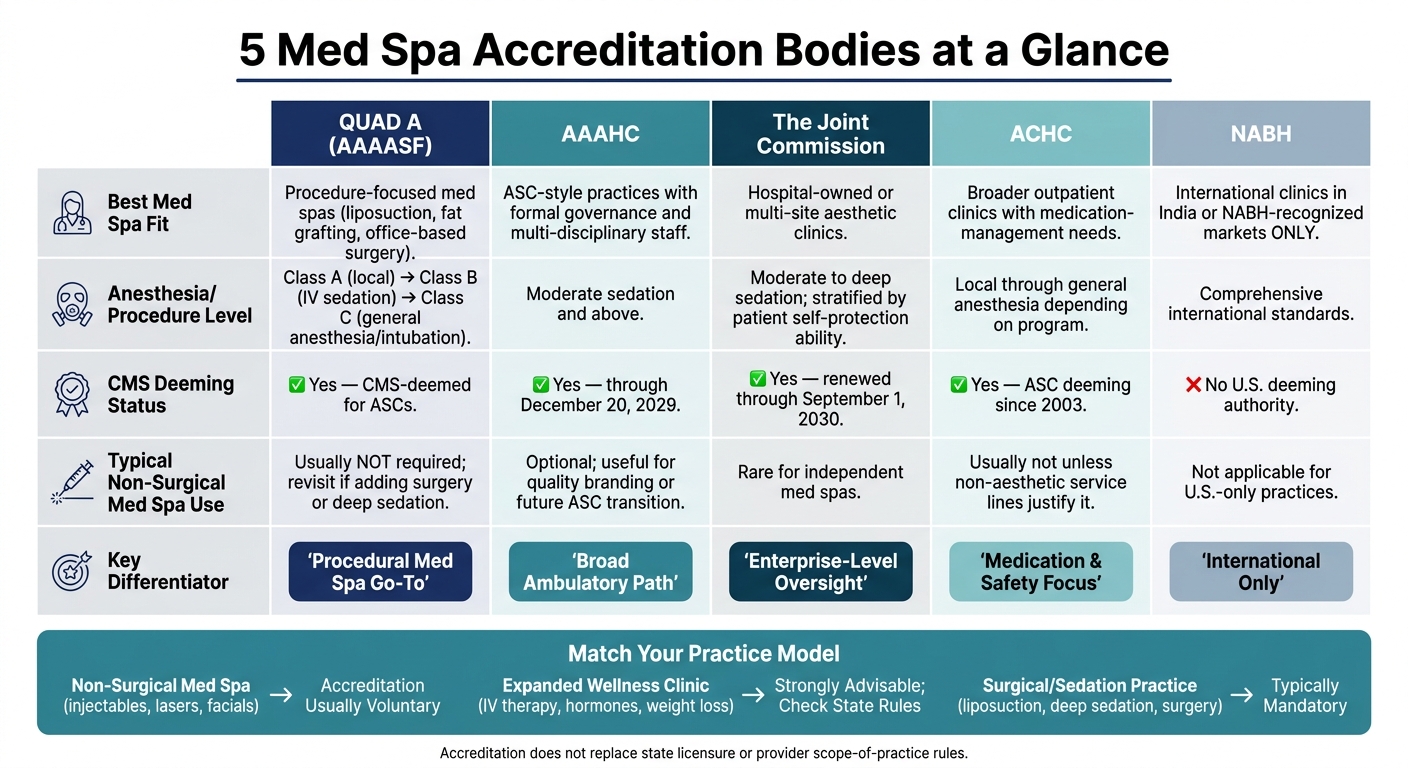
5 Med Spa Accreditation Bodies Compared: Which One Fits Your Practice?
Now that you've looked at each accreditor on its own, it helps to put them side by side. That makes the differences much easier to spot.
| Accreditor | Primary Setting | Best Med Spa Fit | Anesthesia / Procedure Level | CMS Deeming Status | Typical Non-Surgical Med Spa Use |
|---|---|---|---|---|---|
| QUAD A (formerly AAAASF) | Office-based surgery and ambulatory surgery facilities | Procedure-focused med spa offering liposuction, fat grafting, or similar surgery | Moderate to deep sedation or surgery; Class A–C tiers based on anesthesia level | Yes - CMS-deemed for ASCs participating in Medicare/Medicaid | Usually not now; revisit if you add surgery or deep sedation |
| AAAHC | Ambulatory surgery centers and office-based surgery | ASC-style practice with formal governance, quality improvement, and multi-disciplinary staff | Moderate sedation and above; structured perioperative workflows | Yes - CMS-deemed for ASCs; deeming term runs through December 20, 2029 | Optional; useful for quality branding or future ASC transition |
| The Joint Commission | Hospitals and health systems, with a dedicated office-based surgery program | Hospital-owned or multi-site aesthetic clinic wanting enterprise-level consistency | Moderate to deep sedation; requirements stratified by ability to self-protect | Yes - ASC deeming renewed through September 1, 2030 | Rare for independent med spas; more practical for system-affiliated sites |
| ACHC | Ambulatory and office-based outpatient programs; home health and specialty pharmacy are core markets | Broader outpatient clinic with strong medication-management needs | Office-based procedures with a strong focus on medication management, infection control, and clinical safety | Yes - CMS deeming authority for ASCs since 2003 | Usually not now unless non-aesthetic service lines justify it |
| NABH | Hospitals and clinics in India and other international markets (international-only) | International clinics in India or other NABH-recognized markets | Comprehensive international standards | No U.S. deeming authority | Not applicable for U.S.-only practices |
The simplest way to use this table is to start with your highest-risk service and work backward. You're not looking for the biggest name. You're looking for the lightest accreditor that still covers what you do.
For a med spa focused on neurotoxin injections, fillers, laser hair removal, or basic IV hydration, accreditation is usually not required unless your state says otherwise. And CMS deeming only matters if you bill Medicare or plan to become an ASC.
So treat this table like a filter, not the final call. Match your current service mix to the least burdensome accreditor that still fits your top-risk procedure. For most non-surgical med spas, accreditation starts to matter when the menu shifts into sedation or surgery.
How to Match Your Practice Model to the Right Level of Oversight
Start with the highest-risk service you offer. Then choose the lightest oversight level that still fits your practice. That gives you a simple way to narrow your options after reviewing the five bodies above.
For most non-surgical med spas, facility accreditation is usually voluntary. In day-to-day terms, your main duties are provider licensure, supervision, and business licensure.
IV therapy, hormone management, and weight-loss programs fall into a gray area. Before you launch, check your state nursing board’s delegation rules and your medical board’s prescribing rules. That line can shift once care becomes more procedural or starts to involve anesthesia.
By contrast, moderate sedation, deep sedation, general anesthesia, liposuction, and surgical blepharoplasty often trigger accreditation or ASC licensure under state rules.
The practical way to sort this out is simple: match the service model first, then confirm the state rule that applies. In plain English, look at your current highest-risk service and find the smallest accreditor that still covers it.
| Practice Model | Typical Services | Accreditation Status | First Verification Step |
|---|---|---|---|
| Non-surgical med spa | Injectables, lasers, facials, body contouring | Usually voluntary | State medical board + health department |
| Expanded wellness clinic | IV therapy, hormone therapy, weight-loss programs | Strongly advisable; varies by state | State nursing board + medical board |
| Surgical or sedation-based practice | Liposuction, surgical procedures, moderate/deep sedation | Typically mandatory | State OBS rules + accepted accreditor list |
Write down what you find. If a rule is unclear, ask for written guidance. Then keep those records in a HIPAA-compliant system like Prospyr so your policies, standing orders, consent forms, and training records stay in one place and are easy to track.
Conclusion
The right accreditor comes down to your highest-risk service. That's the main takeaway from the comparison table: line up your current service mix with the lightest accreditor that still covers it, whether you're running a non-surgical med spa, a broader wellness clinic, or an office-based surgery practice.
Licensure decides who may practice. Accreditation looks at how the facility runs its systems.
If your service mix is starting to move toward sedation or surgery, it's time to stop comparing options at a high level and start checking your state's rules. Before you add higher-risk services, confirm your state's facility requirements, the oversight you need, and which accreditors the state accepts.
Whatever your current service mix looks like, keep your policies, consent forms, and training records organized in a HIPAA-compliant system like Prospyr. Paper records alone won't protect you in an audit.
Match your oversight to your highest-risk service, and keep licensure, credentials, and day-to-day compliance in sync.
FAQs
How do I know if my med spa needs accreditation now?
In the United States, med spa accreditation is usually voluntary. It’s not a standard legal requirement across the board.
That said, it can still be worth considering if you want outside validation of your clinic’s patient safety practices, clinical oversight, and day-to-day systems.
A smart next step is a readiness assessment. Put your current documents, like delegation records and procedure notes, side by side with your chosen accreditor’s standards. That makes it easier to spot gaps before you start the process.
Which accreditor best fits my services?
The right accreditor depends on your practice’s size, risk level, and how you run day-to-day care. AAAHC is often a good fit for smaller practices, while The Joint Commission is often a better match for higher-risk care or offices that use anesthesia. AAAASF may work well for surgery-focused centers, and ACHC fits many outpatient settings.
Pick the one that lines up with your state’s rules and helps you maintain safe care, infection control, and solid administrative processes. Facility accreditation is separate from provider licensing.
Does accreditation replace provider licensing?
No. Provider licensing is the legal approval an individual needs to practice or carry out certain duties in a state.
Accreditation usually applies to the facility. It looks at things like systems, safety protocols, and day-to-day operations.
Put simply:
- Licensing shows a provider is legally allowed to practice.
- Accreditation shows the clinic meets high standards for safety and management.
To operate legally, you need both.