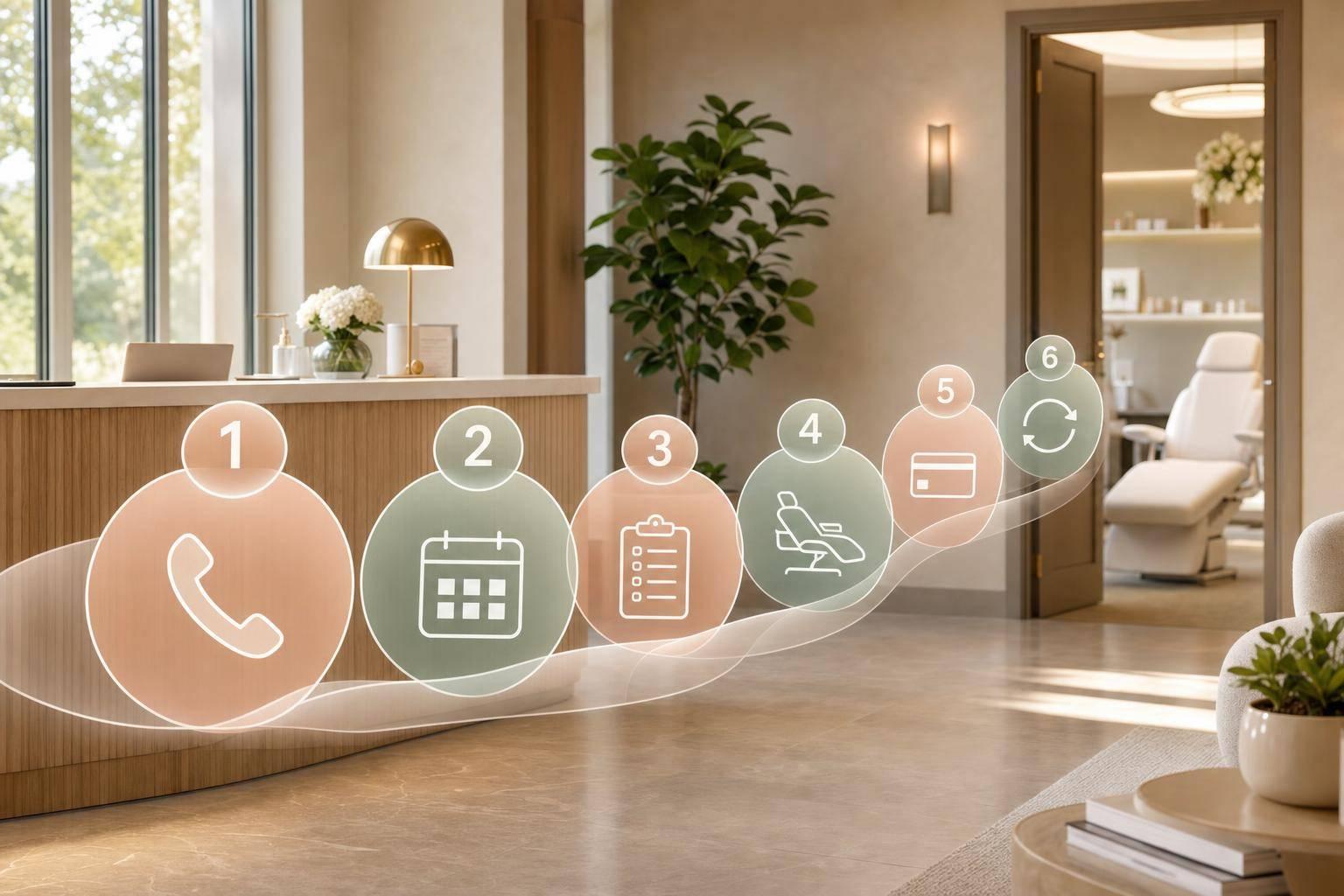

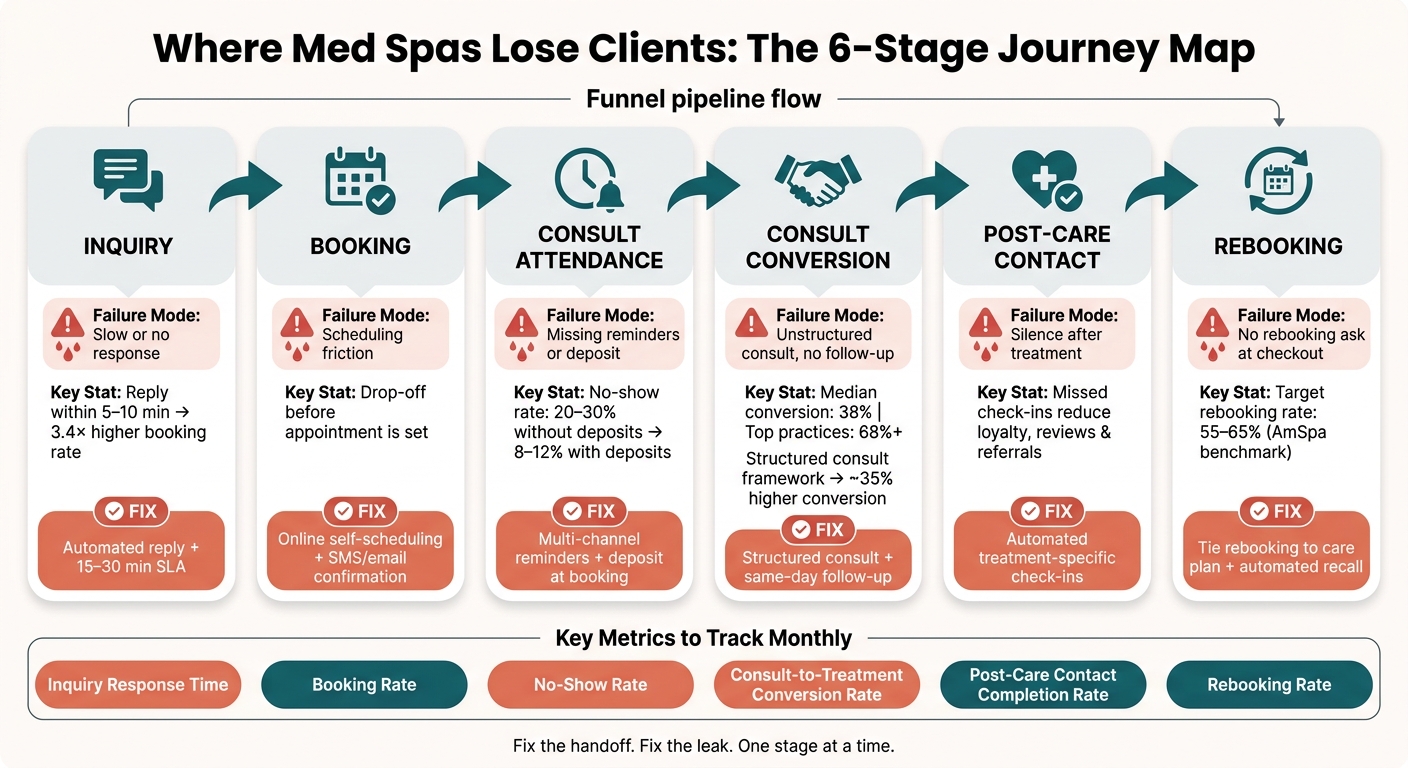
Most med spas lose clients in handoffs, not from lack of demand. If I had to sum it up fast, I’d say the biggest drop-offs happen in six places: lead management, booking, show-up rate, consult conversion, post-care follow-up, and rebooking.
Here’s the short version:
- If I reply to a new inquiry within 5 to 10 minutes during business hours, I give that lead a much better shot of booking.
- If reminders, deposits, and confirmation steps are weak, consult no-shows can sit around 20% to 30%.
- If the consult feels loose or the next step is vague, treatment acceptance drops. Many spas see median consult-to-treatment conversion near 38%, while stronger teams can hit 68%+.
- If I don’t check in after treatment or ask for the next visit before checkout, I leave repeat revenue on the table.
- If I track just six numbers each month, I can see where clients slip out of the process before the loss gets bigger.
The fix is usually simple: give each stage a clear owner, send follow-up fast, use one repeatable workflow, and make the next step obvious every time.
A med spa client journey is not complicated. But it does break down fast when the team handles inquiry, consult, checkout, and follow-up as separate jobs instead of one connected path. That’s why I’d look at the journey stage by stage, find the leak, and fix the handoff first.
Med Spa Client Journey: 6 Stages Where Clients Drop Off (And How to Fix Them)
Before the visit: slow follow-up and no-show risk
Slow follow-up after inquiry reduces booking odds
Inquiry-to-response time has a direct effect on booking. If the first reply doesn’t show up within minutes during business hours, that lead may book somewhere else. In many cases, people go with the first clear reply they get.
The fix is simple: use one standard response path for every inquiry. Aim to acknowledge digital inquiries within 5 to 10 minutes during business hours and within 1 to 2 hours after hours. Once delays stretch past 15 to 30 minutes, booking odds can drop hard. At the booking handoff, the main problem usually isn’t just inbox speed. It’s slow routing and delayed staff assignment.
Send an immediate SMS or email with one clear next step. Then follow up with a short 3- to 5-touch sequence over 3 to 7 days. Automation can route leads right away and show who is moving toward a consult.
Even after the booking is locked in, there’s another leak: attendance.
Why booked clients still fail to show up
No-shows go up when reminders are weak and expectations aren’t clear. Most no-shows come from long gaps between booking and visit, weak reminders, missing confirmation, and unclear cancellation rules. This handoff tends to break when booking, confirmation, and expectation-setting are handled as separate tasks instead of one workflow.
A tighter reminder flow helps:
- Send an immediate confirmation
- Send a reminder 3 to 7 days before
- Send a final reminder 24 hours before
- For higher-ticket visits, add a same-day text 2 to 3 hours before
Automated reminders and live phone reminders both cut no-shows. Text reminders alone can materially lower no-show rates. Use a clear deposit policy for consults and higher-value treatments, and repeat that policy at booking and again in reminders. If someone cancels, a waitlist workflow helps staff fill the slot fast instead of letting that time sit empty.
Once clients arrive, the next leak is the consult.
sbb-itb-02f5876
At the consult: where interest fails to become treatment
Weak consult structure lowers treatment acceptance
Once a client makes it to the consult, the issue usually isn’t speed anymore. It’s structure. At that point, the client is close to a decision, so the consult needs to guide that decision in a clear way.
The biggest problem is often simple: too many choices and no direct recommendation. That tends to leave people stuck. Lead with one main plan tied to the client’s stated goal. Bring up another option only if it actually fits their situation.
Pricing can also make or break the moment. If pricing feels vague, clients tend to shop around or put things off. Share clear price ranges, give written estimates, and bring up financing during the consult, not afterward. Be specific about expected redness, downtime, and results. That kind of detail helps build trust and makes the next step feel easier.
Practices that use a structured consult framework covering goals, recommended treatment, expected results, pricing, and a defined next step report roughly 35% higher conversion rates than practices using informal consultations. Median consult-to-treatment conversion is 38%, while top-quartile practices reach 68% or higher.
Post-consult delay causes conversion drop-off
If a client leaves without booking, the next handoff starts right away. Follow up the same day or within 24 hours. Wait longer than that, and conversion tends to drop.
Keep the follow-up short and useful. Recap the client’s goal, the treatment, expected results, downtime, pricing, and include a booking link. Automated post-consult sequences can help here: a 24-hour thank-you, a 48-hour check-in, a 7-day pricing reminder, and a 14-day final follow-up can lift consult-to-treatment conversion in a meaningful way. One system for lead capture, scheduling, messaging, and automation helps close the gap between the consult and the booking.
Post-consult follow-up should remove friction, not add pressure. Give people clear information, easy access, and one obvious next step.
After treatment: poor post-care contact and missed rebooking
No post-care check-in weakens retention
Once treatment ends, the next handoff is post-care and rebooking. This is where many practices slip. If a practice goes quiet after treatment, clients may assume the worst. That silence can chip away at trust, cut down positive reviews and referrals, and lead to fewer repeat bookings.
A simple follow-up goes a long way. Send a same-day or next-day text with aftercare steps, a brief check-in, and an invite to ask questions. For higher-touch services like laser treatments or chemical peels, a two-step sequence often works best: immediate aftercare instructions, then a short check-in within a day or two. Log that contact so staff can track replies and follow up if something needs attention.
That same follow-up should flow straight into the next appointment.
Missed repeat revenue from skipped rebooking
The other missed handoff is the rebooking decision. The best time to lock in the next visit is before the client walks out the door. But in many practices, checkout centers on payment, and rebooking gets pushed to the side.
A better approach is to tie rebooking to the treatment’s expected return window and present it as part of the care plan. Clients are more likely to book on the spot when staff frame it as a clinical next step, not a sales pitch.
If a client leaves without booking, follow up before the next return window closes. The American Med Spa Association suggests a target rebooking rate of 55–65% for established practices. Practices that segment lapsed clients by time since last visit - and send a gentle check-in around 60 days, a direct prompt at 90 days, and a more personal win-back message at 120+ days - often bring back more of those clients before they drift to another provider.
Prospyr supports post-care workflows with scheduling, messaging, tasks, and analytics in one system.
The next step is to track where post-care and rebooking break down.
Metrics and fixes: how to find and close each drop-off point
Table: journey stage, failure mode, business impact, and fix
Once you’ve mapped the handoffs, the next step is simple: track the metric that shows where people slip away. Each leak should have one main metric. Without that, you’re just making changes and hoping they work.
Use the table below to match each stage with its weak spot and the fix that fits.
| Journey Stage | Typical Failure Mode | Likely Business Impact | Key Metric | Fix |
|---|---|---|---|---|
| Inquiry | Slow or no response to leads | Lost bookings; wasted ad spend | Inquiry response time | Automated reply + response SLA within 15–30 minutes during business hours |
| Booking | Scheduling friction | Drop-off before the appointment is set | Booking rate | Online self-scheduling with SMS/email confirmation |
| Consult Attendance | Missing reminders or deposit | Wasted provider time; empty slots | No-show rate | Multi-channel automated reminders + deposit at booking |
| Consult Conversion | Unstructured consult, no follow-up | Low treatment acceptance rate | Consult-to-treatment conversion rate | Structured consult framework + prompt follow-up sequence |
| Post-Care Contact | Silence after treatment | Lower satisfaction; weaker loyalty | Post-care contact completion rate | Automated treatment-specific check-ins |
| Rebooking | No rebooking ask at checkout | Lost repeat revenue | Rebooking rate | Rebooking tied to the care plan + automated recall by treatment cycle |
The core metrics med spas should review every month
The table helps you spot the failure point. The monthly review tells you if it’s getting better or worse.
Across inquiry, booking, consult, post-care, and rebooking, six numbers do most of the heavy lifting.
- Inquiry response time: Responding within 5 minutes leads to a 3.4× higher booking rate than waiting more than an hour.
- Booking rate: This shows how well the front desk turns interest into scheduled appointments.
- No-show rate: Consult no-shows usually land around 20–30%, while deposits can bring that down to 8–12%.
- Consult-to-treatment conversion rate: Unstructured consults convert at about 25–45%, while structured in-person consultations reach 55–65%.
- Post-care contact completion rate: This is the share of eligible patients who actually get their follow-up message.
- Rebooking rate: The American Med Spa Association points to 55–65% for established practices.
Watch these numbers month over month against your own baseline. That matters because a clinic doesn’t need perfect stats on paper. It needs clear movement in the right direction.
Conclusion: fix handoffs first
Most client loss doesn’t happen in one big dramatic moment. It happens in the spaces between steps.
A slow inquiry response gives the lead to a faster competitor. No deposit policy can turn a booked consult into a no-show. And a quiet checkout can let a happy client walk out without their next visit on the calendar.
The fixes usually aren’t huge. Clear ownership, fast communication, and measurable workflows solve most of the gaps. Give one person ownership of each stage, set response-time rules, and automate repeat tasks so things don’t get missed when the team gets busy.
Prospyr centralizes lead capture, scheduling, messaging, tasks, and analytics so every handoff is visible.
FAQs
Which client journey leak should I fix first?
Start with the no-show leak. Look at which appointment types and time slots get the most no-shows or cancellations. Then clean up your scheduling and confirmation flow with multi-channel reminders and, for higher-risk patients, deposits and one-tap rescheduling links.
No-shows are common, costly, and often the fastest place to make a difference. Use patient history and booking data to spot the highest-risk patterns first instead of guessing.
How can I lower consult no-shows quickly?
Use a timed three-touch reminder sequence across email, SMS, and phone: 48 hours before, 24 hours before, and a final same-day reminder.
Each reminder should do two jobs at once:
- Share prep instructions
- Spell out the cancellation policy in plain English
That way, patients know what to do before the visit and what happens if they need to cancel.
It also helps to make the next step almost effortless. Offer one-tap SMS confirmation or rescheduling so patients can reply fast without digging through email or calling the office.
If a patient still hasn’t confirmed by the 24-hour mark, have staff make a phone call. That extra nudge can be the difference between a filled appointment and a no-show.
Prospyr can automate these HIPAA-compliant reminders and confirmations, which takes a lot of the manual follow-up off your team’s plate.
What should I track every month?
Review your automated workflows and patient engagement metrics each month to find friction points in the client journey.
Pay close attention to no-show rate - ideally under 7% - along with 72-hour confirmation rate, message delivery, response rates, reactivation rates, average response time, open and click-through rates, and patient conversion rates. These numbers show whether your outreach is actually turning into booked appointments.