
Certification tracking is a patient-safety and compliance system, not just admin work. If one license expires, one training record is missing, or one supervision agreement is out of date, your med spa can face fines from $5,000 to $50,000+, stopped scheduling, weak malpractice defense, and board scrutiny.
Here’s the plain answer: every service should link to a checked license, training record, and written approval before a provider treats patients. As I read this article, the pattern is clear: manual spreadsheets often fail once a med spa adds staff, devices, or locations.
The article comes down to five points:
- Track the right records: licenses, board certifications, delegation agreements, CE, CPR/BLS, OSHA, HIPAA, and emergency drills
- Know the difference between credentialing and privileging: a provider may hold a license but still not be cleared for a given procedure
- Close supervision gaps: paper-only medical direction can trigger board action and fines
- Build checks into hiring and scheduling: verify records before first shift and before any new device or injectable goes live
- Use one digital system: store files, set 90/60/30-day reminders, and keep an audit trail
A few facts stand out:
- Patient complaints are a top trigger for medical board investigations in states like California, Florida, and Texas
- 100% current credentials should be the target
- 100% completion before launch should be the rule for new protocol training
- Missing training records are often treated as if the training never happened
| What needs tracking | Why it matters |
|---|---|
| Licenses and certifications | Confirms legal authority to treat |
| Privileges by procedure | Shows who can do which service in your practice |
| Supervision agreements | Proves medical oversight is active, not just signed |
| OSHA and HIPAA training | Helps avoid workplace and privacy violations |
| Emergency response drills | Prepares staff for vascular occlusion and anaphylaxis |
Bottom line: if you can’t show who is cleared to perform each treatment, with proof on file, your med spa is exposed. This article explains how to fix that with a simple matrix, tighter onboarding, repeat reviews, and a digital tracking system tied to daily scheduling and task follow-up.
The Compliance Problems That Come From Weak Certification Oversight
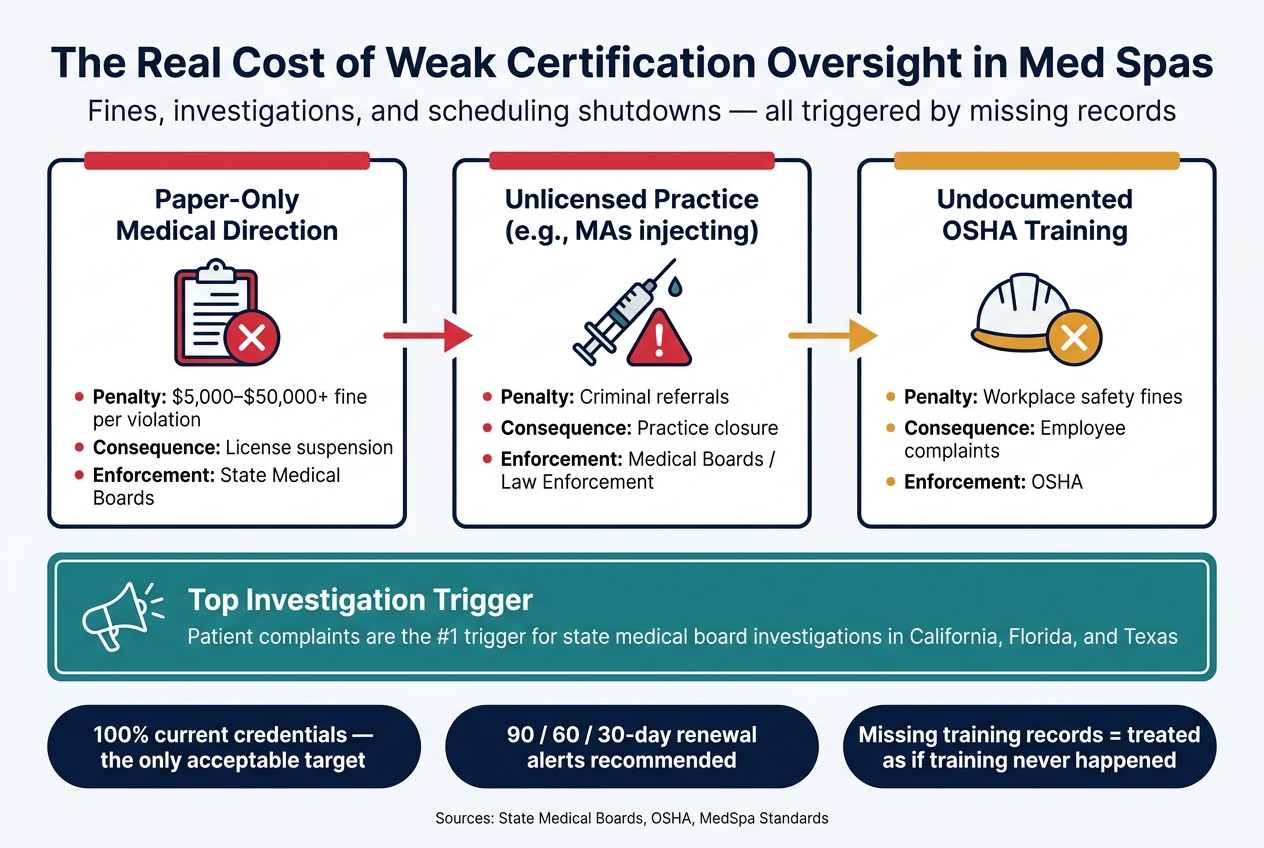
Med Spa Certification Violations: Penalties, Triggers & Enforcement Bodies
How State Rules, HIPAA, OSHA, and Supervision Requirements Overlap
When certification tracking breaks down, one missing record can set off more than one violation. That's where practices usually run into trouble: supervision gaps, missing records, and scope-of-practice mistakes.
A common example is paper-only medical direction. This happens when a physician signs a supervision agreement but doesn't review charts, answer clinical questions, or document that they're available. On paper, it looks fine. In practice, it falls apart. Fines for this issue usually range from $5,000 to $50,000+ per violation. Regulators look closely at whether supervision is both documented and happening day to day.
HIPAA and OSHA issues often start with small shortcuts that seem harmless in the moment. Think patient messages sent on personal phones, notes kept outside the EMR, missing exposure-control plans, or bloodborne-pathogen training that was never documented. Those little gaps can stack up fast.
Credentialing, Privileging, and Scope of Practice for Aesthetic Procedures
These terms don't mean the same thing, and mixing them up can create major liability.
Credentialing confirms that a provider has the needed license and certifications. Privileging spells out which procedures that provider is allowed to perform in your practice, based on checked training and your internal protocols. That line matters because it decides who can perform each aesthetic procedure safely and legally.
A provider can be fully credentialed and still not be privileged for a certain treatment. For instance, an RN may have an active state license and a manufacturer's certification for a laser device. But if the practice never formally recorded that she is approved to use that device on patients, there's a privileging gap. That becomes a bigger problem with higher-risk procedures like RF microneedling and injectables, where missing records create direct compliance risk.
"Standing orders may delegate authority for specific services, but they do not expand a person's legal scope of practice." - Weitz Morgan
What Can Go Wrong When Licenses, Training, or Records Are Missing
The fallout from weak certification oversight isn't theoretical. It shows up in very concrete, expensive ways.
| Violation Type | Potential Penalty | Primary Enforcement Body |
|---|---|---|
| Paper-Only Medical Direction | $5,000–$50,000+ fine; license suspension | State Medical Boards |
| Unlicensed Practice (e.g., MAs injecting) | Criminal referrals; practice closure | Medical Boards / Law Enforcement |
| Undocumented OSHA Training | Workplace safety fines; employee complaints | OSHA |
Fines are only part of the problem. Investigations can start fast. Patient complaints are the single largest trigger for state medical board investigations in major states such as California, Florida, and Texas. One complaint can snowball into a full practice audit if inspectors spot credential gaps or missing training records. And if a malpractice claim comes after an adverse event, undocumented training is treated as if it never happened, which strips away the practice's main legal defense.
"The chart you create today is the chart that will be reviewed when a complaint arrives eighteen months from now." - MedSpa Standards
The short-term disruption can hurt just as much. An expired license or lapsed malpractice coverage can stop scheduling on the spot. Some device manufacturers may disclaim liability for adverse outcomes if the provider can't show proof of required device-specific training. Missing records also make malpractice defense weaker and audits much harder to get through.
That's why certification management needs to tie every rule to a specific credential, training record, or approval.
sbb-itb-02f5876
How Certification Management Supports Compliance and Patient Safety
Once the risks are clear, the next step is simple: turn each rule into a tracked workflow.
Map Each Regulation to the Exact Training or Credential Required
Create a procedure-to-credential matrix that connects each rule to the exact license, training, and proof of completion required. This is the day-to-day fix for missing licenses, weak supervision, and scope-of-practice mistakes discussed above.
| Regulatory Requirement | Required Certification/Training | Documentation Method |
|---|---|---|
| State Licensure | Active State License (MD, NP, PA, RN) | Primary source verification; copy in personnel file |
| Medical Supervision | Written Delegation/Collaborative Agreement | Signed legal contract; Medical Director sign-off |
| OSHA Safety | Bloodborne Pathogens, Exposure Control, Sharps Safety | Annual certificate of completion; training log |
| HIPAA Compliance | Annual Privacy & Security Training | Digital certificate; signed acknowledgment |
| Laser Safety | Laser Safety Officer (LSO) Training | Manufacturer or accredited course certificate |
| Clinical Competency | Hands-on training; manufacturer device education; complications management | Skills checklist with evaluator sign-off |
| Emergency Response | Vascular Occlusion & Anaphylaxis Protocols | Quarterly drill logs; signed SOP acknowledgments |
This procedure-to-credential matrix is one of the strongest documents you can bring into an audit or lawsuit. Review it every quarter with the Medical Director.
Then use that same framework to shape onboarding and day-to-day procedure approvals.
Build Certification Checks Into Onboarding and Procedure Approvals
Verify credentials before a provider's first shift. Confirm the active state license through primary source verification. Confirm the supervision or delegation agreement is signed. Check competency with a skills assessment. Then document which procedures that provider is cleared to perform. Clinical work should start only after all of that is done. That keeps unverified staff out of the treatment room.
"The strongest med spas treat standing orders and credentialing as interconnected systems rather than separate administrative tasks." - Weitz Morgan
Any new device or injectable should trigger a credential review. Providers need to complete the required manufacturer training and have that training documented before using the new technology on patients.
It also helps to standardize annual revalidation, even when state law doesn't require it. Refresher training for OSHA bloodborne pathogens, infection control, and role-based procedure competency keeps staff prepared and records ready for review.
The same cycle should happen any time services, devices, or protocols change.
Use Continuing Education to Reduce Complications and Build Patient Trust
Regular CE helps lower complication risk and gives patients more confidence in the care they receive. Providers who stay trained in facial anatomy, vascular structures, and complication management are better prepared to spot early signs of vascular occlusion, avoid laser burns, and respond to anaphylaxis before things get worse.
"If it's not documented, regulators and insurers assume it didn't happen." - MedSpa Standards
When providers can speak clearly about their training and keep it current, patients tend to see that as proof of professionalism and safety.
Practical Systems for Managing Certifications in a Growing Med Spa
Once credentials are tied to each procedure, the next job is keeping them current. That means moving away from reactive spreadsheets and into a controlled system that centralizes records, automates reminders, and keeps audit trails.
Centralize Records, Reminders, and Audit Trails in One Digital System
Each clinical staff member should have a digital credentialing file with their active state licenses, CE certificates, competency evaluations, and signed supervision agreements. When those records live in a controlled system with an audit trail - instead of a shared drive or paper folder - it's much easier to show what was in place, and when, during a review. And the system can't just act like a filing cabinet. It should also make it clear who is approved for which procedures.
Keep the documents regulators ask for most in one controlled system:
- Medical Director agreements
- Facility licenses
- Staff license verifications
- Signed protocols
- DEA registrations
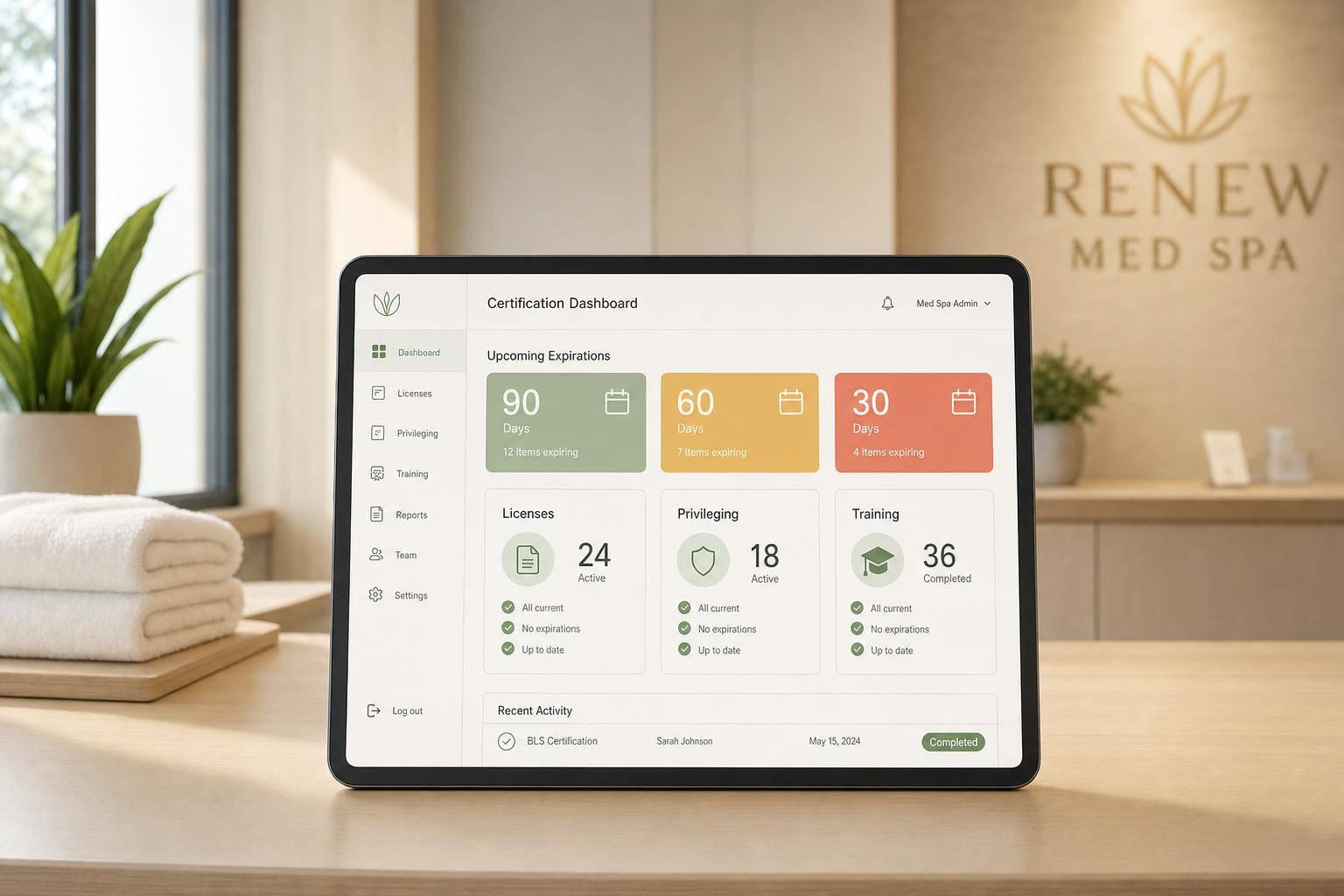
Set automated alerts for 90, 60, and 30 days before any credential expires. Pair that with a documented renewal workflow so the practice stays ahead of expirations instead of relying on memory, sticky notes, or random calendar reminders.
Use Prospyr to Connect Credential Tracking With Operations
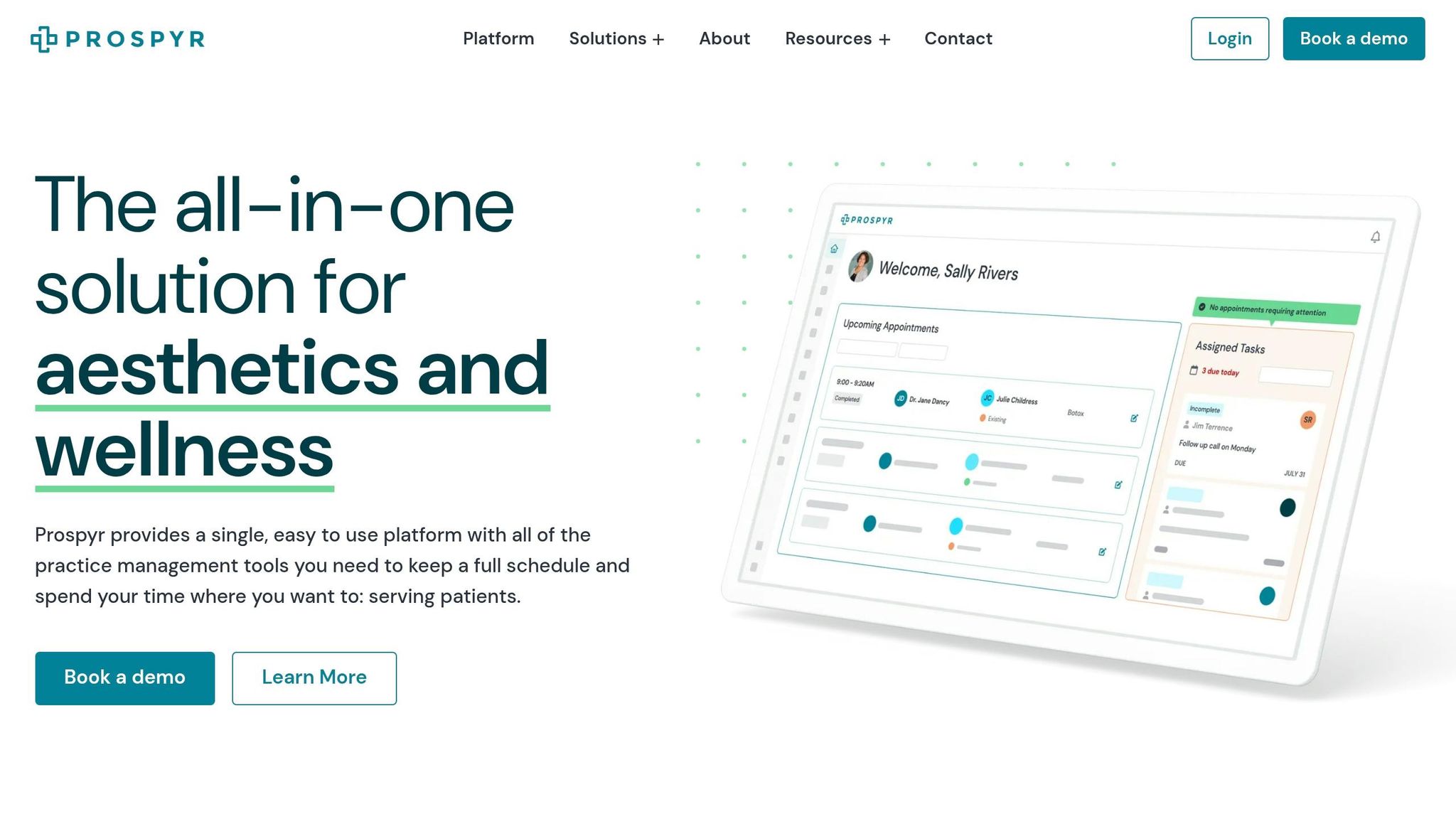
A platform like Prospyr can tie credential tracking directly to day-to-day operations. Its task management tools can automate renewal reminders and annual revalidation workflows, including OSHA bloodborne pathogens training, so nothing expires without notifying the person who owns the task.
Its scheduling controls can also line up with the procedure-to-credential matrix, which helps make sure only properly credentialed providers are booked for specific medical aesthetic procedures. On top of that, reporting gives managers a clear view of staff completion rates and upcoming expirations across the team.
Track a Few Core Metrics to Keep the Process on Track
Certification management doesn't need a complicated dashboard. Review a small set of metrics every quarter to catch drift early.
| Metric | Target Value | Data Source |
|---|---|---|
| Staff with current credentials | 100% | Master training matrix / digital credential files |
| Alert lead time for renewals | 90, 60, and 30 days before expiration | Automated task reminders |
| Annual OSHA/bloodborne training completion | 100% of staff | Digital training records |
| New protocol training completion | 100% before launch date | Competency checklists |
These four measures tell you if the system is holding up or starting to slip. A quarterly review helps stop small gaps before they turn into compliance failures.
Conclusion: Certification Management Supports Compliance, Trust, and Long-Term Growth
Certification management is core compliance work, not just admin busywork. It connects straight to regulatory standing, patient safety, and the financial health of the practice. And all of it rests on one thing: reliable certification tracking. When credentials are tracked on an active basis, the practice has protection. When they slip, the risk is plain: a single claim can lead to major losses and years of higher premiums.
The fix is simple in concept, even if it takes discipline to run well: one live credential matrix. The strongest med spas tie standing orders, privileges, onboarding, and training into a single workflow. In practice, that means:
- mapping credentials to each procedure
- checking credentials during onboarding
- keeping CE up to date
- storing records in one searchable system
This does more than help with compliance. It can also cut costs. Med spas with documented protocols and training records can lower insurance costs. That creates a direct return on the time spent building a structured credentialing process.
As you grow your practice by adding providers, services, or locations, a centralized system like Prospyr makes it easier to keep that structure in place without piling on extra admin work. When credential tracking connects with scheduling, task management, and practice analytics, compliance stays visible across the whole operation.
Keeping every license, training record, and agreement in one place is one of the smartest investments a med spa can make for long-term stability.
FAQs
What’s the difference between credentialing and privileging?
Credentialing checks a professional’s qualifications, including education, training, and an active state license, to confirm they’re legally allowed to practice.
Privileging is the internal process a facility uses to approve a practitioner for specific clinical procedures at that location, based on documented competency, training, and the scope set by the medical director.
How often should a med spa review certifications and training records?
Med spas should run a full credential and license audit at least quarterly so they can spot compliance gaps early, not after they turn into a problem. Professional licenses should also be checked with the state board at each renewal cycle.
Key training should be finished and documented annually. That includes bloodborne pathogen refreshers, emergency protocol simulations, and role-specific competency revalidations.
What should a med spa do if a provider’s license or training expires?
If a provider’s license or training expires, they must immediately stop performing any related medical procedures. Letting unlicensed or unqualified staff keep practicing can trigger legal, financial, and regulatory problems.
To stay compliant, med spas should:
- track renewal dates
- audit credentials on a regular basis
- keep all required training and competency records up to date