
If you use one consent packet for every patient, there’s a good chance it misses state rules. In 2026, med spa consent is shaped state by state, and the biggest trouble spots are written procedure consent, minor consent, telehealth consent, and photo/marketing authorization.
Here’s the short version:
- Consent rules are not the same in every state.
- Telehealth is a big risk area: 45 states, Washington, D.C., and Puerto Rico have some type of telehealth consent rule, and 34 states plus D.C. have telehealth-specific consent laws or regulations.
- Photo use needs extra care: under HIPAA, identifiable patient photos used for marketing need a separate written authorization. That should not be mixed into a general treatment form.
- Minors usually need a parent or legal guardian to sign, but state exceptions can apply.
- Procedure-specific forms are often the safer route for services like injectables, lasers, microneedling, and body contouring.
- The patient’s location during a telehealth visit often controls which state rules apply.
What I’d take from this article is simple: match the form set to the patient’s state, age, visit type, and service. I’d also make sure staff check for missing digital intake forms before rooming or treatment, not after.
A few state examples show why this matters:
- Florida: procedure consent should cover risks, alternatives, and what happens if treatment is refused; photo release should be separate.
- Iowa: some aesthetic services need a signed consent form before treatment.
- Washington: electronic signatures may work for consent forms.
- Maryland: telehealth records may need identity, location, and third-party presence documented.
This guide explains where clinics usually slip, what kinds of consent forms need special handling, and how to keep forms current across staff, services, and locations.
State consent rules for med spas in 2026
State medical, board, and telehealth rules differ enough that consent rules can change a lot from one place to another. In practice, that tends to affect injectables, lasers, body contouring, and virtual consults more than anything else. Record-retention rules also change by state, which affects how forms are stored and how long staff need to keep them on hand. That matters the moment a team member decides which form belongs in the chart before treatment begins.
Where state-level variation shows up most often
Most state-to-state differences show up in three areas.
- Written and treatment-specific consent: some states require written consent for certain procedures, while others allow documented verbal consent.
- Minor consent: most states set 18 as the age of majority and require a parent or legal guardian to sign. But there are exceptions, including emancipated minors and certain services.
- Telehealth and photo authorization: one national policy report found that 45 states, the District of Columbia, and Puerto Rico include some form of telehealth consent requirement, and 34 states plus Washington, D.C. have explicit telehealth-specific informed consent statutes or regulations.
Photo and marketing authorization can also trip clinics up. HIPAA requires a separate written authorization for identifiable patient images used in marketing, and that authorization cannot be bundled into a general treatment consent form.
This is where a one-size-fits-all intake packet usually starts to break down. These are the pressure points, and they tend to show up early.
Why one universal form usually falls short
The risk isn't theoretical. It shows up when a clinic tries to use the same packet for every service and every visit type.
Some states require a separate signed form for each procedure. That means injectables, laser treatments, and body contouring may each need their own risk disclosures and their own form. Florida's medical consent statute, for example, requires consent to cover procedure details, material risks, alternatives, and the consequences of refusal, so a clinic needs a procedure-specific form rather than a broad, catch-all agreement.
Telehealth visits bring a different set of issues. They often need their own standalone consent that covers technology limits, privacy protections, emergency protocols, and how patients can get in-person care. That content doesn't belong buried in a general treatment agreement.
There's another snag too: in states that require payment consent to be separate from treatment consent, a combined form creates a compliance problem from the very first signature. That's why intake teams need state-specific form workflows, not generic templates.
sbb-itb-02f5876
Written consent, minor consent, telehealth consent, and photo consent explained
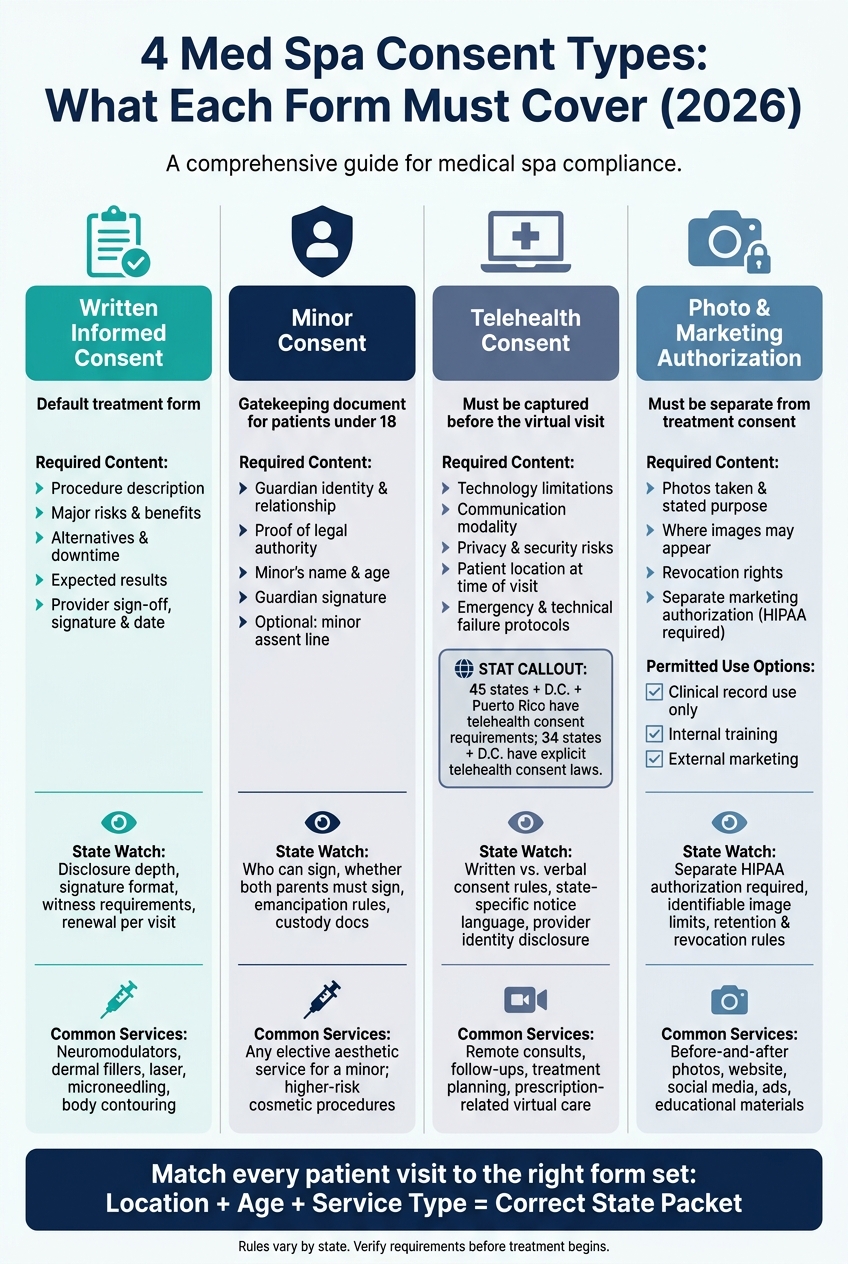
4 Med Spa Consent Types: What Each Form Must Cover by State (2026)
These four consent types cause a big share of intake mistakes. Each one does a different job from a legal and clinical standpoint. So the key move is simple: match the visit to the right form.
Written informed consent and treatment-specific procedure forms
For intake staff, this is the default treatment form. A procedure consent for services like neuromodulators, dermal fillers, laser treatments, microneedling, and body contouring should spell out the procedure, major risks, expected benefits, alternatives, and downtime. It should also confirm that the provider went over these points with the patient and that the patient had a chance to ask questions before treatment starts.
These treatments carry different risk profiles, and that matters. One form usually won't do a good job across all of them. A botulinum toxin consent should address vascular occlusion risk. A laser consent should cover pigment changes, burns, and scarring. The safer route is to use procedure-specific templates, each with its own signature line, date, and provider sign-off.
Minor consent, guardian authorization, and age-related limits
For minors, this is the gatekeeping document. Patients under 18 need guardian authorization. The form should record who signed, their relationship to the minor, and how the clinic confirmed their legal authority. Staff should verify photo ID and, when needed, custody or guardianship papers.
Many clinics also add a separate assent line for the minor. That doesn't replace guardian authorization, but it does help show the minor understood what was being discussed and took part in the process. Some higher-risk or invasive cosmetic services draw extra scrutiny when age is a factor, so clinics should check both internal policy and malpractice carrier guidelines before booking the visit.
Telehealth consent, photo consent, and marketing authorization
For virtual visits, telehealth consent needs to be captured before the consult. It should stand on its own. The form needs to cover the limits of remote assessment, technology risks, privacy protections, patient location, and how emergencies or technical failures will be handled. The AHRQ notes that verbal telehealth consent at the start of the first visit can be acceptable if it's documented in the chart, though state rules still vary.
Photo consent needs its own lane too. The risk shows up when clinics use the same authorization for chart images and marketing images. Clinical photos used for charting and outcome tracking are not the same as permission to place a patient's image on a website, social media post, or ad. Those uses need separate, explicit authorization. A practical setup is to use separate checkboxes or a standalone form that gives patients clear choices, such as:
- Clinical record use only
- Internal training
- External marketing
Train staff to match each visit to the right document set. Use this as the staff checklist.
| Consent type | Purpose | Required content | State differences | Common services |
|---|---|---|---|---|
| Written informed consent | Document patient understanding of a procedure | Procedure, major risks, benefits, alternatives, downtime, expected results, signature, date, provider sign-off | Disclosure depth, signature format, witness requirements, whether consent must be renewed each visit | Neuromodulators, dermal fillers, laser treatments, microneedling, body contouring |
| Minor consent | Confirm legal authority to treat a patient under 18 | Guardian identity, proof of authority, minor's name and age, guardian signature, minor assent line | Who can sign, whether both parents must sign, emancipation rules, custody documentation | Any elective aesthetic service for a minor; higher-risk or invasive cosmetic procedures |
| Telehealth consent | Document acceptance of care delivered virtually | Technology limitations, communication modality, privacy risks, patient location, emergency protocols | Whether written or verbal consent is sufficient, state-specific telehealth notice requirements | Remote consults, follow-ups, treatment planning visits, prescription-related virtual care |
| Photo and marketing authorization | Authorize image capture and define permitted uses | Photos taken, stated purpose, where images may appear, revocation rights, separate marketing consent | Whether a separate HIPAA authorization is required, identifiable image limits, retention and revocation rules | Before-and-after photos, website content, social media, ads, educational materials |
Next, verify which of these forms must be separate, signed, witnessed, or renewed in each state.
State-by-state variations to watch
Use the consent types above to see where state rules split in day-to-day practice. This section helps clinics track the rules that tend to shift most: consent type, who signs, timing, and record storage.
Documentation patterns clinics should verify before treatment
Review these consent categories state by state before care starts:
| Variation pattern | What to verify |
|---|---|
| General informed consent | Does the state require written informed consent, or does it allow verbal or electronic consent if that consent is documented in the chart? |
| Telehealth consent | Does the state require specific notice language about telehealth limits, privacy or security risks, provider identity, or treatment alternatives? |
| Minor and guardian authorization | Who can legally sign for a minor, and does the clinic need guardianship or caregiver paperwork at intake? |
| Photo and marketing authorization | Is a separate release required for before-and-after photos, social media use, or other promotional use? |
| Procedure-specific forms | Does the state expect separate forms for lasers, chemical peels, microneedling, or permanent cosmetics? |
| When consent must be signed and how long to keep it | Must consent be completed before treatment, and how long does the record need to be kept? |
A few state examples make this clearer:
- Iowa rules for certain aesthetic services require a consent form that states the procedure purpose, known risks, acknowledgment of disclosure, and a signature from the client or lawful representative. In plain terms, the form has to be signed before treatment.
- Washington aesthetics guidance confirms that consent forms may be signed electronically and dated. So a digital signature workflow can work there.
- Florida guidance for med spas calls for procedure-specific informed consent, HIPAA acknowledgment, and a separate photo and marketing authorization if patient images are used on a website or social media. In other words, photo release needs its own form.
Maryland telehealth rules require identity, location, and third-party presence to be documented. That kind of detail usually pushes clinics to use a state-specific telehealth form.
Multi-location and cross-state telehealth workflow risks
The patient’s location at the time of the visit usually controls which consent rules apply, not the clinic’s home state and not the provider’s location.
That can trip people up fast. A patient joining from another state may set off different telehealth disclosure rules, minor consent rules, or photo and marketing rules. If a clinic uses one catch-all form for everyone, it can easily miss those state-level differences.
The practical move is simple: build intake so staff confirm the patient’s current location and age status before assigning forms. Then match the packet to the service type, such as Botox, filler, laser, or a telehealth-only consult. The packet should be built from three things: location, age, and service type.
Once the patient’s location is confirmed, staff can send the right state packet before the visit starts.
Staff training, form maintenance, and daily intake workflow
How staff training supports compliant intake every day
After you identify the right state packet, the next step is simple in theory but easy to miss in practice: staff need a process they can follow the same way every single time.
Consent compliance starts at scheduling. Before forms are assigned, staff should verify the treatment type, the patient's age, and the visit mode. Those are the same three intake triggers established earlier - location, age, and service type - and they decide which state packet applies.
An intake SOP should map each visit to the right state packet. It also helps to pair that SOP with:
- a pre-visit checklist tied to scheduling
- a rooming-readiness checklist used right before the patient is roomed
The point is to confirm that all required forms are signed before rooming, not after. If something is missing, staff should escalate it to a clinical lead instead of guessing or filling in the gaps on the fly.
Training also needs a paper trail. Document the date, the topics covered, and staff signatures; undocumented training has no audit value. Role-play can help here too, especially for edge cases and escalation steps. That's often where teams trip up.
How to review and update forms when rules change
Training falls apart if the forms themselves are out of date.
Review high-risk forms every quarter and the full form library once a year. That review should cover HIPAA acknowledgments, telehealth language, photo consent, and minor authorization.
Each template should include a version number and an effective date so staff can tell which copy is current. It's smart to assign one editor, log each change, and record the version number, effective date, and approval.
When a major update changes risk disclosures or state-specific language, patients should sign the new version at their next visit. That transition should also be documented in the chart.
Scheduled reviews aren't enough on their own. Event-driven updates matter just as much. If state law changes, a new service is added, or telehealth expands, the related consent forms should be reviewed right away - not weeks later at the next quarterly check-in.
Using Prospyr to centralize consent forms and workflow tracking
For med spas with multiple providers, locations, or telehealth services, keeping consent workflows lined up across the team can get messy fast without one central system. Prospyr is built for aesthetics and wellness clinics and brings digital intake forms, scheduling, and task management into one HIPAA-compliant platform. That central setup helps keep updates from splitting apart across locations.
The main upside is intake-to-chart tracking in one place. Digital forms can go out before the appointment, which cuts check-in slowdowns and front-desk mistakes. Managers can also use task tools to spot open consent items - like a missing telehealth authorization or an unsigned photo release - before the provider starts treatment.
Version control can be handled centrally too, so staff across locations pull the current form instead of an old one. In plain terms: it helps teams catch missing forms before treatment begins.
FAQs
Which state's consent rules apply to a telehealth visit?
The telehealth consent rules that apply depend on where the patient is physically located at the time of the visit. In the United States, your practice has to follow that state’s licensing rules and consent requirements.
Because these rules change from state to state, check that state’s rules before the session starts. That includes whether consent must be written or verbal and whether you need to give any specific disclosures up front.
When do med spas need separate photo marketing authorization?
Med spas need a separate photo marketing authorization when patient images are used for anything beyond routine clinical documentation. That matters most when photos are headed into public or digital channels like websites, social media, email campaigns, printed materials, or in-office displays, including before-and-after photos.
Verbal permission isn’t enough for public-facing use. The patient should sign and date a separate written permission form that spells out where the images may appear and makes clear that saying no to promotional use will not affect their care.
How often should med spas update consent forms and staff training?
Update consent forms on a set schedule so they stay in line with state law, FDA updates, and any new treatments or procedures. A good rule is to review all forms every six months, and then review them again anytime regulations or privacy policies change.
Staff training needs the same kind of attention. Train your team on consent steps and HIPAA/privacy practices on a regular basis, keep attendance records, and run audits at least quarterly. If those audits show weak spots, refresh the training to fix them. Photo consent policies should also get a review once a year.