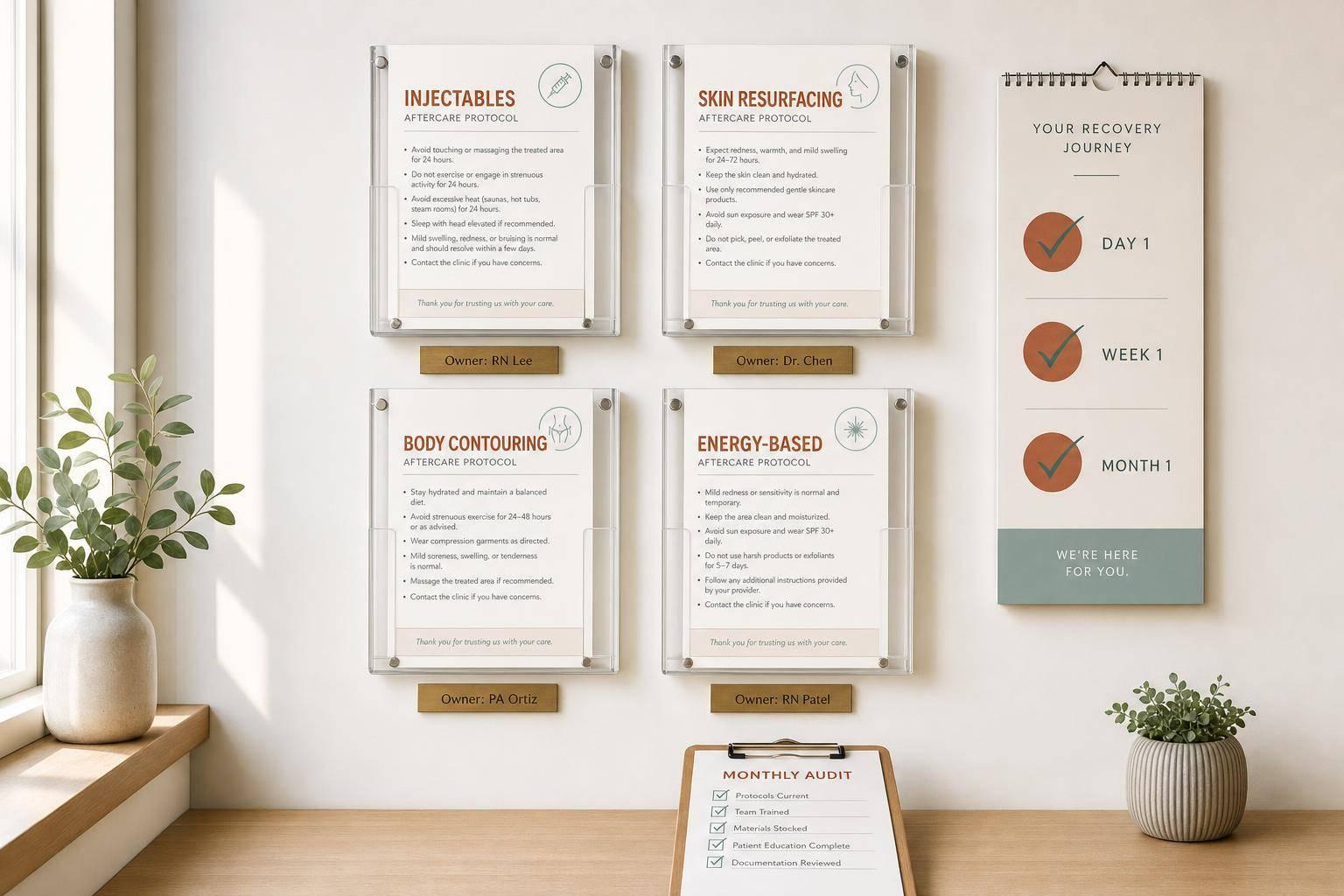

If your clinic does not use one written aftercare system, staff will fill the gaps on their own. That leads to mixed instructions, missed follow-up, and weak charting.
I’d sum the article up like this: clinics need one clinic-wide aftercare template, clear staff ownership, fixed follow-up timing, and audits that check if the process was actually done. That matters in a market where 28,243,407 minimally invasive procedures were reported in 2024, making up 91.5% of total procedure volume.
At a glance, the article says you should:
- Use one written format for every treatment
- Group protocols by service type: injectables, lasers/energy, peels/microneedling, threads, and body treatments
- Include timing, home care, warning signs, ER rules, and chart fields
- Set fixed check-ins for same day, 24–48 hours, 10–14 days, and 4–6 weeks
- Give each team member a defined job
- Track missed follow-up, red-flag cases, lot numbers, and adverse-event logs
- Review and update protocol versions on a set schedule
A few numbers stand out. FDA adverse-event data reviewed over 10 years found 5,024 cases tied to dermal fillers, including infection, vascular events, and inflammatory reactions. The article also points out that patients need fast action for warning signs like vision changes, unusual pain, skin color change, chest pain, or shortness of breath.
| Area | Main focus |
|---|---|
| Written protocol | Same instructions every time |
| Treatment families | Shared format, service-specific details |
| Red flags | Clear same-day, urgent care, ER, or 911 rules |
| Follow-up | Pre-set timing instead of ad hoc outreach |
| Documentation | Lot numbers, photos, instructions, acknowledgment |
| Review cycle | Version control, audits, retraining |
In short, I see this article as a practical guide for turning aftercare into a repeatable clinic process instead of a verbal handoff.
Build the Clinic-Wide Aftercare Framework
Use one clinic-wide template across every provider and location. Keep the structure the same, then change only the treatment-specific parts. That gives your team a shared way of working without forcing every service into the exact same script.
Core Fields Every Protocol Should Contain
Each protocol should start with the treatment name and family. For example: "Botulinum toxin type A – injectables." After that, move through indications, contraindications, and then timing-based aftercare.
Every protocol should include:
- Treatment name and family
- Indications and contraindications
- Timing-based aftercare steps
- Red flags and escalation steps - spell out who reviews a concern, the expected response window, and when the patient should be sent to the ER
- Required chart fields - product lot numbers, device settings, treated areas, dosing maps, pre- and post-treatment photos, instructions given, format used, and patient acknowledgment
Group Protocols by Treatment Family
Organize services into shared treatment families: injectables, lasers and energy devices, peels and microneedling, threads, and body treatments. Each family tends to share a similar risk pattern and healing timeline. That means the main template can stay the same, while each family-level version handles the details.
| Component | Injectables | Lasers / Energy | Peels / Microneedling | Threads | Body Treatments |
|---|---|---|---|---|---|
| Lot number / device settings | Required | Required | Required | Required | Required |
| Baseline + outcome photos | Yes | Yes | Yes | Yes | Yes |
| Primary risk emphasis | Vascular occlusion | Burns / PIH | PIH / barrier disruption | Migration / contour | Contour / burns |
| Default follow-up window | 2 weeks | 4 weeks | 2–4 weeks | 4–6 weeks | Service-dependent |
Use the same timing bands for every family. The immediate window (0–2 hours) should cover stabilization, cooling measures, positional guidance, and acute complication monitoring. The 24–48 hour band should cover activity limits, skincare rules, and sun avoidance. Days 2–7 should explain normal healing signs and the patient’s gradual return to routine. Weeks 2–6 should define when results can be assessed and when follow-up visits or touch-ups make sense.
How to Review, Approve, and Update Protocols
Start with clinical guidance and manufacturer guidance, then send the draft to the medical director for approval before it goes live. Test it with a small staff group first, collect feedback, and lock it in before full rollout.
Each protocol should carry a version number and a scheduled review date. If a protocol changes, document what changed, who approved it, and which staff members need retraining.
Use Prospyr to store protocol versions, assign follow-up tasks, and send HIPAA-compliant reminders.
sbb-itb-02f5876
Treatment-Specific Aftercare Protocol Templates
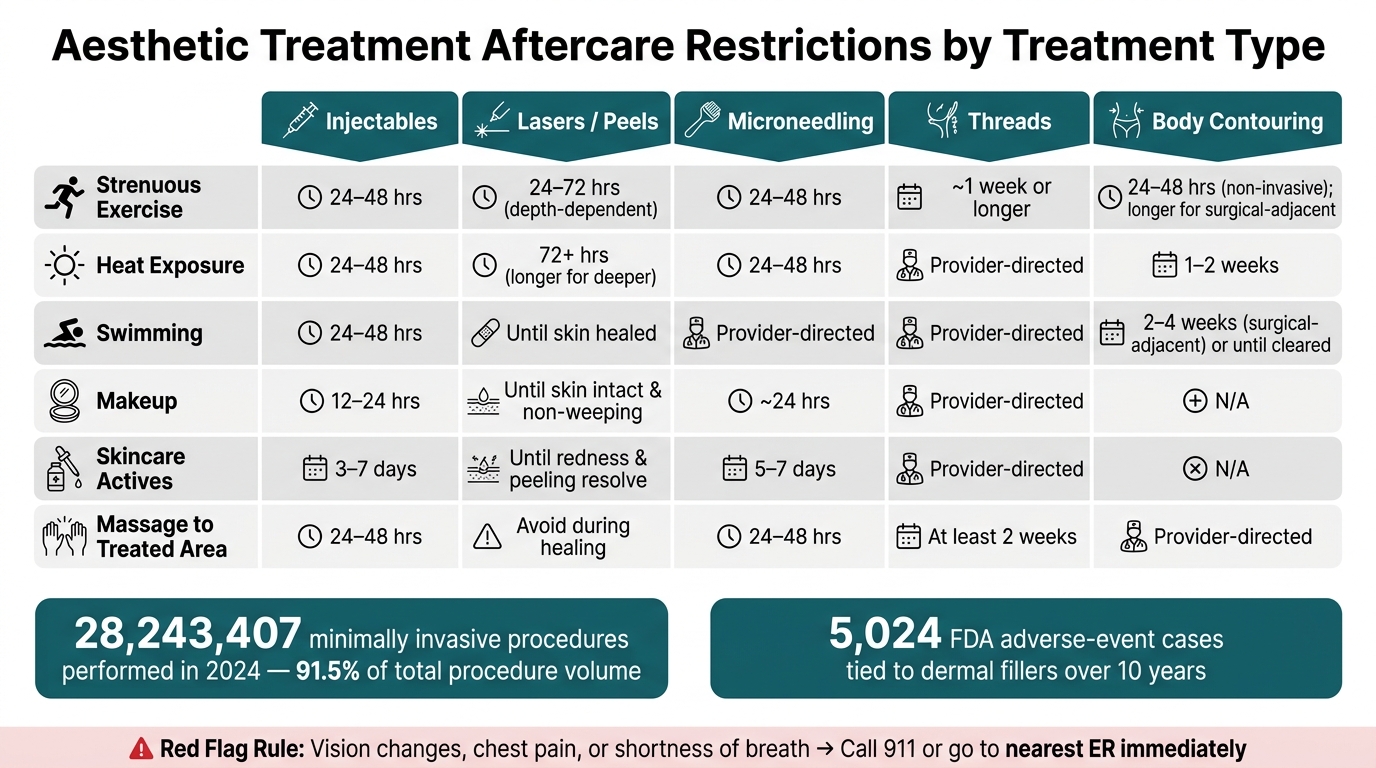
Aesthetic Treatment Aftercare Restrictions by Treatment Type
Use these as staff-facing, chart-ready aftercare instructions. Each one spells out normal healing, what should trigger concern, and exactly when to escalate.
Injectables: Neurotoxins and Dermal Fillers
Primary risk: vascular and pressure risk.
For the first 4 hours after neurotoxins or dermal fillers, keep the patient upright. They should avoid touching or rubbing the treated area and skip strenuous exercise, saunas, hot tubs, and tanning beds. No facial massage or professional facial treatments that day. If medically appropriate, avoid alcohol and blood-thinning supplements to help limit bruising.
For filler patients, use a cold compress wrapped in cloth in 10-15 minute intervals as needed for swelling. Never place ice directly on the skin. Sleep with the head elevated on the first night. No makeup over injection sites for at least 12-24 hours. Patients should not self-massage or mold filler unless the provider gave direct instructions to do so. For pain control, recommend acetaminophen instead of NSAIDs, since ibuprofen and similar drugs can make bruising worse. Neurotoxin results build over 7-14 days, so schedule a 2-week photo check-in to review the result.
Expected healing: mild swelling, tenderness, and small bruises.
Red flags: severe pain, blanching, mottling, cool skin, vision changes, severe headache, or breathing difficulty.
Escalation path:
- Immediate escalation to the treating provider for any vascular warning sign or pressure-related concern
- If vision changes or breathing difficulty are reported, treat this as an emergency and direct the patient to 911 or the nearest ER immediately
- Document symptom onset, location, severity, and provider notification in the chart at once
For resurfacing procedures, the focus changes. It’s less about injection-site care and more about barrier repair and sun avoidance.
Lasers, Chemical Peels, and Microneedling
Primary risk: barrier disruption and infection risk.
For the first 24 hours, use only a gentle rinse with cool or lukewarm water. After that, switch to a fragrance-free, non-foaming cleanser once or twice daily. No scrubbing, no washcloths, and no mechanical exfoliation.
Moisturizer depends on treatment depth. Light microneedling or superficial peels usually do well with a non-comedogenic moisturizer. Deeper laser resurfacing or medium-depth peels need a petrolatum-based occlusive used continuously to prevent drying and cracking. Hold all active skincare, including retinoids, AHAs, BHAs, vitamin C, and benzoyl peroxide, for at least 5-7 days, or until redness and peeling are gone. During healing, stick to a gentle cleanse, a bland moisturizer, and mineral SPF 30+. Avoid direct sun exposure and wear a wide-brim hat outdoors. Patients should not pick or peel flaking skin.
No makeup until the skin surface is intact and non-weeping. In practice, that usually means about 24 hours for light microneedling or non-ablative lasers, and about 3-7+ days for deeper peels or ablative lasers.
Expected healing: even pink-to-red skin that slowly fades, mild tightness, and peeling that often starts around day 3.
Red flags: increasing focal pain, expanding redness, warmth, pustules, drainage, fever of 101.5°F or higher, or feeling generally unwell.
Escalation path:
- Same-day evaluation for increasing focal pain, spreading redness, warmth, pustules, or any drainage
- If the patient reports a fever of 101.5°F or higher or says they feel unwell overall, arrange same-day evaluation or urgent care
- Chart the timing of symptoms, treatment type and depth, home products used, and all outreach attempts
Threads and Body Treatments
Primary risk: mechanical displacement and swelling risk.
For thread lifts, patients should sleep on their back with the head elevated to 30-45° for the first 3-7 nights. A wedge pillow is often the easiest option. Avoid side and stomach sleeping for at least 1-2 weeks. Limit wide jaw movements, exaggerated facial expressions, and chewing tough foods for the first 3-5 days. No facial massage, jade rollers, gua sha, or aggressive cleansing tools for at least 2 weeks. Delay non-urgent dental work that requires prolonged mouth opening for 1-2 weeks.
For body contouring and surgical-adjacent treatments, follow the prescribed compression plan, encourage early walking, and push steady hydration. Chart garment use, activity limits, and clearance criteria. When garments are prescribed, patients usually wear them 22-24 hours per day for the first 2-3 weeks, then daytime only. Encourage light walking for 5-10 minutes every few hours while awake to support circulation. A simple hydration goal is at least 64 oz of water per day to help lymphatic drainage.
Expected healing: swelling, soreness, tightness, and mild asymmetry early on, depending on the treatment.
Red flags: sudden increase in swelling, marked asymmetry, severe pain, skin color change, drainage, shortness of breath, chest pain, or signs that threads may have shifted.
Escalation path:
- Immediate provider review for severe pain, marked asymmetry, drainage, or suspected thread displacement
- For shortness of breath or chest pain, direct the patient to 911 or the nearest ER immediately
- For thread and surgical-adjacent procedures, exact timing should always follow the treating provider’s written instructions
- Record garment compliance, mobility status, hydration guidance, and all symptom reports in the chart
| Restriction | Injectables | Lasers / Peels | Microneedling | Threads | Body Contouring |
|---|---|---|---|---|---|
| Strenuous exercise | 24-48 hours | 24-72 hours, depending on depth | 24-48 hours | About 1 week or longer | 24-48 hours for non-invasive; longer for surgical-adjacent |
| Heat exposure | 24-48 hours | At least 72 hours; longer for deeper resurfacing | 24-48 hours | Provider-directed | 1-2 weeks |
| Swimming | 24-48 hours | Until skin is healed | Provider-directed | Provider-directed | 2-4 weeks for surgical-adjacent, or until cleared |
| Makeup | 12-24 hours | Until skin is intact and non-weeping | About 24 hours | Provider-directed | N/A |
| Skincare actives | 3-7 days | Until redness and peeling resolve | 5-7 days | Provider-directed | N/A |
| Massage to treated area | 24-48 hours | Avoid during healing | 24-48 hours | At least 2 weeks | Provider-directed |
Next, assign ownership and automate follow-up so every aftercare step is delivered and documented.
Assign Staff Roles and Automate Follow-Up
Who Owns Each Part of Aftercare
Aftercare tends to break down when no one is clearly in charge. The fix is simple: assign ownership before treatment starts.
The medical director approves the protocol, escalation rules, and any updates. The treating provider documents instructions and follow-up. Nurses and medical assistants handle patient education and symptom checks. Front desk staff route scheduling issues and patient concerns right away.
Across multi-site clinics, assign one protocol owner for all locations. The protocol should also spell out the after-hours escalation path, so patients know exactly who to contact if symptoms become concerning.
Once roles are clear, the clinic can standardize the timing of each follow-up.
Standard Timing Rules for Check-Ins and Follow-Ups
A set follow-up schedule cuts out guesswork for both staff and patients:
- Same day: instructions and acknowledgment
- 24–48 hours: symptom check
- 10–14 days: injectable review
- 4–6 weeks: outcome assessment
Higher-risk procedures, combination treatments, or patients with a history of complications may need earlier or more frequent outreach. That call should come from the treating provider and should be documented in the chart.
That schedule can then power reminders and task assignments automatically.
Use Software Reminders, Tasks, and HIPAA-Aware Messaging
Manual follow-up leaves room for missed steps. Use Prospyr to trigger follow-up tasks from the chart, send reminder messages, and keep documentation tied to the patient record.
For messaging, keep automated texts short and focused on the task at hand. If a patient needs to discuss symptoms in detail, move the conversation to a phone call or a secure, documented clinical workflow. Staff should never send medical details through a standard text channel unless the clinic's technology and policies clearly allow it. Set message templates ahead of time, keep them brief, and chart anything clinically relevant right away.
Track completion and outcomes next, so missed follow-up steps show up early.
Audit Protocols and Improve Them Over Time
Track Compliance, Outcomes, and Missed Steps
Once aftercare is standardized, the next job is simple: check whether the clinic actually did what it said it would do.
That means auditing whether aftercare instructions were delivered, follow-up was completed, and red flags were escalated. These checks show where aftercare slips. They also strengthen the clinic's liability record by showing that instructions were given, follow-up happened, and escalation took place on time.
A monthly dashboard helps keep this visible. Then, once each quarter, do a deeper review and tie those findings to protocol updates.
Track metrics like these:
- Aftercare documentation rate: What share of visits include documented written and verbal aftercare?
- Follow-up completion rate: How many patients completed required check-ins?
- Red-flag escalation documentation: Are urgent symptom contacts documented with the escalation taken?
- Adverse-event log completeness: Does each logged event include the date, product or device, lot number, provider, outcome, and any manufacturer or MedWatch reporting when indicated?
- Lot number capture rate: Is every injectable or device treatment charted with product name, lot number, and expiration date?
- Missed follow-up rate: What percentage of scheduled follow-ups are missed, and how often do staff remain unable to reach a patient after repeated contact attempts?
Documentation also needs to support regulatory reporting. Report serious cosmetic adverse events to the FDA within 15 business days, file follow-up reports if new medical information appears within one year, and keep records for 6 years.
Monthly chart audits can catch small misses before they turn into habits. Review a sample of records for consent, lot numbers, aftercare documentation, and follow-up notes.
Update Training and Protocol Versions
Audit findings should lead to action. If a pattern shows up, revise the protocol and retrain the team. Protocols also need review whenever products, IFUs, adverse events, or regulations change.
Assign a clinical owner to each treatment family. In most clinics, that's the medical director, lead injector, or laser specialist. That person monitors manufacturer safety communications and professional society updates. When something changes, the owner starts a formal review, documents what changed and why, and sends it through clinical leadership for approval before the update goes live.
That's how the loop stays tight: audit findings lead to revision, revision leads to retraining, and retraining shows up in the next audit cycle.
Keep each protocol in one version-controlled system with a version number and effective date. Prospyr can help by keeping updated protocols next to treatment templates, so staff pull the current version instead of using an old printout. Retire old versions right away. Old printouts and shared-drive copies often lead to mixed instructions.
Training should match the role:
- Providers: triage
- Front desk: scheduling and scripts
- Nurses and MAs: documentation and lot capture
Quarterly micro-trainings or short huddles work well for narrow updates. Annual or semiannual sessions are better for bigger protocol reviews and case-based learning tied to recent adverse events or workflow gaps.
Key Takeaways for a Reliable Aftercare System
A reliable aftercare system is measured, not assumed. Clinics that protect patients more consistently tend to do the same few things well: they standardize by treatment family, assign ownership at each step, set fixed follow-up timing inside scheduling and automated reminders, and document every patient touchpoint. That includes instructions delivered, messages sent, triage actions taken, and products and lot numbers used, so the full care path is visible in the chart.
- Standardize by treatment family so every provider works from the same baseline
- Assign ownership at each aftercare step so nothing gets missed
- Automate follow-up timing and build those windows into scheduling and reminders
- Document every touchpoint - instructions, messages, triage actions, lot numbers
- Audit regularly and use findings to refine protocols, retrain staff, and fix workflow gaps
FAQs
How do we build one aftercare template for all treatments?
Use one secure, centralized system instead of relying on a single static template.
Why? Because aesthetic treatments don’t all follow the same recovery path. Different services come with different timelines, care steps, and patient needs. A one-size-fits-all document just doesn’t do the job. Prospyr can automate treatment-specific aftercare based on the service provided.
You can also send a personalized email or SMS after checkout. Just keep those messages HIPAA-compliant by leaving out treatment names and medical details. Then direct patients to a secure portal where they can view tailored instructions, videos, and documentation.
Who should own follow-up and escalation in the clinic?
Ownership needs to be assigned clearly by role and protocol. Automation can take care of routine messages, but staff should step in for exceptions, including clinical questions and non-standard replies.
In most cases, RNs should own structured, protocol-based follow-ups. That includes routine post-injection check-ins and progress reviews.
For serious adverse events or medical emergencies, the medical director or facility owner should be the named responsible party. Staff also need a clear escalation path, so urgent concerns go straight to a physician or nurse practitioner without delay.
What should we audit to confirm aftercare was completed?
Use regular chart audits with a random sample from different procedure types. This helps you spot gaps before they turn into bigger problems.
Check that each record includes:
- a complete medical history
- a signed consent form that shows the patient received aftercare instructions
- detailed procedure notes
Then look at follow-up communication. That includes automated reminders, text messages, and emails. Your chart should show that those messages were documented, not just sent.
In your HIPAA-compliant platform, review audit logs to confirm messages were sent and accessed. Also make sure every record is dated and stored securely based on your retention policy.