

Yes - sometimes. If I strip the article down to the answer, it comes to this: a physician assistant may be able to own all, part, or only the non-clinical side of a med spa, depending on state law as of August 26, 2026.
Here’s the short version:
- Strict CPOM states usually block a PA from owning the clinical medical practice.
- Middle-ground states may allow co-ownership or a minority stake, often with a physician holding control.
- More open states may allow a PA to own the business directly, but physician oversight still often applies if the spa offers medical services.
- Medical director rules, supervision rules, and fee-splitting rules can limit control even when ownership is allowed.
- Services like Botox, fillers, lasers, IV therapy, and GLP-1/medical weight loss often trigger medical-practice rules.
- The article notes that 91% of med spas offer neurotoxin injections and 50% offer medical weight loss, which is why ownership issues come up so often.
In plain English: owning a med spa is not just about who files the LLC or signs the lease. It also turns on:
- who owns the clinical entity
- who controls medical decisions
- who can serve as medical director
- how money moves between the practice and any MSO
- whether compensation looks like fee-splitting
The article breaks states into three broad buckets:
-
Physician-led only
- Examples include California, Texas, New York, Illinois, Tennessee, and Colorado
- A PA may still own an MSO or hold a limited minority interest
-
Mixed or conditional
- Examples include Arizona, Florida, North Carolina, and Ohio
- A PA may have a path to ownership, but there are limits tied to entity type, physician role, or scope rules
-
More open ownership paths
- Some states give PAs more room to own the med spa directly
- Even then, many medical services still need a physician medical director and written protocols
What I’d check first before forming or buying in:
- your state’s CPOM posture
- whether a PA can own the clinical practice or only the MSO
- whether a physician must hold 51% or more
- whether a PA can hold voting equity
- whether the compensation model uses percentage-based payments
- whether the service mix includes medical treatments that trigger more rules
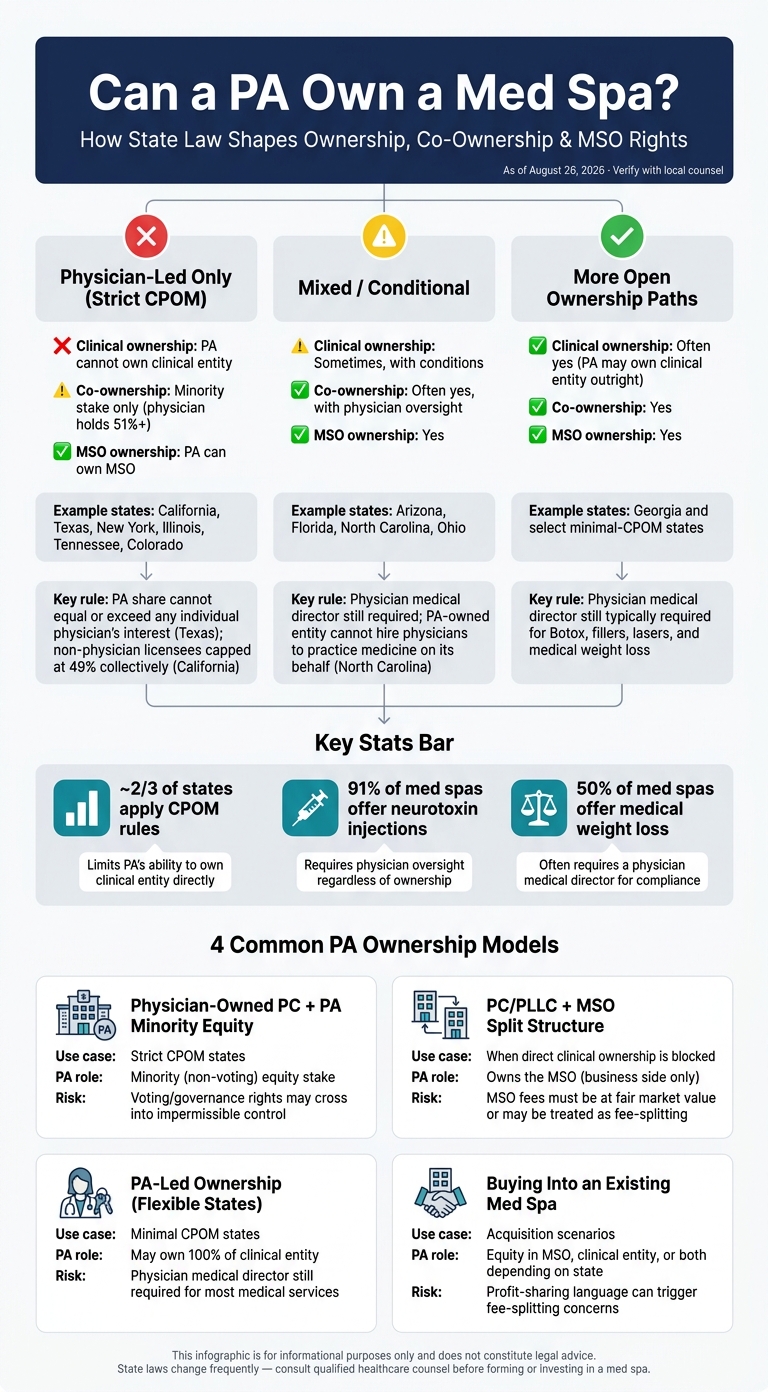
Can a PA Own a Med Spa? 50-State Ownership Rules at a Glance
Quick Comparison
| State group | Can a PA own the clinical entity? | Can a PA co-own? | Can a PA own an MSO? | Main issue |
|---|---|---|---|---|
| Strict CPOM | Usually no | Sometimes, with physician control | Usually yes | Control and fee-splitting |
| Mixed / conditional | Sometimes | Often yes, with limits | Yes | Supervision and entity rules |
| More open states | Often yes | Yes | Yes | Medical director and scope rules |
So if you’re asking, “Can I own a med spa as a PA?” the best short answer is: maybe - but the legal structure matters as much as the ownership percentage.
sbb-itb-02f5876
National Rules That Shape PA Med Spa Ownership
These rules don't land the same way in every state. On paper, two states may both regulate med spas. In practice, one may let a PA hold part of the clinical business, while another may limit the PA to the business side only.
Put simply, these rules shape whether a PA can own:
- the clinical entity itself
- only the business entity
- or just a minority share
Corporate practice of medicine: strict, moderate, and minimal states
CPOM limits who may own the entity that bills for and delivers medical services. About two-thirds of states apply CPOM rules, but the level of restriction varies.
| CPOM Posture | Who Can Own the Clinical Entity | Can a PA Own Equity? | Common Compliant Structure |
|---|---|---|---|
| Strict | Physicians or physician-owned professional entities only | Direct clinical ownership is usually blocked; minority stakes may be allowed through limited structures | Physician-owned PC + PA ownership of a separate MSO for non-clinical services |
| Moderate | Licensed clinicians, including PAs, NPs, and sometimes RNs | Yes, typically as minority equity | Physician 51% / PA 49% professional entity with physician veto power over clinical issues |
| Minimal | Non-physicians and licensed clinicians alike, subject to licensing and supervision rules | Yes, including majority ownership in some cases | PA-owned LLC with a contracted physician medical director; MSO used only if needed |
In a strict CPOM state, a PA who wants to open a med spa may own the MSO, while a physician owns the professional corporation that provides medical services such as Botox, fillers, or hormone therapy. The MSO can run staffing, marketing, and admin work under a written management agreement.
In a minimal CPOM state, a PA may be able to own the operating entity directly and hire a supervising physician or medical director under contract.
That CPOM posture is the main reason state ownership outcomes look so different.
How medical director and supervision rules affect control
Owning equity is not the same as controlling care.
In many states, a physician medical director must approve or set treatment protocols, delegation policies, and standing orders for services like neurotoxin injections, dermal fillers, and laser treatments. If the med spa wants to add something new, like a prescription GLP-1 weight-loss program, the physician often has to update delegation agreements before the PA can roll it out. Very few states let a PA act as the sole medical director of a med spa. In most places, that job must be handled by a physician with an active, unrestricted license and proper malpractice coverage.
That affects day-to-day operations more than many people expect. Clinic hours may need to match physician availability. New procedures can get held up until the physician signs off. And if the supervision agreement has to list each practice site, opening a second location or starting a mobile service may require updated filings before launch.
So even when a PA is allowed to own part of the business, supervision rules can still limit how much control the PA has in the room where decisions get made.
Fee-splitting and compensation limits
Fee-splitting comes up when a physician or professional entity shares medical fees with another person or company in a way regulators may treat as payment for referrals or a cut of professional income. Many states restrict or ban percentage-based payments tied to gross medical revenue, especially when the money goes to non-physician owners, MSOs, or investors.
The risk climbs when MSO payments or injector compensation follow a percentage of medical revenue. Some states do allow carefully structured percentage-based deals. Even so, many attorneys still lean toward fixed-fee or tiered-fee setups to lower risk.
Safer models often use fixed monthly fees or cost-plus terms for MSO payments. Compensation for a PA or injector may include salary and bonuses tied to quality metrics or patient satisfaction scores, instead of a direct percentage of each procedure fee. Profit distributions to equity owners of a professional entity are usually treated differently from fee-splitting with non-professional entities, but they still must fit the state's CPOM and ownership rules.
This is one of those areas where a deal can look fine at first glance and then fall apart under legal review.
How the med spa's service mix changes the ownership rules
The service mix matters. A national industry survey found that 91% of medical spas offer neurotoxin injections and 50% offer medical weight loss. In most states, both count as medical services.
If a med spa offers only non-medical services, such as basic facials, superficial chemical peels, cosmetic skincare consultations, and retail product sales, a PA may be able to own the entity without triggering CPOM rules. Other licensing and cosmetology rules may still apply.
Once medical services enter the picture, the ownership rules, revenue flow, and supervision setup often change too. That's why the next section breaks states apart by the ownership model they allow.
50-State Guide: PA Ownership, Co-Ownership, and Minority Stakes
PA ownership rules can look very different from one state to the next. Some states keep med spa ownership in physician-led setups. Others leave room for co-ownership, minority stakes, or even direct PA ownership. The entries below answer the same four legal questions in each state, so it's easier to compare one jurisdiction with another.
State statutes and board guidance change often; verify current rules with local counsel before forming, joining, or buying into a med spa.
How to read each state entry
Each state entry uses the same six labels for a side-by-side comparison:
- Clinical ownership - Can a PA own the medical entity directly?
- Co-ownership - Can a PA co-own with a physician, and under what conditions?
- Minority stake - Is a PA minority interest explicitly allowed, and is there a cap?
- MSO / non-clinical ownership - Can a PA own the management or business entity?
- Medical director - Is a physician medical director typically required?
- Key caution - One practical warning tied to that state.
States where PA ownership is limited to physician-led structures
Some states apply strict CPOM or entity rules that keep clinical ownership in physicians' hands. A PA may still be able to hold minority equity in a physician-led entity or own a separate MSO for non-clinical work. In this group, a physician medical director is usually required.
Here’s a quick snapshot:
| State | Clinical ownership | Co-ownership | Minority stake | MSO / non-clinical ownership |
|---|---|---|---|---|
| California | No | Yes, if physician owns at least 51% | Up to 49% collectively with other non-physician licensees | Yes |
| Texas | No | Yes, but only as a minority owner; PA share cannot equal or exceed any individual physician's interest | Yes, with strict caps | Yes |
| New York | No | Limited; physician control required | Generally limited | Yes |
| Illinois | No | Yes, if physician holds at least 51% of the professional entity | Up to 49% in some professional entities | Yes |
| Tennessee | No | Physician-led structure required | Limited | Yes |
| Colorado | No | Yes, physician majority required under C.R.S. § 12-36-134 | Minority stake permitted | Yes |
Key caution for this group: even a small PA equity stake can draw board scrutiny if the PA seems to control clinical decisions through contracts, scheduling power, or management agreements. In plain English, the setup matters just as much as the ownership percentage.
The next group gives PAs more room, but usually with physician oversight or ownership limits still in place.
States with mixed or conditional PA ownership options
These states give PAs some path to direct ownership, but there are strings attached. Most often, that means a physician majority, a supervision agreement, or limits on the type of entity a PA can use.
Arizona allows PAs to own a med spa operating entity, but a licensed physician medical director is still required to supervise medical procedures and set clinical protocols.
Florida permits non-physician ownership of the operating entity in many cases, but once the spa offers medical services, physician oversight is required.
North Carolina allows PAs to own their own practices to render PA services, but a PA-owned entity cannot hire or contract with physicians to practice medicine on behalf of that PA-owned entity. That line matters a lot for med spas that want to offer physician-level services.
Ohio is generally more flexible on CPOM, which opens the door to broader PA ownership, but scope of practice, delegation, and physician oversight for certain procedures still apply.
In this group, the most common compliant setup is a physician-owned professional entity for clinical services paired with a PA-owned or jointly owned MSO that handles operations, marketing, and staffing.
Examples of broader PA-friendly ownership paths
In the most flexible states, the main issue isn't whether a PA can own the med spa. It's how clinical oversight is put on paper.
A small set of states has minimal CPOM barriers or expressly allows non-physician ownership of medical practices under defined oversight rules. In those states, a PA may be able to own the clinical entity outright, whether as an LLC or another business form, without needing a physician co-owner.
That said, broad business ownership doesn't wipe away clinical compliance duties. A PA who owns 100% of the operating entity may still need a physician medical director for procedures treated as the practice of medicine, including neurotoxin injections, dermal fillers, and laser treatments. Scope-of-practice rules, delegation agreements, and documentation standards still apply no matter who signed the business filing.
Georgia is one example where non-physicians - including PAs - may own medical practices as long as specific requirements are met, which shows just how much these rules can differ by state. PAs looking at ownership in these states should still document supervision arrangements with care, because board guidance can shift fast.
Common Ownership Models for PAs in Med Spas
Once you know what your state permits, the next step is picking a structure that fits those rules. In day-to-day practice, most PA-involved med spas land in one of four models. The best fit comes down to your state's rules, the services you want to offer, and how much control you want over the business. Use the state-by-state rules above to line up your ownership model with the local CPOM posture.
Physician-owned clinical entity with PA minority equity
This is the standard setup in strict CPOM states. The physician owns most of the professional entity - usually the PC or PLLC that provides medical services - while the PA holds a minority, non-controlling equity stake. That stake often comes with non-voting rights or only limited voting rights. In Texas, a PA's ownership share cannot equal or exceed any individual physician's interest. In California, non-physician licensees can collectively hold up to 49% of certain medical corporations.
This model gives the PA a share of the upside while leaving clinical control with the physician. Before you sign anything, pay close attention to four areas: voting rights, supervision, compensation, and exit terms. In plain English, the paperwork needs to match the state's control rules, the supervision setup has to fit the actual services being offered, compensation can't drift into fee-splitting, and the exit language should spell out a clear valuation method, such as an EBITDA multiple or an independent appraisal.
If direct clinical equity is blocked, the two-entity model is usually the fallback.
PC-PLLC plus MSO structure for operations and branding
When direct clinical ownership is blocked, the two-entity model is usually the fallback. The physician-owned professional entity handles the clinical side - procedures, prescriptions, charting, and clinical staffing. A separate management services organization, or MSO, usually set up as a standard LLC or corporation, handles the business side: branding, marketing, lease obligations, equipment, HR for non-clinical staff, software, and general operations.
A PA can often own the MSO even when clinical ownership is off-limits, because the MSO is not practicing medicine. That said, the line matters. The MSO agreement should stay at fair market value, and the MSO should stay out of clinical decisions. Put simply: business support is fine; control over medical judgment is not.
| Model | Who owns clinical care | Where PA can hold equity | Main compliance benefit | Main legal risk |
|---|---|---|---|---|
| Physician-owned clinical entity with PA minority equity | Physician-owned PC/PLLC or equivalent | Minority stake in the clinical entity where state law allows it | Preserves physician control while giving the PA upside participation | PA voting or governance rights may cross into impermissible control |
| PC-PLLC plus MSO structure | Physician-owned clinical entity | Often in the MSO, sometimes in both depending on state law | Separates medical practice from business operations | MSO fees may be treated as disguised fee-splitting if not at fair market value |
| PA-led ownership in more flexible states | PA may own all or most of the business, but physician still handles required medical oversight | Direct ownership may be broader in some states | Allows greater entrepreneurial control where allowed by law | Supervision and medical director duties may still limit autonomy |
| Buying into an existing med spa | Depends on what is being bought: clinical equity, MSO equity, or assets | Equity may be in the MSO only, the clinical entity only, or both | Can tailor the transaction to state law and existing structure | Profit-sharing language can trigger CPOM or fee-splitting concerns |
PA-led ownership in more flexible states
In more flexible states, a PA may own most - or even all - of the clinical entity outright. But ownership is only one piece of the puzzle. It does not override service-specific delegation rules. Injectables, laser treatments, and prescription-based therapies still generally require a physician medical director to set protocols, handle more complex cases, and stay available for consultation. Non-medical wellness services usually give the PA more room to operate.
That is why the written agreements matter so much. Supervision triggers, escalation steps, and service limits should be spelled out clearly. And as the menu of services grows, those documents should be reviewed again so the legal setup still matches what the business is doing.
Buying into an existing med spa as a PA
Buying into an existing med spa brings a different set of issues. A profit-sharing setup that is not drafted with care can start to look like fee-splitting, especially when the payout is tied to medical revenue instead of fair-market-value compensation.
Before closing, review the change-of-control terms, licensing history, and any open compliance issues. Those details can tell you a lot about what you're actually buying - and what problems may come with it. The next section breaks down the supervision issues that can still limit control after the deal closes.
Medical Director, Supervision, and Delegation Issues PAs Must Address
Once ownership is settled, the next issue is supervision. That part often ends up driving what a med spa can and can’t offer on a day-to-day basis.
When a physician medical director is still required
Ownership doesn’t override medical-oversight rules. In most med spas, services like Botox, fillers, lasers, IV therapy, and medical weight loss still need a physician medical director. A PA can’t fill that role. In general, the job has to go to an MD or DO.
That physician isn’t there just to lend their name to the business. They’re expected to approve protocols, oversee prescribing, review charts, and stay available for consults and complications. Regulators pay close attention to “sign-only” medical directors who sign paperwork but don’t take an active role in patient care.
Here’s one point that trips up a lot of PA owners: in states like California, the supervising physician must already have cosmetic medicine within their own customary practice. So a physician coming from family medicine or another field may not be allowed to supervise cosmetic procedures done by a PA, even if they’re happy to sign the agreement.
How supervision rules affect scheduling, expansion, and staffing
Supervision rules don’t just sit on paper. They shape staffing, hours, and growth.
California limits a physician to four PAs and requires on-site or real-time availability. Texas puts caps on delegation and requires quality-assurance review. That can put a hard ceiling on hiring and expansion. If you want to open a second location, you may need another supervising physician or updated state filings.
Here’s how different supervision levels affect operations:
| Supervision Level | Physician physically present? | Operational effect |
|---|---|---|
| Direct | Yes, during the procedure | Limits evening/weekend hours; restricts simultaneous treatment rooms |
| Indirect / remote | No, but must be reachable in real time | Allows more scheduling flexibility; requires documented availability |
| General / retrospective review | No; retrospective chart review acceptable | Broadest scheduling flexibility; still requires written protocols and QA |
Delegation inside a PA-owned med spa comes with its own set of rules too. That includes RNs, NPs, and aestheticians. Written standing orders should spell out roles, dosage limits, contraindications, and escalation triggers.
There’s also a clear line with unlicensed staff. Medical assistants and other unlicensed workers can’t perform injections, laser procedures, or other tasks that count as the practice of medicine. Before you roll out a new service, update supervision agreements and standing orders first.
These supervision rules also shape compensation and MSO terms, which the next section covers.
Compensation, Fee-Splitting, and MSO Payment Terms
Even when supervision is allowed, the payment setup can still cause compliance trouble. Ownership, supervision, and compensation have to fit together. A setup that looks fine on paper can still fall apart if the MSO fee, rent, or bonus formula rises and falls with clinical volume.
Compensation arrangements that commonly raise red flags
The biggest warning sign is a percentage-based MSO fee. If an MSO takes a slice of revenue from medical services, regulators may view that as improper fee-splitting. New York presumes that compensation tied to a percentage of a physician’s gross or net revenue is illegal unless a statute says otherwise. Illinois takes much the same position.
The same problem shows up in other payment models too. Per-procedure payments to a marketing company or investor tie compensation directly to treatment volume. Digital lead-gen fees tied to booked procedures can create the same risk. PA bonuses set as a fixed percentage of professional fees for certain services may also be flagged as an improper financial incentive, especially if there is no fair-market-value (FMV) analysis behind them. The AMA Code of Medical Ethics states that payment "solely for referral of a patient" is fee splitting and is unethical.
Lower-risk ways to structure business payments
A safer path is to use FMV-based fees tied to defined services, not a cut of clinical revenue. Put simply: the medical side earns medical revenue, and the business side gets paid for business services.
| Arrangement | Main compliance risk | Lower-risk alternative |
|---|---|---|
| Percentage of total med spa collections paid to MSO | Improper fee-splitting with a lay entity sharing in professional fees; especially risky in strict CPOM states | Fixed or tiered monthly FMV management fee based on defined non-clinical services |
| Per-procedure or per-unit payments to marketing company or investor | Fee-splitting or referral-fee concerns because compensation is tied to medical services | Flat monthly or project-based marketing fee tied to deliverables, not procedures |
| PA bonuses set as a fixed percentage of professional fees for specific services | May be seen as fee-splitting or an improper inducement; encourages overutilization | Bonuses based on overall practice financial performance, patient satisfaction, and quality metrics |
| Collections-based rent or facility fee charged by MSO to professional entity | Potential fee-splitting if applied to medical revenue | FMV-based flat rent or cost-plus facility fee calculated from square footage and market lease rates |
| Revenue share for digital lead-generation platform | Participation in professional fees through a percentage of booked procedures; potential kickback issues | Subscription or pay-per-click/pay-per-lead model priced by traffic or leads, not completed medical services |
A strong management services agreement should spell out each non-clinical service the MSO provides, explain the pricing method up front, and confirm that fees are not tied to referrals or patient volume. It also helps to keep current FMV support on file so you can show how the fees were set if regulators ask.
That same logic applies whether the PA owns the MSO, holds a minority stake, or is buying into an existing spa.
Those payment terms should be reviewed before anyone signs the ownership deal.
Due Diligence Checklist Before a PA Forms, Joins, or Invests in a Med Spa
After you identify the state's ownership posture, use this checklist before you sign.
Entity, licensing, and ownership questions
Start with the basic structure. Confirm which entity types may own or operate the med spa in your state, whether a PA may hold equity, and whether that equity can be voting or non-voting.
Then verify:
- Confirm every required state license, registration, or facility filing.
- Confirm who must be listed on each filing.
- If an MSO is involved, limit it to non-clinical functions only.
A small mistake here can turn into a big mess later. If the ownership setup looks fine on paper but clashes with state rules, the deal can go sideways fast.
Contract and operations questions
Once ownership is clear, move to the agreements that shape daily operations.
Review the supervision agreement and medical director contract for delegation, oversight, and chart-review requirements. Document delegated services, authorized staff, and physician-departure procedures.
For the medical director agreement, confirm:
- An active, unrestricted in-state license.
- Appropriate malpractice coverage.
- A clearly defined scope covering chart review, protocol approval, and clinic visits.
Before closing, have transaction counsel review:
- Restrictive covenants and buyout rights
- Exit triggers, including physician departure, physician death, termination without cause, and state-law change
Confirm the exit path before closing.
Next, confirm how the structure will work in day-to-day operations.
Running a Med Spa After the Ownership Structure Is Set
Once the legal structure is in place, day-to-day operations become the real compliance check.
At that point, the med spa needs clear systems that keep daily work in line. HIPAA-compliant workflows should cover patient intake, service documentation, and communication. That includes recording who performed each service and which protocol was used.
The business side needs the same level of clarity. Billing, membership tracking, and invoicing should follow clear processes. Clean records cut down on confusion about how revenue is classified and help staff handle renewals and service packages the same way every time.
Many med spas run better on a single platform. Platforms built for aesthetics and wellness clinics - such as Prospyr - bring CRM/EMR, scheduling, digital intake forms, payment processing, email/SMS communication, marketing automation, AI note creation and transcription, practice analytics, and membership management into one HIPAA-compliant system. That keeps documentation in one place and helps prevent the gaps that can happen when teams juggle disconnected tools.
It also helps to track a small set of core numbers on a regular basis, including:
- Revenue by service
- Provider productivity
- Membership churn
- No-show rate
- Marketing conversion
Watching these figures over time helps ownership catch compliance issues and staffing problems early.
Next, confirm that the structure still matches the spa's actual services, staffing, and ownership terms.
Conclusion: What to Confirm Before You Form or Buy a Med Spa
PA med spa ownership turns on state law. So before you sign anything, have health care counsel check the entity type, ownership caps, medical director rules, compensation terms, and current board guidance.
| What to Confirm | Why It Matters |
|---|---|
| Entity type | Affects who may own the clinical entity |
| Ownership percentages | Minority stakes may be capped under CPOM rules |
| Medical director arrangement | Remote vs. on-site supervision requirements vary by state |
| Compensation model | Payment terms between PA owners, medical directors, and MSOs can trigger fee-splitting issues |
| State board guidance | Clarifies how rules are applied in practice |
After that, line up the structure with how the spa will bill, supervise care, and pay owners. That part matters more than many buyers expect. A setup that looks fine on paper can still cause trouble if the billing flow, supervision model, or payment terms don’t fit the legal structure.
Once the structure is in place, a HIPAA-compliant system can bring digital intake, scheduling, documentation, payments, and communication into one place. And if any answer is still hazy, stop there and pause the deal until local counsel clears the structure.
FAQs
Can I own 100% of a med spa as a PA?
It depends on your state’s Corporate Practice of Medicine rules. In some states, a physician assistant can own a medical practice. In many others, only licensed physicians can fully own the clinical entity.
Take Texas as an example. A PA may be limited to a minority stake, while a physician keeps majority ownership and clinical control. Since these rules change from state to state, it’s smart to talk with a healthcare attorney in your jurisdiction.
Do I still need a physician medical director if I own the business?
Yes. In most states, you still need a licensed physician medical director even if you own the med spa.
That physician handles clinical oversight. That usually includes:
- protocols and SOPs
- delegated procedures
- record and chart review
And this role can't be just a name on paperwork. The medical director needs to be actively involved.
In strict CPOM states, clinical control must stay with a physician-owned clinical entity.
What ownership structures are safest for PAs?
Usually, the safest paths are:
- Minority ownership in the clinical entity, but only in states that clearly allow PA minority stakes. A licensed physician should still keep majority ownership and control.
- An MSO model, where the physician owns 100% of the clinical entity and the PA takes part only on the non-clinical side.
With an MSO model, management fees should be set at fair market value, not as a percentage of revenue. Clinical control also needs to stay separate.