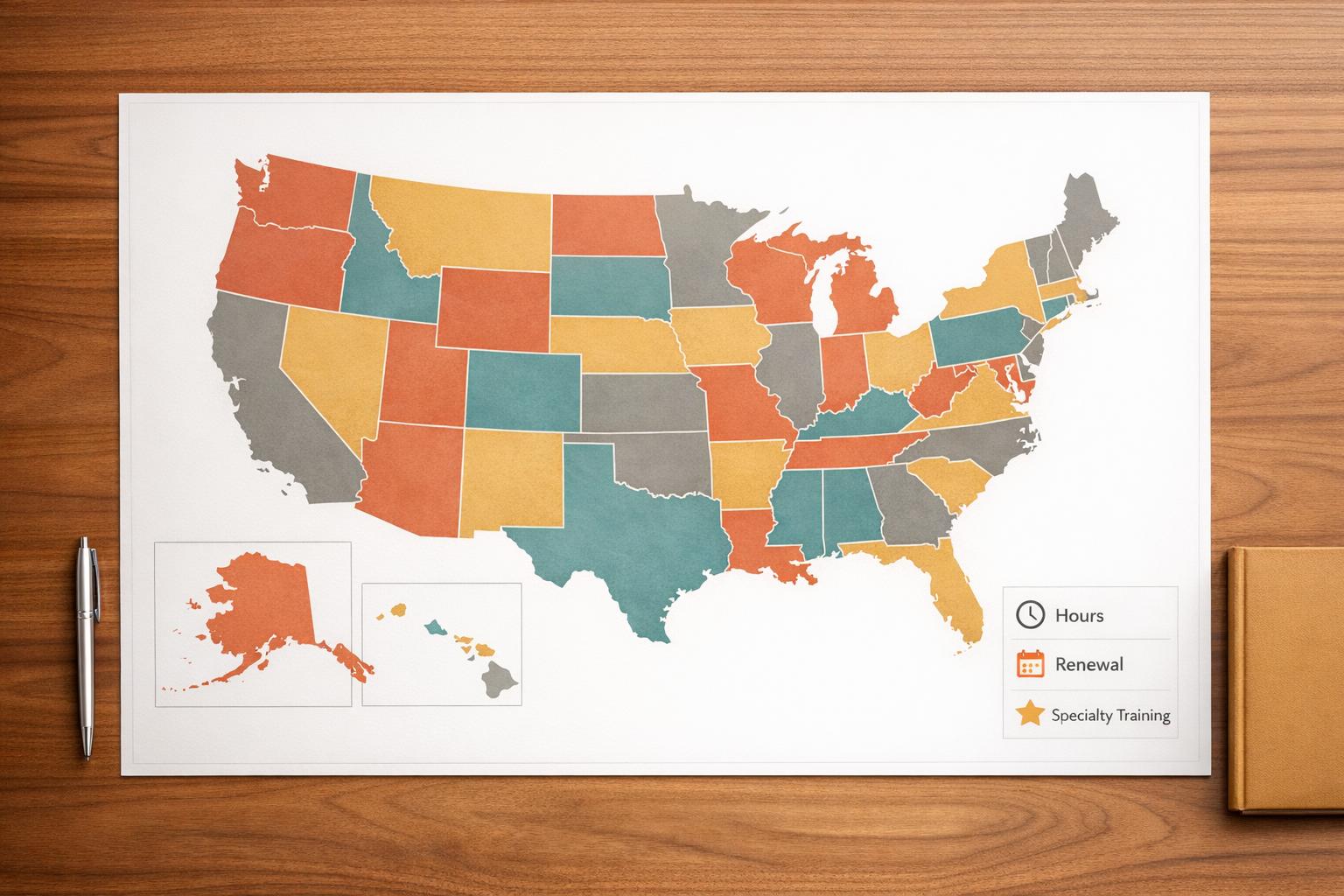

Continuing education (CE) requirements for aesthetic practitioners in the U.S. vary by state. Some states mandate CE hours for license renewal, while others don't require any. Here's a quick overview:
- States with CE requirements: Examples include Louisiana (16 hours annually), Florida (10 hours every two years), and Georgia (5 hours every two years).
- States without CE requirements: States like California, Connecticut, and Vermont don't require CE for basic esthetician license renewal.
- Specialized roles: Advanced practices like laser treatments or medical aesthetics often require additional training or certifications.
- Renewal cycles: Renewal periods typically range from 1 to 2 years, with fees varying by state.
Understanding your state's CE rules is crucial for maintaining your license and staying competitive in the field. Below, you'll find a detailed breakdown of requirements by state.

CE Requirements for Aesthetic Practitioners by State: Quick Reference Guide
1. Alabama
In Alabama, licensing for estheticians emphasizes thorough initial training over continuing education (CE) requirements after licensing.
The Alabama Board of Cosmetology and Barbering (ABOCB) does not mandate CE hours for renewing an esthetician license. Instead, the focus remains on comprehensive training and testing before obtaining a license.
To renew your license, you’ll need to complete the process every odd-numbered year by the end of your birth month. You can renew online through the ABOCB website or by mail. The renewal fee is $80, but if you miss the deadline, a $50 late fee will apply. If your license has been expired for over four years, reinstatement requires a practical exam along with payment of all back fees.
For initial licensing, you must complete either 1,000 clock hours at an accredited school or 2,000 hours through a certified apprenticeship. The apprenticeship must be under the supervision of an esthetician who has held a license for at least five consecutive years.
While CE isn’t required, taking advanced training in areas like chemical peels or micro-needling can help you stand out in the field. Be sure to keep records of any additional training, as licensing requirements may change in the future.
For the latest updates, visit the ABOCB website or reach out via email at [email protected].
sbb-itb-02f5876
2. Alaska
Alaska takes a unique stance on continuing education for aesthetic practitioners, adding to the diverse requirements across states. The Alaska Board of Barbers and Hairdressers does not require continuing education hours for esthetician license renewal. As BeautySchools.com notes, “There are no continuing education hours included in esthetics license requirements in AK”.
Esthetician licenses in Alaska expire on August 31 of odd-numbered years. Renewal is required every two years, with a fee of $180, processed through the Alaska Division of Corporations, Business and Professional Licensing. Since Alaska does not offer an inactive license status, it's crucial to renew your license even if you’re not actively practicing to avoid a lapse.
For medical practitioners holding a physician license, the Alaska State Medical Board has specific requirements. Physicians must complete at least two hours of education in pain management and opioid use and addiction every two years. However, exemptions are possible for those who can prove their practice does not involve pain management, opioid prescribing, or if they lack a valid DEA registration number.
Although continuing education isn’t a requirement for estheticians in Alaska, keeping up with advanced techniques and industry trends can help you maintain a competitive edge.
For further details or assistance, reach out to the Alaska Board of Barbers and Hairdressers via the Division of Corporations, Business and Professional Licensing.
3. Arizona
In Arizona, continuing education (CE) requirements vary depending on the professional role within the aesthetic industry. For standard aestheticians, license renewal occurs every two years, but there are no mandatory CE hours required for basic renewal.
Starting August 4, 2025, dentists and dental hygienists who administer Botox or dermal fillers must complete 12 CE hours within a three-year cycle. These hours count toward their overall CE requirements - 63 hours for dentists and 45 hours for dental hygienists. Importantly, these courses must be taken through Arizona State Board-approved providers, such as ADA CERP or AGD PACE. This rule applies even if the practitioner performs these procedures infrequently.
For those involved in laser procedures, the training requirements are more intensive. Aestheticians performing cosmetic laser or IPL treatments must undergo 40 hours of didactic training at a DHS-certified program, plus 24 hours of hands-on training specifically for hair removal. If performing additional cosmetic laser procedures, they need an extra 24 hours of hands-on training, covering at least 10 procedures. Before enrolling in any laser training, ensure the program is certified by the Arizona Department of Health Services (DHS) to guarantee the credits will be accepted.
The total licensing fee in Arizona is $247, which includes $177 paid to Professional Credential Services (PCS) and $70 to the Arizona Board of Cosmetology. Practitioners can check the status of any license using the "License Verification Look-Up Tool" available on the Arizona Barbering & Cosmetology Board's licensing portal.
For further assistance, contact the Arizona Barbering and Cosmetology Board for licensing matters, the DHS for laser certification questions, or the Arizona State Board of Dental Examiners for dental CE requirements.
4. Arkansas
In Arkansas, estheticians are not required to complete any continuing education (CE) hours to renew their licenses. Licenses must be renewed every two years, expiring on the licensee's birthday. The renewal fee is $50 and must be paid within 30 days of the expiration date. This lack of a CE requirement reflects the varied approaches taken by different states, with Arkansas leaving ongoing education up to individual practitioners.
Although CE credits aren't mandatory, many estheticians in Arkansas choose to pursue additional training to broaden their career prospects. For those looking to deepen their expertise, optional courses such as a 350-hour electrology program or business management and analytics training are available. However, since CE isn't required, the state does not provide specific guidelines for these optional programs.
If a license has been inactive for over five years, reinstatement requires submitting a new application and passing an examination. Arkansas also offers a lifetime license for practitioners who are at least 55 years old and have 20 or more years of active experience in cosmetology, whether through practicing or teaching.
For more information about license renewal or other regulations, you can reach out to the Arkansas Department of Health Cosmetology Section at 4815 West Markham, Slot 8, Little Rock, AR 72205.
5. California
In California, esthetician licensing separates basic practices from more advanced medical aesthetic procedures.
Estheticians in the state must complete 600 hours of training to obtain their license, which is valid for two years and requires a $50 renewal fee. However, there are no continuing education (CE) requirements for license renewal.
For advanced medical aesthetic procedures like Botox and dermal fillers, which are classified as medical treatments, non-physician injectors must work under the supervision of a licensed physician. These professionals are also required to undergo thorough, hands-on training specific to these treatments.
Dental professionals in California face specific CE requirements. Dentists must complete 50 CE units every two years, while dental assistants need 25 units within the same timeframe. Certain topics are mandatory, including Infection Control (2 units), the Dental Practice Act (2 units), and Basic Life Support (BLS). The BLS training must include an in-person skills session and test. Additionally, California recognizes CE providers approved by organizations such as the American Dental Association CERP and the Academy of General Dentistry PACE programs.
When it comes to dental CE courses, up to 50% of the required units can be completed through non-live instruction, but the remaining hours must involve live sessions. Furthermore, no more than 8 CE units can be earned in a single day.
Estheticians should stay informed about updates from the California Board of Barbering and Cosmetology, particularly regarding CE requirements. For example, Senate Bill 803 expanded the scope of practice to include services like dermaplaning and lash/brow perming. Practitioners offering these services need to ensure their liability insurance covers them.
6. Colorado
Colorado takes a unique approach compared to other states. For cosmetology or esthetician licenses, there are no continuing education (CE) requirements for the standard biennial renewal. All that's needed is to pay the $40 renewal fee every two years.
However, if you're looking to perform advanced procedures, specific training is mandatory. Here's a breakdown of the requirements:
- Chemical peels: 24 hours of coursework
- Microdermabrasion: 14 hours of coursework
- Permanent or semi-permanent makeup: 132 contact hours
"132 contact hours of training must be completed prior to a licensed cosmetologist or esthetician performing semi-permanent or permanent makeup." - Erica Roybal, Elite Aesthetics Academy
All advanced training must be completed at institutions approved by the Division of Private Occupational Schools (DPOS) or the Colorado Community College System (CCCS). Certificates must include the school's official seal, as the Director may request proof of training at any time. Training completed out-of-state is acceptable, but it must be considered "substantially equivalent" to Colorado's approved programs.
CE requirements only kick in if your license expires. If your license has been expired for two to five years, you’ll need to complete 16 hours of practice-related CE. For licenses expired more than five years, 24 hours of CE is required. Additionally, medical aesthetic services like Botox injections are regulated under Rule 800, which requires specialized training that includes both theoretical and hands-on components under physician supervision.
7. Connecticut
Connecticut has a structured yet varied approach to regulating aesthetic practitioners. For estheticians and eyelash technicians, there are no continuing education (CE) requirements, and license renewal happens every two years at a cost of $100. However, professionals in more specialized roles must meet additional CE standards.
Medical aesthetic practitioners holding an APRN license are required to complete 50 contact hours of CE every two years. This includes five hours focused on pharmacotherapeutics, along with at least one hour each in areas like risk management, sexual assault, domestic violence, substance abuse (including pain management), cultural competency, and diseases such as HIV/AIDS. Additionally, they must complete two hours on mental health conditions affecting veterans during their first renewal and then once every six years.
Electrologists face annual CE requirements of 10 contact hours, with at least two hours dedicated to infection control, sanitation, and sterilization. Managing these specialized supplies often requires robust inventory management systems to ensure compliance and safety. Approved courses can be taken through the American Electrology Association (AEA), its affiliates, board-approved electrology schools, hospitals, medical schools, or accredited academic institutions.
Interestingly, Connecticut did not require esthetician licensing until a 2019 law took effect in 2020. While CE isn't mandatory for estheticians and eyelash technicians, they are encouraged to pursue additional training and keep their certificates as proof of professional growth. Many practitioners store these credentials within their digital intake and provider profile systems for easy access during audits. This mix of requirements highlights the variety of CE standards across the country.
8. Delaware
Delaware keeps things simple when it comes to continuing education for beauty professionals. Estheticians, cosmetologists, and nail technicians are not required to complete any continuing education (CE) hours for license renewal.
For nursing professionals, though, the state has specific CE requirements based on credentials. Registered Nurses (RNs) must complete 30 contact hours every two years. Licensed Practical Nurses (LPNs) need 24 contact hours within the same time frame, with at least three hours focused on substance abuse education. Additionally, nurses must show proof of either 1,000 practice hours in the past five years or 400 hours in the past two years.
Physician Assistants are required to complete 100 hours of Continuing Medical Education (CME) every two years. This can be done by maintaining NCCPA certification or completing 50 hours of Category I and 50 hours of Category II CME. Meanwhile, Physicians (MD/DO) need 40 hours of CME during the same period, using AMA or AOA-approved Category I courses.
Once these CME requirements are met, practitioners use the DELPROS portal to handle license renewals. CE certificates should not be uploaded to DELPROS unless an audit is requested. In case of an audit, you’ll need to provide documentation including the course name, provider, dates, and hours. This process is part of Delaware’s overall license renewal system.
For beauty industry professionals, license renewal costs around $110 for a two-year cycle. If you miss the deadline, a 50% late fee is applied. Most cosmetology-related licenses expire on October 31st of even-numbered years, while nursing licenses follow separate renewal schedules. For those interested in enhancing their skills, there are optional training programs available.
9. Florida
Florida has set clear guidelines for continuing education (CE) requirements tailored to different license types in the aesthetics field. For registered facial specialists, the state mandates 10 board-approved CE hours every two years, with a renewal fee of $45 and an expiration date of October 31. Meanwhile, nurses working in medical aesthetics (RN, LPN, APRN) are required to complete 24 contact hours within the same period.
Facial specialists in Florida must cover specific topics during their CE courses, including HIV/AIDS education, OSHA regulations, workers' compensation, state and federal cosmetology laws, the chemical properties affecting hair, skin, and nails, and environmental considerations. Additionally, for initial licensure, applicants need to complete a board-approved HIV/AIDS course consisting of at least four credit hours.
"All continuing education courses must be completed from a Board of Cosmetology approved continuing education provider." – Florida Department of Business and Professional Regulation
To ensure compliance, practitioners should verify course and provider approval using the DBPR "Continuing Education Course Search" tool before enrolling. The Florida Board of Cosmetology, under the Department of Business and Professional Regulation, is the only body authorized to approve CE providers and courses. Missing CE requirements can result in the need to take a refresher course of up to 48 hours.
10. Georgia
Georgia's continuing education (CE) requirements offer a glimpse into how states tailor their standards to balance safety and professional growth. While modest in scope, these guidelines reflect a commitment to maintaining quality in the esthetics and beauty industry.
Licensed estheticians in Georgia must complete 5 hours of Board-approved continuing education every two years, with licenses expiring on August 31 of odd-numbered years. Cosmetic laser practitioners have a similar requirement: 5 contact hours every two years focused on laser services, equipment safety, procedures, and skin care techniques, with renewals due by the last day of their birth month. Esthetics instructors, on the other hand, must complete 15 hours per renewal cycle, with at least half of those hours centered on teaching methods and lesson planning.
The coursework is designed to be specific to each role. For estheticians, 3 of the required 5 hours must cover health and safety topics developed by the Technical College System of Georgia (TCSG), while the remaining 2 hours address other relevant subjects. This ensures that practitioners receive targeted training that aligns with their field of expertise.
"As of January 1, 2026, all Cosmetologists and Barbers licensed to practice in the state of Georgia will be required to: Register and report their continuing education coursework and submit proof of completion of continuing education experiences into CE Broker®." – Georgia State Board of Cosmetology and Barbers
Georgia offers flexibility in how CE can be completed. Formats include online courses, home study programs, and in-person events. However, all course providers must be registered with the Georgia State Board of Cosmetology and Barbers. Courses from organizations like the American Red Cross, the National Interstate Council of State Boards of Cosmetology (NIC), and the Professional Beauty Association (PBA) are generally accepted. For cosmetic laser practitioners, courses must be approved by the Accreditation Council for Continuing Medical Education (ACCME), the American Medical Association (AMA), or the Georgia Composite Medical Board.
Certain exemptions and waivers add further nuance to these requirements. Practitioners renewing their license for the first time are exempt from CE obligations. Additionally, those who have held a license for 25 years or more may apply for a waiver. The standard renewal fee is $50, but this doubles to $100 if renewed within the 30-day grace period. Cosmetic laser practitioners are also required to keep records of their CE attendance for at least 5 years.
Georgia's approach to continuing education ensures that professionals stay informed while offering enough flexibility to accommodate diverse learning preferences.
11. Hawaii
Hawaii keeps things simple when it comes to continuing education for estheticians and cosmetologists. There are no continuing education (CE) requirements to renew licenses. However, practitioners must still submit their renewal applications and fees every two years, with the deadline falling on December 31 of every odd-numbered year.
"Hawaii currently mandates no continuing education for non-medical aesthetic practitioners." – BeautySchools.com
This straightforward policy stands out compared to the varying CE requirements in other states. While CE isn’t mandatory, organizations like the National Coalition of Estheticians Association (NCEA) provide optional training resources for those looking to expand their skills. For initial licensure in Hawaii, candidates must either complete 600 hours of training at a licensed beauty school or accumulate 1,200 hours through a registered apprenticeship.
For medical professionals, the rules are a bit different. Registered Nurses (RNs) and Licensed Practical Nurses (LPNs) need to complete 30 contact hours of CE every two years. Advanced Practice Registered Nurses (APRNs) follow the same requirement but must include at least 8 hours in pharmacology if they have prescriptive authority. These CE hours can be earned through online courses, recorded lectures, or in-person workshops, including telehealth-based training for remote learners, with accreditation often provided by organizations like the American Nurses Credentialing Center or for AMA PRA Category 1 Credits™.
The renewal process for estheticians is relatively affordable, with a biennial fee of $171. Late renewals incur an additional $37 penalty. Practitioners can manage their renewals, check license statuses, and print pocket IDs through the eHawaii MyPVL online portal.
12. Idaho
Idaho takes a straightforward approach when it comes to continuing education for estheticians and cosmetologists: none is required for license renewal. This makes maintaining your license a simple and hassle-free process.
"Idaho doesn't require continuing education courses to renew your license." – Beauty Schools Directory
Licenses must be renewed annually on the original issue date through the Idaho Division of Occupational and Professional Licenses (DOPL) Online Services. The renewal fee is $25, and reminders are sent about six weeks before the due date.
Although continuing education isn’t mandatory, the Idaho Barber and Cosmetology Services Licensing Board encourages professionals to voluntarily seek further training. This is especially important as the industry evolves, with a projected 32% growth in esthetician jobs between 2022 and 2032 and a median annual salary of $41,230.
If your license expires, you’ll need to pay a $25 reinstatement fee and might have to provide additional documents, such as proof of continuing education, to get reinstated. Make sure to keep your contact details up-to-date to avoid missing renewal notices.
13. Illinois
Illinois has structured its continuing education (CE) requirements to align with recent regulatory changes. Estheticians in the state are required to complete 10 CE hours every two years, with licenses expiring on September 30 of odd-numbered years. The renewal fee is $50. For esthetics teachers, the requirement is 20 hours, including 10 focused on teaching methodology, with licenses expiring on September 30 of even-numbered years. Notably, CE requirements are waived for the first renewal after initial licensure.
"As of May 30, 2025, IDFPR issued a statewide variance allowing all continuing education hours to be completed fully online." – Beauty License Guide
This change eliminates the prior rule that required half of the CE hours to be completed in person, making it easier for professionals to meet their requirements.
Illinois mandates specific topics for CE, including one hour of sexual harassment prevention training with each renewal and one hour of domestic violence and sexual assault awareness training during the first renewal. Additionally, starting in August 2025, practitioners will need training to identify abnormal skin growths and refer clients to physicians. Courses must be provided by IDFPR-approved sponsors, and practitioners can verify approved courses through the CORE online system, which launched on October 30, 2024. It's important to keep completion certificates, as the Division conducts random audits.
These updates, including the fully online CE option and newly required topics, make Illinois a leader in simplifying compliance while addressing critical industry needs.
14. Indiana
Unlike many states that require continuing education (CE) for license renewal, Indiana takes a notably different approach. Estheticians in Indiana are not required to complete CE hours to maintain their licenses. Instead, they simply need to pay a $40 fee every four years and submit their renewal application before their license expires.
According to state regulations:
"The board shall renew a license if the license holder pays the fee established by the board under IC 25-1-8-2 to renew the license before the license is to expire." – IC 25-8-4-19
To obtain an initial license, estheticians must complete a state-approved 700-hour training program. The Indiana Professional Licensing Agency (IPLA) sends renewal reminders about 90 days before expiration, so it’s crucial to keep your contact information current. If your address changes, notify IPLA within 30 days to avoid missing important updates.
For licenses that have lapsed for over three years, the Indiana State Board of Cosmetology and Barber Examiners may require additional training or remediation, assessed on a case-by-case basis. If a license has been expired for five or more years, practitioners must pass the written licensing exam administered by PSI to regain their credentials.
Although not mandatory, many estheticians opt to pursue advanced training, such as learning new spa techniques, to stay competitive in the industry.
To simplify license tracking and manage your practice efficiently, you might want to check out Prospyr (https://prospyrmed.com), a platform tailored for aesthetics and wellness clinics.
15. Iowa
In Iowa, licensed practitioners must complete six hours of continuing education (CE) every two years. The renewal cycle runs from April 1 to March 31, and any unused hours cannot be carried over to the next period.
Out of the six required hours, four must focus on your specific practice area, while the remaining two hours must cover state law, rules, and sanitation/infection control. If you hold multiple active licenses, you’ll need to complete four hours for each discipline and an additional two hours on law and infection control.
You can choose to take CE courses online or in-person, giving you flexibility. However, Iowa does not pre-approve CE providers. It’s up to you to ensure your courses meet the state standards outlined in Iowa Administrative Code 481 - 944. Be sure to keep your certificates of completion for at least four years, as random audits are conducted after each renewal cycle.
For those offering advanced services, additional training is required. This includes 14 hours for microdermabrasion, 21 hours for chemical exfoliation, and 40 hours per laser or IPL device. Once certified, no further CE is needed for these advanced services.
If you’re renewing your license for the first time, you’re exempt from CE requirements during that initial renewal period. The renewal fee is $60, and there’s a $60 late fee if you renew within the 30-day grace period following expiration. Iowa’s CE structure emphasizes the importance of staying updated on both your practice discipline and regulatory standards in the ever-evolving aesthetics industry.
16. Kansas
Kansas has specific requirements for continuing education, depending on the type of license you hold. If you’re a standard esthetician, you don’t need to complete any continuing education hours to renew your license. However, instructors in esthetics or cosmetology must complete 20 hours of professional development every two years to maintain their license.
For professionals involved in cosmetic tattooing or body piercing, Kansas mandates 5 hours of continuing education every two years. These hours must align with the training curricula for your practice, focusing on areas like safety, infection control, and professional standards. According to Kan. Admin. Regs. § 69-15-12:
"Continuing education courses shall be of the same subject matter relating to the practice as the required curricula for training as a cosmetic tattoo artist, tattoo artist, and body piercer".
There are several ways to fulfill these requirements. You can attend board-approved instructional programs or earn up to one hour of credit by attending a Kansas Board of Cosmetology meeting (though participating in the public comment section doesn’t count). Each course must last at least one hour to qualify.
If you take a course that isn’t preapproved, you’ll need to submit a credit request. This request should include details like the location, date, times, subject description, and instructor qualifications. Make sure your certificate includes the program title, date, and the instructor’s signature.
To simplify the process, the Kansas Board of Cosmetology provides a list of preapproved courses and providers on their website. They also frequently update regulations, especially those related to infection control and training guidelines. Checking the "Important Updates" section on their website can help you stay on top of any changes.
17. Kentucky
Kentucky shapes its continuing education (CE) requirements based on the type of aesthetic practice and professional role, with rules varying by license type. Nurses working in aesthetics - whether you're an RN, LPN, or APRN - must complete 14 contact hours of approved CE annually. This earning period runs from November 1 through October 31 and applies across various settings, including aesthetic treatments, infusion therapy, or medical spas. APRNs have additional, more specific CE requirements layered on top of these general nursing standards.
For APRNs, 5 of the 14 annual CE hours must focus on pharmacology. If you hold CAPA-CS or DEA registration with a PDMP account, 3 of those hours must address pain management or addiction disorders. Starting January 1, 2025, APRNs authorized to certify medicinal cannabis use will need to complete an extra 3 contact hours annually on topics like diagnosing qualifying conditions and understanding cannabis pharmacology.
Kentucky also requires several one-time courses for nurses. Within three years of initial licensure, you’ll need to complete:
- 2 contact hours on suicide prevention.
- 1.5 contact hours on pediatric abusive head trauma (exempt if you graduated from a Kentucky program after December 2011).
- A 3-hour domestic violence course (exempt if you graduated from a Kentucky program after May 1998).
Additionally, all nurses licensed as of July 15, 2024, must complete 1 contact hour on Alzheimer's disease by October 31, 2027.
For professionals outside of nursing, Kentucky has different CE requirements. Estheticians and cosmetologists under the Kentucky Board of Cosmetology do not have CE mandates; they only need to complete an administrative renewal, which includes submitting an application, paying a fee, and providing an updated photo. On the other hand, dental professionals performing aesthetic injections must complete 30 CE hours every two years, with at least 10 hours in live, interactive formats. Those with sedation or anesthesia permits are required to complete an additional 4 hours of sedation-specific training in a classroom setting.
For LPNs working in aesthetics and performing infusion therapy, specialized training and competency validation are mandatory before practicing. To meet the 14-hour CE requirement, you can earn hours through various methods like maintaining national certification, completing college courses (1 semester hour equals 15 CE hours), or participating in a 120-hour preceptorship.
18. Louisiana
In Louisiana, estheticians must complete 16 hours of continuing education (CE) annually. At least 8 of these hours should focus on technical topics directly tied to esthetic practices. The rest should cover areas like sanitation, sterilization, Louisiana cosmetology law, and professional ethics. To ensure your CE credits count, confirm that your course provider is approved by the Louisiana State Board of Cosmetology. Use their searchable directory to verify approval before enrolling.
Nursing professionals in Louisiana have different CE requirements. Registered Nurses (RNs) need to complete 30 CE hours every two years or substitute this with 900 hours of practice. Nurse Practitioners (NPs), on the other hand, must complete 30 CE hours annually, but they can opt to substitute with 300 practice hours and 2 college credit hours in their specialty. Licensed Practical Nurses (LPNs) currently do not have CE requirements for license renewal.
For nurses involved in aesthetic procedures like Botox injections or laser treatments, the Louisiana State Board of Nursing (LSBN) mandates courses that include both classroom instruction and hands-on training. Nurse Practitioners performing cosmetic procedures must have national certification in their specialty and hold a valid Louisiana license free of disciplinary actions. However, RNs are prohibited from performing dermal filler procedures such as Restylane or Juvederm.
General nursing CE in Louisiana can be completed through various formats, including online courses and printed materials. However, aesthetic-specific training often requires in-person, hands-on learning to comply with LSBN standards. Be sure to maintain detailed records of your CE certificates, as state boards may audit your compliance months or even years after you complete a course.
19. Maine
Maine takes a straightforward approach when it comes to continuing education (CE) for aestheticians. Unlike many other states, Maine does not require CE for standard aesthetician license renewal. Some sources may claim a 14-hour biennial CE requirement, but this is inaccurate for standard licenses.
The license renewal process in Maine is also simple. Aesthetician licenses need to be renewed annually by October 31st, with a renewal fee of $40. However, there’s an exception for licensed instructors in aesthetics and cosmetology - they are required to complete 14 hours of CE every two years to maintain their teaching credentials.
It’s important for license holders to report any changes to their name, address, or email to the Office of Professional and Occupational Regulation (OPOR) within 10 calendar days. If you miss the October 31st renewal deadline, a 90-day grace period allows for late renewals, though you cannot legally work during this time. Keeping your contact information updated with OPOR is crucial to avoid complications.
Although CE isn’t mandatory for license renewal, many aestheticians voluntarily take courses to stay on top of emerging techniques, safety practices, and industry trends. These extra efforts can help professionals refine their skills and stay competitive in an ever-evolving field.
20. Maryland
Maryland has recently updated its continuing education (CE) requirements for licensed estheticians and cosmetologists, with changes taking effect on January 1, 2026. To renew a license, practitioners will need to complete six hours of board-approved CE courses.
The six-hour requirement is divided into two categories: two hours of mandatory topics - covering areas like health, safety, welfare, sanitation, or board laws and regulations - and four hours of elective topics, where professionals can choose subjects that align with their interests or career goals. Additionally, practitioners must complete a one-hour Domestic Violence Awareness training at the time of both initial licensure and renewal.
CE courses can be taken in various formats: in-person, online, or hybrid.
"Courses are offered virtually or in person. Some Providers offer both options".
For those opting for online courses, a computer is recommended to ensure the best experience with interactive course elements.
Only courses approved by the Maryland Board of Cosmetologists are accepted. The board provides a list of approved providers, which includes options like MHEC-approved private career schools, Maryland public or private accredited universities, Maryland community colleges, and cosmetology textbook publishers. For example, the MIAA Beauty Institute offers individual courses starting at $9.99, with a full six-hour CE bundle priced at $89.99. Most providers submit completion certificates directly to the board within 14 days, but some, like Milady Training, require licensees to handle the submission themselves.
CE certificates are valid for two years and must include an expiration date. It’s crucial to store these certificates securely, as the board may request proof of completion during the renewal process. If you hold multiple licenses, you’ll need to complete six hours of CE for each license type. These updates highlight the diverse CE requirements across the U.S. and Maryland's commitment to maintaining professional standards.
21. Massachusetts
Massachusetts stands out as one of the few states that does not require continuing education (CE) for estheticians or cosmetologists to renew their licenses. Instead, license renewal occurs every two years on the practitioner's birthday, with no mandatory CE courses involved.
To obtain an esthetician license initially, applicants must complete 600 hours of professional training at a Board-approved school and pass both written and practical exams. The state categorizes estheticians into two distinct license types: Type 7 (Operator License) for those with less than two years of experience and Type 6 (Manager License) for individuals with at least two years of professional experience.
While the state doesn't enforce CE requirements, professionals are encouraged to engage in advanced training to stay aligned with industry developments. For licensed nurses working in aesthetics, specialized clinical training can provide contact hours that count toward their nursing education requirements.
To check your license status or renewal date, use the Massachusetts ePLACE portal. Additionally, the Board's Policy on Distance Based Learning outlines acceptable educational formats for initial training. This straightforward licensing system highlights Massachusetts' simplified approach compared to other states.
22. Michigan
In Michigan, estheticians are not required to complete continuing education (CE) hours to renew their licenses. License renewal happens every two years through MiPLUS, where you’ll need to confirm your attestation and pay a $48 fee. Renewal reminders are typically sent out about 90 days before your license expires. If you miss the deadline, there’s a 60-day grace period, but it comes with a $20 late fee.
Although CE isn’t required, Michigan has recently increased its initial training requirements. Starting July 1, 2024, new trainees must complete 750 hours of training instead of the previous 400 hours. Jarrett Skorup, Vice President of Marketing and Communications at the Mackinac Center for Public Policy, commented on this change:
"Estheticians will go from 400 hours of mandatory training to 750 hours; a nearly 90% increase".
This adjustment ensures compliance with federal financial aid standards, which require alignment between state-mandated training hours and institutional programs.
For estheticians licensed before this change who perform hydrodermabrasion, documented training in accordance with Section 339.1210 is required. Additionally, only FDA-approved, noninvasive light therapies that don’t penetrate living skin are allowed, and all professionals must adhere to Michigan’s medical waste disposal regulations under Part 138.
To avoid complications, make sure your contact details in MiPLUS are current so you don’t miss renewal notifications. If your license lapses for more than 60 days but less than three years, you’ll need to pay an $83 relicensure fee. For lapses exceeding three years, you’ll have to retake the exams or show proof of an active license from another state.
23. Minnesota
If you're a licensed Esthetician or Advanced Practice Esthetician in Minnesota, you’ll need to complete 8 hours of continuing education (CE) every three years to renew your license. Licenses expire on the last day of your birth month, so it’s a good idea to plan your renewal in advance. The renewal fee is $75, which includes a $60 renewal fee and a $15 application fee.
Here’s how the required 8 hours are divided:
- 4-hour Core CE course: Includes 1 hour on state cosmetology laws and 3 hours on health, safety, and infection control.
- 4-hour Professional Practice CE course: Focuses on topics related to your scope of practice, such as product chemistry, machine use, business management, professional ethics, or clinical techniques. If you're an Eyelash Extension Technician, you only need to complete the Core CE course.
CE courses can be completed online or in person, as long as the provider is board-approved. Costs range from $35–$50 for the Core course, around $50 for Professional Practice, or approximately $80 for an 8-hour bundle. Keep in mind, salons are not allowed to offer Core CE courses, and Professional Practice courses must be attended in person.
Before enrolling, make sure your CE provider is board-approved, as approval is valid for one calendar year and must be renewed annually. The Minnesota Board of Cosmetologist Examiners regularly updates its list of approved providers on its website. Additionally, you’re required to keep proof of your CE credits for four years from the class date (one year beyond their expiration), as the Board conducts random audits. Lastly, no products can be marketed or sold during any CE class that counts toward your credit.
24. Mississippi
Mississippi stands out by not requiring continuing education (CE) for standard estheticians. Licenses in the state are renewed every two years for a fee of $50, ensuring you stay compliant.
For those aiming to advance their careers, Mississippi offers a Master Esthetician designation, which comes with its own CE requirements. To qualify, you need to hold an active Mississippi esthetician license for at least 12 consecutive months and complete 16 hours of Board-approved CE for the initial Master designation. After that, 8 hours of CE are required every two years to maintain the license. The renewal fee for the Master license is $70.
"This is an optional license and pertains only to individuals wishing to complete the continuing education requirement." - Mississippi Code § 73-7-14
CE courses must receive approval from the Mississippi State Board of Cosmetology and Barbering (MSBCB). Before enrolling, check their "Continuing Education Course Provider" list to ensure compliance. Online CE options are available through providers listed on the MSBCB website, offering 24/7 access via computer or mobile device. When attending a CE session, use your Board-issued registration number to sign in and track your CE hours.
Licensed instructors in Mississippi have more extensive CE requirements. They need to complete 24 hours of Continuing Education for Instructors/Teachers (CEIT) every two years, with at least 5 of those hours coming from a mandatory Board-approved "methods of teaching" seminar. The instructor license renewal fee is $80, though practitioners aged 70 and older are exempt from renewal fees.
25. Missouri
Missouri keeps its continuing education (CE) requirements for estheticians simple - there aren’t any! To renew your license, all you need to do is pay a $30 fee every two years.
Esthetician licenses in Missouri expire on September 30 of odd-numbered years, such as 2025 or 2027. Make sure your renewal application is postmarked by the expiration date. If you miss it, you’ll have to go through the reinstatement process.
For instructor licenses, the rules are a bit stricter. Instructors must complete 8 hours of board-approved CE within the two years before renewal. These hours should focus on teaching methods in cosmetology or barbering and can include interactive virtual programs. Don’t forget to keep your certificates of attendance handy, as they’ll need to be submitted with your renewal application.
While CE isn’t required for standard estheticians, the Missouri Board of Cosmetology and Barber Examiners manages all licensing and renewal processes. For those who want to stay updated on industry trends, voluntary education options are available.
| License Type | Renewal Frequency | CE Hours Required | Renewal Fee | Expiration Date |
|---|---|---|---|---|
| Standard Esthetician | Biannual | None | $30 | September 30 (odd years) |
| Instructor | Biannual | 8 hours | Not specified | September 30 (odd years) |
26. Montana
Montana keeps it simple for estheticians - there are no continuing education (CE) requirements to renew a standard license. All you need to do is pay your renewal fee and focus on running your practice without worrying about CE hours. For more tips on managing your business, check out the Prospyr Blog.
That said, there are exceptions for specific roles. Esthetics instructors must complete 30 hours of CE during each biennial renewal period. According to the Montana Board of Barbers and Cosmetologists:
"Only teachers have continuing education requirements. The board does not pre-approve continuing education".
This means instructors are responsible for finding their own courses, as the board doesn’t provide a pre-approved list.
If you’re a medical aesthetic practitioner working under an RN, LPN, or APRN license, you’re also off the hook. The Montana Board of Nursing eliminated all CE requirements for these licenses effective November 18, 2023. Previously, nurses needed 24 contact hours for renewal, but that’s no longer a requirement.
For standard estheticians, the renewal fee is $85 per period. Make sure your email address is current with the Department of Labor and Industry, as they’ll send renewal notifications and updates electronically. Additionally, services like permanent makeup or microblading fall under the Department of Public Health and Human Services instead of the Board of Barbers and Cosmetologists.
| License Type | CE Hours Required | Renewal Fee | Board Pre-Approval |
|---|---|---|---|
| Standard Esthetician | None | $85 | N/A |
| Esthetics Instructor | 30 hours (biennial) | Not specified | No |
| RN/LPN/APRN (Medical Aesthetics) | None (as of Nov 18, 2023) | Not specified | N/A |
27. Nebraska
Nebraska's continuing education (CE) requirements highlight the varied and specific guidelines professionals must follow across states. For actively licensed estheticians and electrologists, the state mandates 8 hours of CE every 24 months before their license expires.
Of those 8 hours, at least 4 hours must focus on your specialized field - whether esthetics or electrology. The remaining hours can cover approved topics like CPR/First Aid, ethics, product knowledge, marketing, business finance, or sanitation and safety. Alternatively, all 8 hours can be completed within your specific area of practice.
For esthetic instructors, the requirements are more extensive. They must complete an additional 4 hours in teaching methodology - covering areas such as lesson planning, teaching styles, test development, or multimedia technology - bringing their total to 12 hours. If all 12 hours are focused on teaching-related topics, instructors are exempt from the separate 8-hour practitioner requirement.
Nebraska allows flexibility in how CE hours are earned. Approved formats include classroom instruction, online courses, in-service programs, home study, and even videotapes. To qualify, programs must last at least 60 minutes, have a clear agenda, be led by qualified instructors, and include a way to verify attendance. For instance, completing the Nebraska Jurisprudence Examination counts as 2 hours of CE credit.
After completing a program, it’s crucial to keep proper documentation. Certificates should include the provider's information, date, location, total hours, your name, and license number. Renewal deadlines vary based on your license type: estheticians must renew by September 30 of even-numbered years, while electrologists renew by July 31 of odd-numbered years. Late renewals are costly, with penalties of $10 per day, up to $1,000.
| License Type | Total CE Hours (24 Months) | Mandatory Category Hours | Expiration Date |
|---|---|---|---|
| Esthetician | 8 Hours | At least 4 Hours | September 30 (Even-numbered years) |
| Esthetic Instructor | 12 Hours | At least 4 Hours | September 30 (Even-numbered years) |
| Electrologist | 8 Hours | At least 4 Hours | July 31 (Odd-numbered years) |
| Electrology Instructor | 12 Hours | At least 4 Hours | July 31 (Odd-numbered years) |
28. Nevada
Nevada structures its continuing education (CE) requirements based on the roles of beauty professionals. For standard estheticians, the requirement is straightforward: they need to complete just 4 hours of infection control training every two years. However, instructors face much more demanding CE expectations, reflecting the advanced nature of their responsibilities.
Instructors must complete 30 hours for a 2-year renewal or 60 hours for a 4-year term. These hours must focus on board-approved topics, including science, health, business, and advanced teaching methods. Additionally, instructors who teach advanced esthetics can earn credit by completing a board-approved laser safety officer training course.
CE courses in Nevada are flexible and can be taken online, in person, or through hybrid formats. However, it’s essential to verify that the course is listed on the Nevada State Board of Cosmetology's approved CEU Provider List before enrolling. This ensures the course meets state standards.
Nevada also has specific rules regarding license expiration and renewal. Licenses expire on the last day of the licensee’s birthday month at the end of their 2- or 4-year term. The state sends email reminders starting three months before expiration. Late renewals incur a $20 monthly penalty, and renewal applications must include a passport-quality photo taken within the last 90 days (free of filters, hats, or sunglasses).
| License Type | Renewal Period | CE Hours Required | Renewal Fee |
|---|---|---|---|
| Esthetician | 2 Years | 4 Hours (Infection Control) | $70 |
| Esthetician | 4 Years | 4 Hours (Infection Control) | $140 |
| Instructor | 2 Years | 30 Hours | $70 |
| Instructor | 4 Years | 60 Hours | $140 |
29. New Hampshire
In New Hampshire, standard estheticians are not required to complete any continuing education (CE) hours. After finishing the mandatory 600-hour training and earning your license, there are no additional CE requirements for maintaining it.
For licensed instructors, however, the rules are different. They must complete 28 hours of continuing education during each two-year renewal cycle. This reflects their critical role in educating and preparing future estheticians.
If you’re interested in offering advanced treatments - like microdermabrasion, chemical exfoliation, lymphatic drainage massage, light therapy, or radiofrequency procedures - additional training is necessary. These specialized certifications are essential for safely performing such services, though they don’t count toward CE hours.
To renew your license, you’ll need to submit an application, a questionnaire, and a government-issued photo ID to the New Hampshire Office of Professional Licensure and Certification (OPLC). The renewal fee is $50, and licenses expire on the last day of your birth month in odd-numbered years.
| Practitioner Type | CE Hours Required | Renewal Cycle | Renewal Fee |
|---|---|---|---|
| Esthetician | 0 hours | 2 years | $50 |
| Instructor | 28 hours | 2 years | $50 |
New Hampshire's straightforward approach to licensing requirements makes it less complex compared to many other states. Be sure to check the OPLC website regularly for any updates or changes to the regulations.
30. New Jersey
New Jersey takes a unique approach when it comes to continuing education (CE) for beauty professionals. The state does not require CE hours for estheticians, cosmetologists, nail technicians, or barbers. Instead, licenses are renewed every two years during even-numbered years.
Whether you're offering facials as an esthetician, delivering a full range of beauty services as a cosmetologist, styling hair as a barber, or focusing on nails, the process is straightforward: renew your license every two years to maintain its validity. No additional CE hours are mandated to stay licensed.
That said, the New Jersey State Board of Cosmetology and Hairstyling strongly encourages professionals to voluntarily pursue further education. Keeping up with the latest industry trends, safety measures, and advanced techniques - like microchanneling or chemical treatments - can help you stay competitive and ensure your clients receive top-notch services, even if it's not a legal requirement.
If you're aiming to work as a makeup artist in a salon, it's important to note that New Jersey doesn't offer a separate makeup artist license. To perform makeup services professionally, you must hold either a cosmetology and hairstyling license or an esthetician license.
| Practitioner Type | CE Hours Required | Renewal Cycle | Regulatory Body |
|---|---|---|---|
| Esthetician | 0 hours | Every 2 years (Even years) | NJ State Board of Cosmetology and Hairstyling |
| Cosmetologist | 0 hours | Every 2 years (Even years) | NJ State Board of Cosmetology and Hairstyling |
| Nail Technician | 0 hours | Every 2 years (Even years) | NJ State Board of Cosmetology and Hairstyling |
| Barber | 0 hours | Every 2 years (Even years) | NJ State Board of Cosmetology and Hairstyling |
This simplified renewal process sets New Jersey apart from many other states with stricter requirements. However, regulations can change, so it’s a good idea to stay updated. For the latest information, contact the New Jersey State Board of Cosmetology and Hairstyling at [email protected] or by mail at P.O. Box 45003, Newark, NJ 07101.
31. New Mexico
New Mexico has adjusted its approach to continuing education (CE) for estheticians and cosmetologists, reflecting broader trends across the U.S. As of August 29, 2023, the state’s Board repealed the mandatory CE requirement for these professionals. This means standard estheticians and cosmetologists are no longer obligated to complete CE hours for license renewal. However, the Board still upholds standards for approved providers, ensuring quality options for those pursuing voluntary education or advanced certifications. While this simplifies licensure for many, some specialized roles still require stricter compliance.
Permanent cosmetics practitioners must meet specific annual requirements, including board-approved blood-borne pathogens (BBP) training and maintaining current CPR and First Aid certifications. While the theoretical portion of CPR training can be done online, hands-on supervised practice remains mandatory.
For aesthetic nurses (RN/APRN), no additional CE hours are required for licensure. However, certifications like the Medical Esthetics Practitioner Certified (MEP-C) often demanded by employers involve 16 hours of initial training - 8 hours each in neurotoxins and dermal fillers. The certification costs $300 initially, with a $175 renewal fee. Additionally, Registered Nurses must complete 30 hours of approved CE every two years for license renewal.
Dentists performing aesthetic procedures such as Botox or dermal filler treatments are required to complete at least 16 CE hours, with 8 hours being live, hands-on training. These sessions cover key areas like patient assessment, contraindications, and adverse reaction management.
New Mexico recognizes several CE providers automatically, including Cosmetology Educators of America (CEA), American Aesthetics Education Association (AAEA), Aveda Institute, and Milady/Thomson Learning's Career Institute. CE credits can also be earned through online programs or trade shows, though trade show attendance is capped at six hours or 50% of the annual requirement, with proof of participation required .
32. New York
New York has a straightforward renewal process but maintains strict standards for initial licensing. A unique aspect of the state’s approach is that continuing education (CE) credits are not required for license renewal. Instead, licenses are valid for a four-year term, making the process less burdensome for professionals once they are licensed.
For first-time applicants, however, there is a mandatory requirement: completing a one-time, 1-hour course on Domestic Violence and Sexual Assault Awareness. This rule, in place since June 17, 2020, must be fulfilled before submitting an initial license application.
The path to initial licensure is demanding. Estheticians must complete 600 hours of approved training, while cosmetologists need 1,000 hours. In addition, all applicants must pass both written and practical exams, achieving a minimum score of 70% to qualify.
Renewing a license is simple and can be done through online scheduling via New York's Appearance Enhancement and Barber Licensing System. Renewal is allowed up to three months before the license expires. The cost is $40 every four years, but if you miss the deadline, a $50 late fee applies. Importantly, if a license is not renewed within five years of expiration, practitioners will need to retake the written exam to regain eligibility.
Educational institutions offering training in appearance enhancement must either be licensed by the Bureau of Proprietary School Supervision (BPSS) or approved by the New York State Board of Regents. This ensures their programs meet state requirements. Though New York doesn’t require continuing education, many professionals voluntarily pursue additional training to stay competitive and grow their careers.
33. North Carolina
In North Carolina, estheticians are required to complete 8 hours of board-approved continuing education (CE) annually to maintain their licenses. Licenses must be renewed by October 1, with a renewal fee of $20, which includes a $10 license fee and a $10 processing fee. This flexible requirement accommodates various learning methods to suit individual preferences.
The Board does not pre-approve specific CE providers or courses, giving professionals the freedom to choose their educational paths. Approved learning formats include online courses, correspondence programs, hands-on workshops, educational videos, tutorials, and even learning directly from other professionals.
Half of the required CE hours must focus on expanding knowledge of the cosmetic art profession. For Esthetics Instructors, this includes dedicating at least 50% of their hours to teacher training or communication skills. As noted by the Board:
"At least 50% of your CE must broaden your knowledge of the cosmetic art profession" (North Carolina Board of Cosmetic Art Examiners)
Practitioners must keep detailed records of their CE activities, including course titles, descriptions, dates, locations or URLs, and total hours. Additionally, they must sign an affirmation of completion and retain certificates for at least three years, as the Board verifies compliance through audits.
Certain exemptions apply: professionals aged 60 or older with 10 consecutive years of active practice are not required to complete CE. The Board also offers free CE classes on their website, allowing practitioners to meet their annual requirements at no cost. For those returning from inactive status, the Board requires between 8 and 24 hours of CE, depending on the circumstances.
34. North Dakota
North Dakota is updating its continuing education (CE) requirements for estheticians and cosmetologists. Currently, professionals can renew their licenses annually by December 31 without needing any CE hours. But starting with the 2028 renewal cycle, all license holders must complete four hours of Board-approved CE each year. Here's what you need to know about the changes.
Professionals have flexible options for earning these credits. CE hours can be completed either in-person or online, with courses focusing on topics like safety protocols, regulatory updates, and new treatment techniques. Additionally, attending trade shows may count for up to one hour of CE credit.
To help track CE compliance, North Dakota uses CE Broker as its official tracking system. Practitioners can create a free basic account at cebroker.com/nd/account/basic/. Courses marked with the "Take it Here" tag are automatically reported to both the practitioner's account and the State Board.
The annual renewal fee is $15. Late renewals come with penalties: $50 for missing the deadline and $150 if the license remains unrenewed for up to five years.
In addition to CE changes, North Dakota is also introducing a new Advanced Esthetician license. This license requires a 1,100-hour curriculum for advanced services like microneedling and advanced chemical peels. Estheticians licensed before January 1, 2025, can apply for the advanced license by December 31, 2027, without needing the extra 500 hours of advanced schooling usually required.
FAQs
How do I confirm my state’s CE rules are current?
To stay current with your state's Continuing Education (CE) requirements, reach out to your state licensing board or check their official website. These sources offer the most reliable and up-to-date information for aesthetic practitioners.
What training is needed for lasers, peels, or microneedling?
Training requirements for lasers, chemical peels, and microneedling can differ significantly depending on the state, but they usually involve a mix of classroom learning and hands-on practice.
For laser procedures, estheticians or cosmetologists often need about 40 hours of coursework, along with supervised training to ensure they can safely and effectively operate the equipment. When it comes to chemical peels or microneedling, additional certifications or specialized programs may be required - especially for devices that are FDA-registered. Each state sets its own rules regarding the number of training hours, the level of supervision needed, and which programs are officially approved.
What happens if I renew late or my license expires?
If your license expires or you renew it late, you could encounter penalties such as suspension, fines, or the need to go through a reinstatement process. This process often requires you to submit specific documents, complete refresher training - especially if the lapse has been lengthy - and pay any required fees. It's crucial to review your state’s exact requirements to steer clear of unnecessary complications.