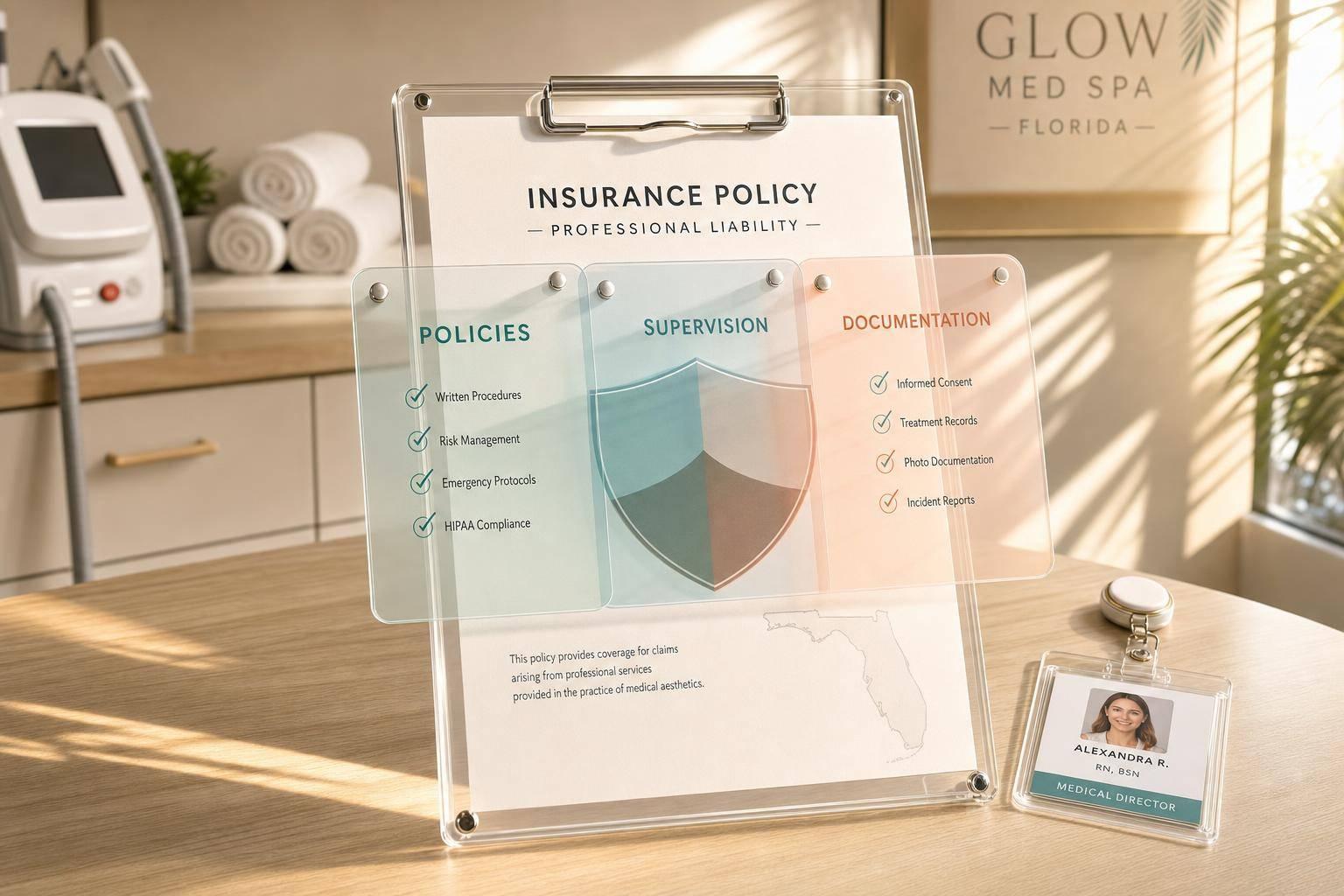

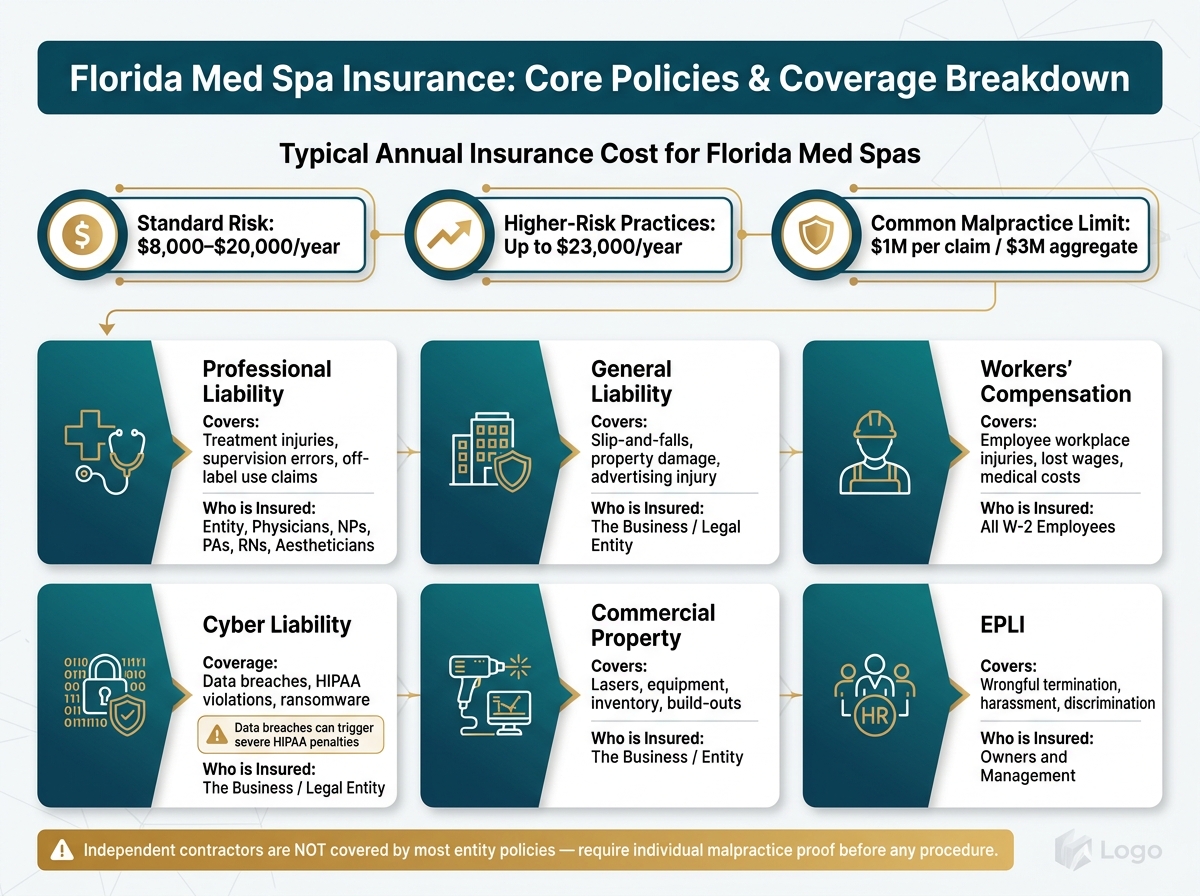
If I run a med spa in Florida, I should assume I need more than one liability policy. In most cases, I’m looking at professional liability, general liability, workers’ comp if I have employees, and often cyber coverage too. For many Florida med spas, total annual insurance cost lands around $8,000 to $20,000+, with some higher-risk setups reaching about $23,000.
Here’s the short version:
- Florida does not set one required med spa insurance package, but contracts, landlords, medical directors, and claim risk often make coverage a must.
- If I offer services like Botox, fillers, lasers, microneedling, PRP, or IV therapy, I’m no longer dealing with a simple spa risk profile.
- General liability and malpractice do different jobs. Slip-and-fall claims are one thing. Treatment injury and supervision claims are another.
- Entity coverage alone is not enough. Owners, medical directors, physicians, NPs, PAs, RNs, and some contractors may each need their own protection.
- Independent contractors are a common gap. Many business policies do not cover them.
- A common malpractice starting point is $1,000,000 per claim / $3,000,000 aggregate, but higher-risk services may need a closer review.
- If I add a new treatment or device and do not tell the carrier, I can end up with a claim that is not covered.
A few facts matter most here: who owns the business, who supervises care, who performs each service, and whether my policy matches that setup today.
| Topic | What I need to check |
|---|---|
| Services | Botox, fillers, lasers, IV therapy, GLP-1, PRP, microneedling |
| People | Entity, medical director, treating staff, contractors |
| Main policies | Professional liability, general liability, workers’ comp, cyber, property, EPLI |
| Common weak spots | Negligent supervision, off-label use, missing contractor coverage, undisclosed services |
| Trigger for policy review | New staff, new device, new treatment, new data system |
If I want the short answer, it’s this: Florida med spa insurance works only when coverage, supervision, contracts, and records all match how the practice runs each day.
Florida rules that shape med spa liability
Medical practice, nursing, and clinic licensure rules
When a Florida med spa starts offering medical aesthetic services, three sets of rules shape liability: medical practice rules, nursing delegation rules, and clinic licensure rules. Before opening a new location or adding services, owners need to line up their service menu, ownership setup, and supervision model with Florida requirements.
This isn't just a paperwork issue. It's about how the business runs day to day. Carriers also look at whether each person performing procedures - including physicians, nurse practitioners, physician assistants, and registered nurses - is covered by an individual or entity malpractice policy. That review becomes especially important when a provider performs treatment directly or hands off part of that treatment to someone else.
Supervision, delegation, and high-risk procedure oversight
In Florida med spas, physician supervision is at the center of liability. Malpractice coverage applies to treatment injuries and negligent supervision, while general liability does not. That gap matters. If the policy setup doesn't match what happens in the treatment room, the owner can end up exposed.
Higher-risk services can also lead to tighter underwriting and higher premiums. So each service should fit the supervision model in place, and the malpractice policy should line up with the treatments the med spa actually offers. Put simply, insurance terms need to match the real-world setup for services, delegation, and supervision.
sbb-itb-02f5876
Who needs coverage and which policies matter most
Florida Med Spa Insurance: Core Policies, Costs & Coverage Breakdown
Once supervision is in place, the next step is figuring out who needs insurance and which policy handles which risk.
Owners, medical directors, physicians, and clinical staff
Coverage should apply to both the business and each person who treats patients. The entity needs protection for claims tied to the premises and for mistakes made by staff. At the same time, every practitioner who provides treatment should have individual coverage on top of the entity policy.
That group includes physicians, medical directors, nurse practitioners, physician assistants, registered nurses, and aestheticians who perform delegated medical tasks. Medical directors and supervising physicians also need protection for claims tied to negligent supervision and off-label use.
That divide, entity coverage on one side and individual coverage on the other, shapes the rest of the insurance setup.
One common weak spot is independent contractors. Many entity policies do not cover them. So if you use contractors, require each one to carry their own malpractice insurance and show proof of coverage before they perform any procedure.
Core policies for a Florida med spa
Florida med spas usually need a layered insurance program, not just one policy. Each policy handles a different type of risk. And when there’s a gap between policies, that’s often where costs start to climb.
| Policy Type | What It Covers | Who Is Typically Insured |
|---|---|---|
| Professional Liability | Treatment injuries and supervision errors | Entity, Physicians, NPs, PAs, RNs, Aestheticians |
| General Liability | Slip-and-falls, property damage, advertising injury | The Business / Legal Entity |
| Workers' Compensation | Employee workplace injuries, lost wages, medical costs | All W-2 Employees |
| Cyber Liability | Data breaches, HIPAA violations, ransomware | The Business / Legal Entity |
| Commercial Property | Lasers, equipment, inventory, build-outs | The Business / Entity |
| EPLI | Wrongful termination, harassment, discrimination | Owners and Management |
When limits and endorsements need a closer look
Policy limits deserve a closer review when a med spa offers higher-risk services. Typical malpractice limits for a med spa entity are $1,000,000 per claim and $3,000,000 aggregate. But those figures may not be enough if your menu includes deep lasers, IV therapy, or GLP-1 treatments. Those services tend to draw more underwriting scrutiny and bring more exposure.
Exclusions matter just as much as the dollar limits. Review whether your professional liability policy responds to consent-related claims. Also check if off-label device or product use is covered or excluded. If you sell products, make sure your general liability policy includes a product liability endorsement.
Lease terms can add one more hurdle. Many Florida landlords want a certificate of insurance that shows general liability coverage, along with an additional insured endorsement, before the lease is signed. Give your broker a full list of every service you offer. If you add treatments after the policy is issued and don’t tell the carrier, you can end up with coverage gaps for those procedures.
From there, liability depends on how the owner and medical director split clinical control.
Owner and medical director liability in practice
How responsibility is split between the business and the physician
After you sort out coverage, the next issue is simple: who gets sued when a claim begins.
In a Florida med spa, liability often splits between clinical oversight and day-to-day business operations. The medical director is usually exposed for supervision problems, protocol failures, improper delegation, and off-label device or product use. The business owner is usually exposed on the operations side, including staffing, training, marketing, premises safety, and patient data protection. That means one patient injury can trigger claims against both sides.
| Responsibility Area | Primary Party |
|---|---|
| Clinical oversight & supervision | Medical Director |
| Patient treatment injuries | Practitioner & Entity |
| Slip-and-fall risk | Business Owner / Entity |
| Hiring, firing & staffing | Business Owner |
| Privacy and data-breach claims | Business Entity |
| Product reactions (retail sales) | Business Entity |
Contracts, protocols, and documentation that reduce exposure
Put each role in writing before anything goes wrong. A medical director agreement should clearly state which procedures are supervised, where delegation stops, and what oversight is expected. Written delegation rules help turn legal duties into daily routines.
The same goes for documentation. Delegation protocols, informed consent forms, treatment records, and staff training logs can help show who was responsible and whether reasonable care was taken. If the practice uses independent contractors, their agreements should also require them to carry their own malpractice coverage. Defense and settlement costs can be substantial, so missing records can make a claim much harder to fight.
Written protocols only help if the practice can produce them quickly.
Using systems to support defensible operations
A HIPAA-compliant platform like Prospyr puts intake forms, EMR and CRM records, AI-assisted notes, communication logs, and task management in one place. That can make it easier to show that protocols were followed and that oversight was in place. It also makes annual insurance and supervision reviews easier to defend.
Building a Florida-compliant insurance and risk program
Review your ownership model, services, and supervision setup
Start with the basics your insurer will look at. Use the liability split above to check the facts tied to your ownership model, staffing, and supervision setup. Make sure clinical staff are classified the right way, and require independent contractors to carry their own malpractice coverage. The agreement should also match what the medical director is actually doing in practice, not just what the paperwork says.
Next, review your service menu line by line. Tell your carrier about every treatment you offer, especially higher-risk lasers or GLP-1 services. If you add a new device or launch a new service and your policy doesn’t reflect it, you can end up with a coverage gap. That’s the kind of problem that tends to show up at the worst time.
It also helps to compare your written supervision and delegation documents with daily operations. Do standing orders and protocols match the treatments staff perform each day? They need to. When the written protocol and day-to-day care drift apart, negligent supervision exposure goes up. And if the protocol on paper doesn’t match what happened in the room, the policy may not protect the claim.
Match policies, workflows, and annual reviews to current risk
Once your structure is clear, your coverage should match the services, staff, and systems now in place. In Florida, risk can shift fast, so your insurance can’t sit still. Your coverage mix will often cost $8,000 to $20,000 per year in Florida, with totals reaching $23,000 for higher-risk practices. Those costs tend to climb when you add providers, equipment, or new services.
A formal review should happen any time something material changes. That includes staffing, devices, treatment types, or the way patient data is handled. A few checks matter most:
- For new providers, confirm individual malpractice coverage is active before the first treatment.
- For new devices, update your commercial property valuation and make sure the service is disclosed to your malpractice carrier.
- For data security, confirm your cyber liability policy matches your current patient record and scheduling setup, since data breaches can trigger severe HIPAA penalties.
This keeps your insurance tied to how the practice runs each day, instead of old policy assumptions that no longer fit.
Conclusion: Key points Florida med spas should remember
Owners and medical directors face different risks, but those risks are closely linked. Strong documentation, current protocols, and organized systems make the practice easier to defend and insure. Clean records and current supervision agreements are what protect the business when claims arise. In Florida, the safest med spas treat insurance, delegation, and documentation as one connected system.
FAQs
Do I need separate malpractice coverage for each provider?
Yes. In Florida, every licensed professional who performs medical procedures should carry their own malpractice insurance.
Depending only on the practice’s policy or a supervising physician’s coverage can leave both the provider and the business exposed. A separate policy for each person helps close coverage gaps that could put a professional license - and the practice itself - at risk.
When should I update my med spa insurance policy?
Review and update your policy once a year. You should also revise it any time there’s a major change in how your business runs.
Common reasons to update it include:
- adding new treatments or products
- bringing on new staff or independent contractors
- renewing your facility license, ideally at least 60 days ahead
What services make a Florida med spa higher risk?
In Florida, med spa services move into a higher-risk category when they include medical-grade procedures such as:
- Injectables like Botox and dermal fillers
- Laser treatments
- Microneedling
- Body contouring
Chemical peels above 30% strength and CO2 laser procedures also fall into that group.
Why does that matter? These treatments carry a higher chance of complications. Because of that, they often call for higher professional liability coverage limits.