
If your New York med spa is set up wrong, insurance may not respond when you need it most. The short version: the medical side should sit in a PC or PLLC owned by New York-licensed physicians, your policies should name the right parties, and your coverage should match every treatment you offer.
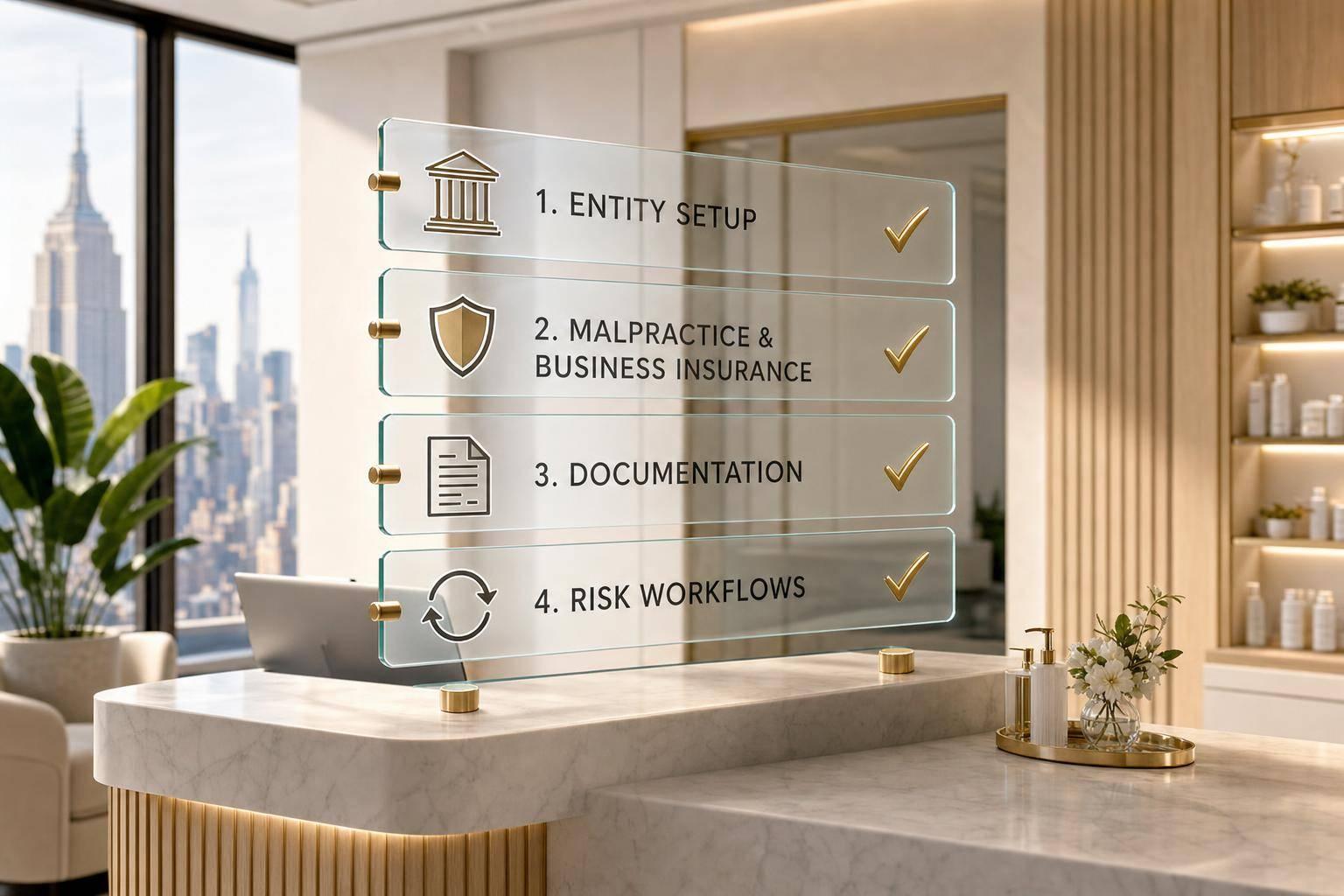
I’d boil this article down to four checks:
- Set up the business the right way. In New York, medical services at a med spa are treated like medical care, not spa services. That affects ownership, licensing, and who can control care.
- Match insurance to the work. Entity coverage, individual malpractice, general liability, workers’ comp, DBL, PFL, cyber, and EPLI each cover different risks.
- Watch for gaps. Claims-made terms, retro dates, tail coverage, excluded services, and contractor issues can leave you exposed.
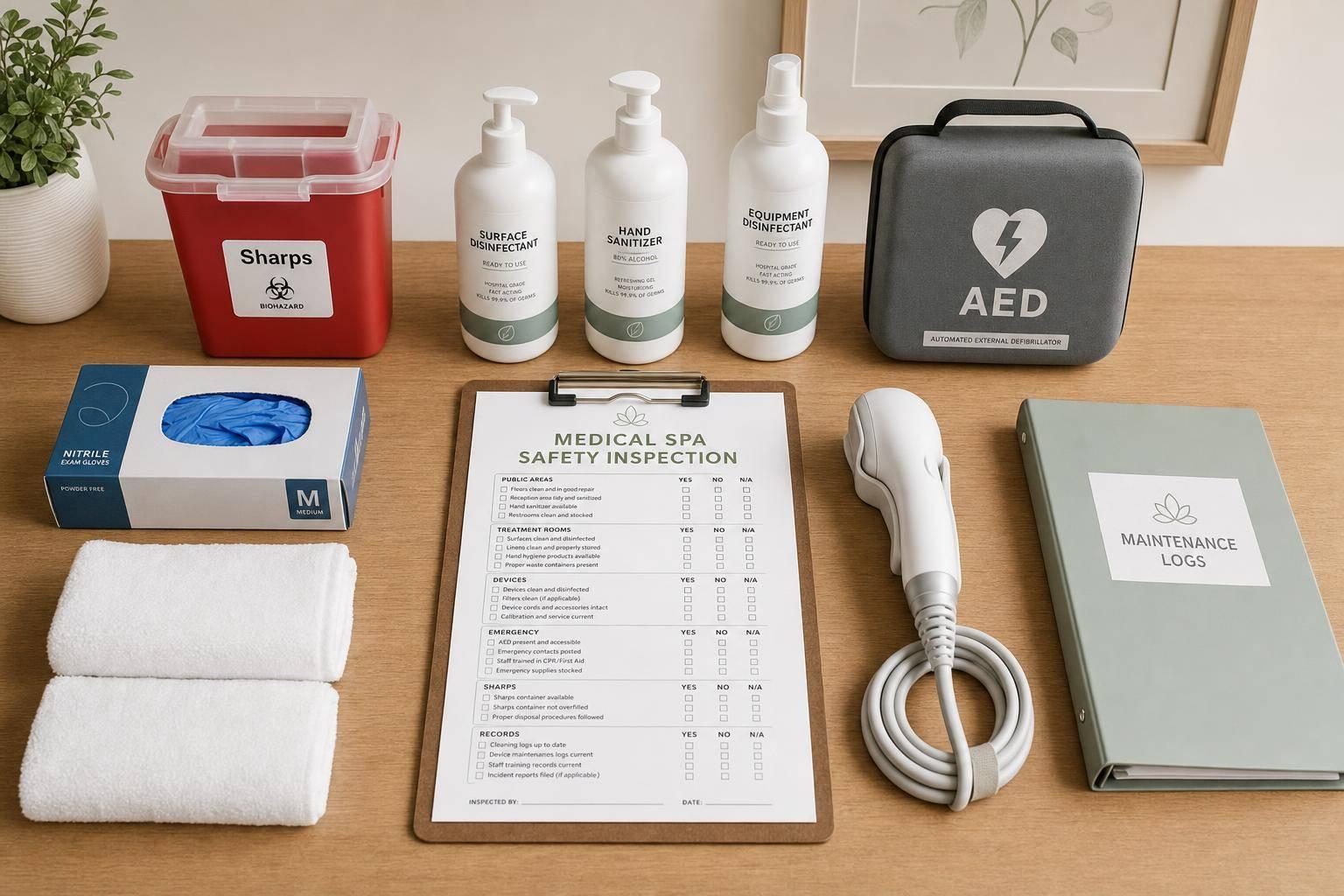
- Keep proof ready. License checks, policy files, training records, contracts, BAAs, and incident logs should be easy to pull during an audit, claim, or state inspection.
A few numbers stand out:
- New York physician malpractice minimums can reach $1.3 million per occurrence and $3.9 million aggregate
- In January 2026, a state task force completed 223 inspections and issued 87 citations
- Tail coverage can cost about 200% of the annual premium
- Medical records often must be kept for at least 6 years
Here’s the plain-English takeaway: if you add injectables, lasers, IV therapy, peels, PRP, RF microneedling, or GLP-1 services, I’d make sure your entity, contracts, and insurance all line up before a claim or inspection puts that setup to the test.
Checklist 1: Verify Legal Structure, Ownership, and Named Insureds
Start with the legal structure. If ownership is set up the wrong way, coverage can fall apart fast and compliance problems can follow. The goal is simple: make sure the business is built the right way, then match each policy to the right legal party.
Confirm a Compliant Entity and Provider Relationships
In New York, the medical entity must operate as a PC or PLLC. And only New York-licensed physicians can own it. Estheticians, investors, and RNs cannot own the medical practice.
Before filing with the Department of State, the entity needs a Certificate of Authority from the New York State Education Department (NYSED) Office of the Professions. If a non-physician business partner is part of the setup, the right path is a Management Services Organization (MSO). The MSO can handle admin work like billing, marketing, and staffing under a written Management Services Agreement (MSA). But there's a hard line here: the MSO cannot control clinical care or take part in banned fee-splitting.
Check every clinician's New York license when they are hired and again at each renewal. Save a dated NYSED verification PDF each time. An out-of-state license does not allow someone to practice in New York.
Match Policies to the Correct Insured Parties
The PC or PLLC must be the primary named insured on all malpractice and professional liability policies. The medical director should also have individual malpractice coverage on top of the entity-level policy. If both the entity and the physician are sued in the same case, one shared policy may leave holes in coverage.
Use this matrix to line up each policy with the right insured party.
| Entity / Individual | Insurance Role | Policy Type |
|---|---|---|
| Professional Entity (PC/PLLC) | Named Insured | Professional Liability, General Liability, Cyber |
| Non-Clinical Entity (MSO) | Additional Insured, where contractually required | General Liability |
| Medical Director (MD/DO) | Named Insured or Individual Coverage | Professional Liability (Malpractice) |
| NPs, PAs, RNs | Named Insured or Individual Policy | Professional Liability |
| Independent Contractors | Must Provide COI | Professional Liability |
| All Employees | Covered Parties | Workers' Comp, Disability (DBL), Paid Family Leave (PFL) |
After you set named insureds, look closely at contractor coverage. Independent contractors should meet minimum limits, provide a current COI that lists the professional entity as the certificate holder, and follow a written first-response order for claims. Also get written confirmation on whether your professional liability policy covers independent contractors, because many practice policies leave them out.
Add MSO additional-insured status only when a contract calls for it. Keep clinical control separate.
Once the entities and insureds match up, move on to policy forms, limits, and exclusions.
sbb-itb-02f5876
Checklist 2: Review Core Insurance Policies and Coverage Terms

NY Med Spa Insurance Coverage: Claims-Made vs. Occurrence Policies Explained
Once your entities and named insureds are in place, the next move is to check whether your policies match what your med spa does day to day. New York's licensing minimums may look fine on paper, but they don't come close to the level of risk most med spas carry.
Professional Liability, Malpractice, and Procedure-Specific Coverage
New York's appearance enhancement license requires either a $50,000 surety bond or liability insurance with $25,000 per occurrence and $75,000 aggregate. For a med spa, that's thin coverage. One bad injectable or laser claim can blow past those limits fast. Because of that, many brokers suggest at least $1 million/$3 million for New York med spas.
The usual benchmark is $1,000,000 per claim / $3,000,000 aggregate. That amount can help meet landlord insurance requirements and gives you more realistic protection if a high-risk procedure leads to a claim.
But limits are only part of the story. You also need to make sure the policy covers every treatment on your menu. A standard salon policy may exclude medical services altogether. Your professional liability policy should clearly list each service you provide, including neuromodulators, fillers, lasers, RF microneedling, chemical peels, PRP, IV therapy, and GLP-1 injections. The same goes for supervising roles. If a service or oversight role isn't listed, treat it as not covered. Also confirm that the policy includes a medical director oversight endorsement.
General Liability, Property, Workers' Comp, EPLI, and Cyber Coverage
Professional liability handles clinical mistakes. The rest of the business needs its own protection.
General liability covers things like slip-and-falls, damage to a rented suite, and products liability tied to skincare sold at the front desk. Commercial property insurance covers your build-out, equipment, and medical devices.
New York requires Workers' Compensation for any business with at least one employee. The state also requires Disability Benefits Law (DBL) and Paid Family Leave (PFL) for almost every employee. Skip workers' comp, and you're not just missing a formality. For a business with more than five employees, that gap can be a felony, with fines up to $50,000. Keep proof of coverage on-site, including Form C-105.2 for Workers' Comp and Form DB-120.1 for DBL.
EPLI, or Employment Practices Liability Insurance, covers claims tied to wrongful termination, harassment, and discrimination. Cyber liability matters just as much. If client photos, intake forms, or health records are exposed, you may face HIPAA notice rules, forensic review costs, and possible fines. New York Public Health Law adds another layer on top of federal HIPAA rules.
Policy Type and Claims-Made vs. Occurrence Comparison Tables
Most New York malpractice policies are claims-made. The tables below help line up each policy form with what it covers and where the risk shows up at renewal.
| Policy Type | What it Covers | Why New York Med Spas Need It |
|---|---|---|
| Professional Liability | Medical errors, burns, filler complications, supervision negligence | Covers the practice of medicine - injectables, lasers, IV therapy |
| General Liability | Slip-and-falls, property damage, retail products liability | Required for licensing and most commercial leases |
| Workers' Comp / DBL / PFL | On-the-job injuries, off-the-job illness, paid family leave | Mandatory by NY law for virtually all employees |
| Cyber Liability | HIPAA violations, ransomware, data breaches, forensic recovery | Protects PHI and digital records under NY Public Health Law |
| EPLI | Wrongful termination, harassment, discrimination claims | Protects against workforce-related lawsuits |
| Commercial Property | Damage to build-out, medical devices, equipment | Protects high-value capital investments |
With claims-made policies, two items get missed all the time: the retroactive date and tail coverage.
| Feature | Claims-Made Policy | Occurrence Policy |
|---|---|---|
| When Coverage Triggers | When the claim is filed, provided the incident occurred after the retroactive date | When the incident occurred, regardless of when the claim is filed |
| Retroactive Date | Critical - incidents before this date are not covered | Not applicable |
| Tail Coverage | Required when the policy is cancelled or not renewed | Not required; coverage is permanent for that policy period |
| Cost | Lower initially; premiums increase over time ("stepping up") | Higher upfront; rates remain relatively stable |
| Common Use | Most medical malpractice and professional liability policies | Most general liability policies |
Tail coverage often costs about 200% of the annual premium. That can sting if you switch carriers, shut down a location, or let a policy lapse without planning ahead.
Checklist 3: Check New York-Specific Exclusions, Documentation, and Contracts
Review Exclusions Against New York Scope and Supervision Rules
Coverage can fall apart for a simple reason: the service isn't covered, or the person doing it isn't allowed to do it under New York law. In New York, claims may be denied when a procedure falls outside the policy's defined professional services or when it is performed by someone working outside their legal scope.
This is where supervision language matters a lot. A claim can run into trouble if a medical procedure is done without the physician involvement the law requires. The same risk shows up when the supervising physician is only a name on paper and has no active clinical role. Each provider type has its own limits, and those limits need to line up with both your operations and your policy.
| Provider Type | NY Supervision Requirement |
|---|---|
| Physician Assistant (PA) | Continuous supervision by a physician; must be reachable at all times |
| Nurse Practitioner (NP) | Independent after 3,600 hours; otherwise requires written collaborative agreement |
| Registered Nurse (RN) | Cannot independently diagnose; must follow physician-approved protocols |
| Esthetician | Limited to facials, waxing, and non-medical exfoliation; cannot perform injections or most laser treatments |
Check that each clinician's role appears on the policy schedule or is covered under a separate malpractice policy. Then add those supervision rules to your inspection file so there's a clear record of how the practice is set up.
Keep Licensure Records, Policy Files, and Contract Insurance Requirements Current
Paperwork issues can cause trouble just as fast as insurance issues. One of the smartest moves here is to keep an inspection binder, either physical or digital, with your NYSED Authority to Incorporate, signed Medical Director Agreement, written procedure protocols, and timestamped license verifications for every clinical staff member.
Record retention matters too. New York requires medical records to be kept for at least 6 years from the date of the last entry, or until age 19 for minors. OSHA Bloodborne Pathogens and HIPAA training should be done and documented every year for all employees.
Then look at your leases and vendor agreements. They should clearly state the insurance limits and coverage terms you require. If a vendor handles Protected Health Information, whether that's a scheduling platform, billing service, or marketing tool, you need a signed Business Associate Agreement in place.
One more thing: indemnity clauses can quietly shift risk onto your business. That's a headache you don't want to spot too late. If a vendor contract includes indemnity language, send it to counsel before signing.
Also confirm whether your workers' compensation, DBL, and PFL duties apply to 1099 workers under the way your contracts are set up.
Checklist 4: Build Compliance, Risk Management, and Claims Workflows
Standardize Protocols, Consent, Training, and Incident Reporting
Once your policies are set, the day-to-day work has to line up with them. That's where compliance either holds up or falls apart.
Use procedure-specific protocols, consent forms, license checks, annual training, and incident logs in one compliance file. Check each clinician's license during onboarding and again at each renewal, then store that verification in the personnel file. Document annual HIPAA and OSHA training. Keep adverse events and complaints in separate logs, since these are often some of the first records requested during an OPMC investigation.
Treat compliance as a daily habit, not a box to check once. If a claim, audit, or investigation lands on your desk, your records need to be easy to find and easy to follow.
Use HIPAA-Compliant Systems to Support Defensible Records
Keep these records in one HIPAA-compliant system. Use Prospyr to centralize scheduling, intake, consent, charts, photos, messaging, and analytics in one HIPAA-compliant system for faster retrieval during audits or claims. Treat before-and-after photos as PHI and get written authorization before marketing use.
When records live in different places, things get messy fast. One system makes it much easier to pull what you need when timing matters.
Conclusion: Key Takeaways for New York Med Spa Insurance Compliance
Review coverage every year and anytime you add procedures, change the medical director, or increase revenue by 25% or more. Insurance reviews should follow operational changes, not just the calendar.
FAQs
What happens if my med spa is owned incorrectly in New York?
In New York, improper med spa ownership isn't a minor paperwork issue. It's a serious regulatory violation. State law says medical spas can be owned only by licensed physicians, and that ownership has to run through a PC or PLLC.
The risks can get steep. Possible consequences include monetary penalties, license revocation, and even criminal charges, including Class E felonies. Regulators also look closely at any setup that gives non-physicians control over clinical decisions, patient care, or medical revenue.
Do I need separate malpractice coverage for the entity and each provider?
Yes. Both the practice entity and each individual provider should be covered.
The practice should keep professional malpractice coverage that fits the medical services it provides. And each licensed clinician should either carry an individual policy or be specifically named on the practice’s group policy.
When should I update my insurance after adding new treatments?
Update your professional malpractice insurance immediately when you add new treatments. The professional services definition in your policy should line up with every treatment on your service menu.
If you start offering treatments that break the skin barrier or add new medical services, check that your current policy covers them. Standard liability policies are not enough for medical procedures.