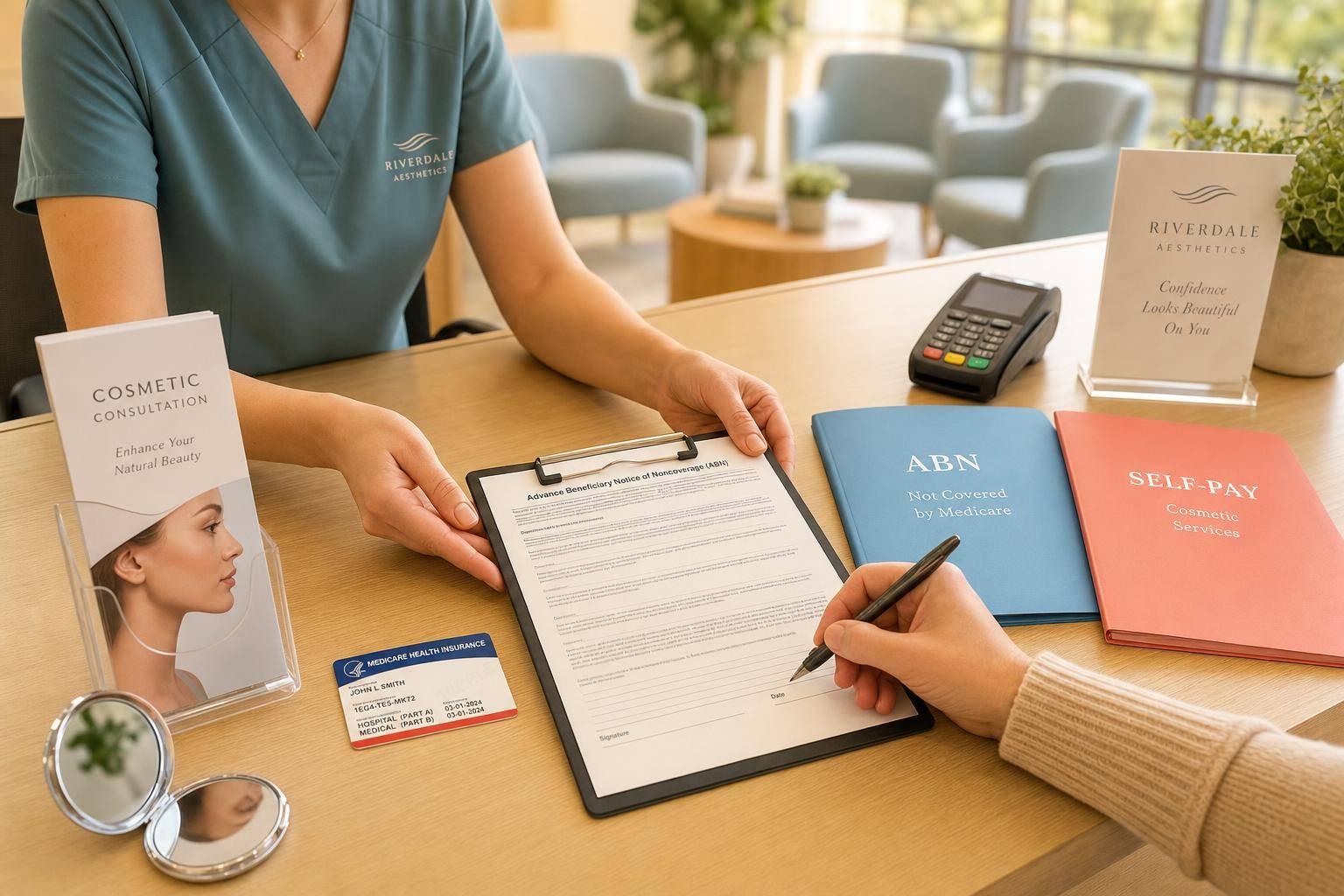

If a service is purely cosmetic, I would not use a Medicare ABN. Medicare does not cover cosmetic services by law, so the right move is usually a self-pay form, not an ABN. I would use an ABN only when Medicare might cover the service but may deny it for that patient.
Here’s the short version:
- Cosmetic only: no mandatory ABN; use a self-pay agreement
- May be covered but likely denied: give a mandatory ABN before treatment
- Mixed visit: split the cosmetic and medical parts, then decide whether the medical part needs an ABN
That means the job is simple at each step: classify the service early using digital intake tools, separate charges, and document the reason. If staff hand ABNs to 100% of Medicare cosmetic patients, they are often using the wrong notice.
A quick side-by-side view:
| Visit type | What I’d use | Billing note |
|---|---|---|
| Botox for wrinkles, fillers, laser aesthetics | Self-pay form | If billed, statutorily excluded items may use GY |
| Service Medicare may cover, but denial is expected | ABN (CMS-R-131) before service | Claim may need GA |
| Visit with both cosmetic and medical care | Separate forms/workflows by line item | Keep covered and self-pay charges apart |
A few points matter most:
- An ABN does not fix coding or billing errors
- An ABN given after the procedure is generally invalid
- Mixed visits are where staff miss ABNs most often
- A missing cost estimate, unchecked option box, or missing patient signature can make the ABN hard to enforce
So if I were training a front desk team, I’d use one rule: cosmetic is self-pay, possible coverage with likely denial gets an ABN, and mixed visits must be split before treatment starts.
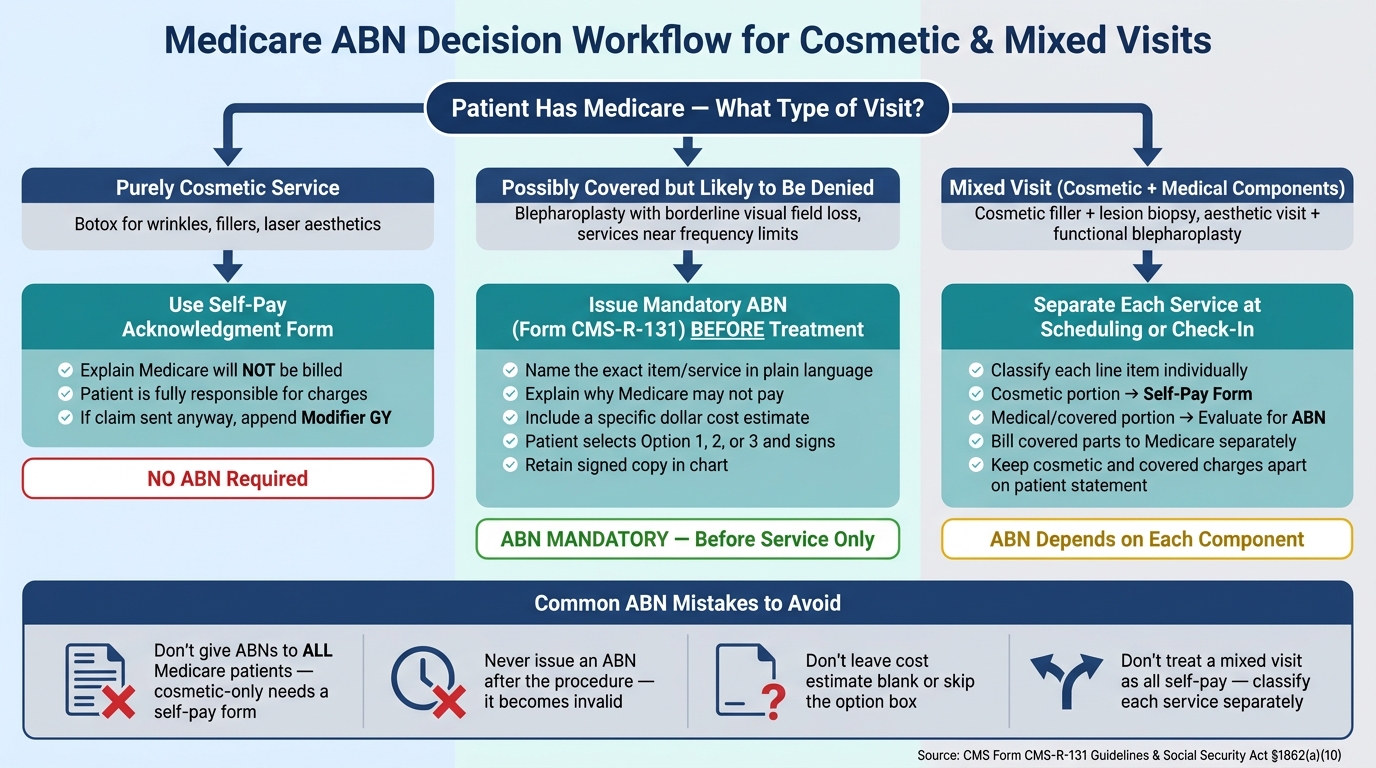
Medicare ABN Decision Workflow for Cosmetic & Mixed Visits
1. Cosmetic vs. covered services under Medicare
Medicare’s rule is simple on paper: cosmetic procedures are excluded, while reconstructive or medically necessary services may be covered if the chart backs that up. That means the front desk, clinical team, and billing staff need to sort out excluded cosmetic care from possibly covered care before choosing any form. That first call tells you whether the visit needs a mandatory ABN, a voluntary notice, or no ABN at all.
Purely cosmetic services are statutorily excluded from Medicare
Medicare excludes cosmetic surgery under Social Security Act §1862(a)(10), so documentation alone won’t make it payable. CMS says it clearly:
"We don't cover cosmetic surgery or related expenses. Cosmetic surgery includes any procedure to improve the patient's appearance."
If the service is cosmetic only, the clinic should use a financial consent form or a voluntary ABN-style notice to show that the patient will pay out of pocket before treatment. If the clinic still sends a claim, the billing team should append modifier GY to show the service is statutorily excluded.
Reconstructive and medically necessary services may qualify for coverage
Medicare covers services that are reasonable and necessary for the diagnosis or treatment of illness or injury, or to improve the function of a malformed body member. If a procedure meets that standard and fits within a Medicare benefit category, coverage may be available. That’s the point where ABN review matters.
In aesthetics, common examples include blepharoplasty for documented visual field loss, nasal surgery for confirmed obstruction that affects breathing, and reconstruction after skin cancer removal. These cases need strong chart support: symptoms, objective findings, proof of prior conservative treatment, and a clear connection between the procedure and the functional problem. When coverage is possible but not certain, the record comes first and the ABN comes before treatment. That’s when a mandatory ABN may be needed.
Key terms front desk, clinical, and billing staff need to know
These terms help staff document the visit and send it down the right path.
| Term | Plain-language definition | How it affects ABN decisions |
|---|---|---|
| Statutorily excluded | Services Medicare law explicitly never covers, such as cosmetic surgery, routine dental care, and hearing aids | No mandatory ABN is needed; use financial consent and modifier GY instead |
| Reasonable and necessary | Medicare’s coverage standard: the service must treat illness, injury, or improve function of a malformed body member | Guides coverage review for reconstructive cases; weak chart support makes denial more likely |
| Noncovered | Services Medicare won’t pay for, either because they are statutorily excluded or because they do not meet medical necessity rules | Helps teams sort services before choosing an ABN or financial consent |
| Original Medicare | The federal fee-for-service program, Parts A and B, run by CMS | ABN rules apply here; Medicare Advantage plans may use different notice steps |
Once the service is classified, the next step is figuring out when Medicare requires an ABN - and when it doesn’t.
sbb-itb-02f5876
2. When an ABN is required, optional, or not appropriate
Once you've classified the service, the next step is pretty simple. There are only three lanes: mandatory ABN, voluntary notice, or no ABN at all. That one choice shapes how the front desk talks about the fee and how billing handles the claim.
When an ABN is mandatory for Medicare patients
A mandatory ABN is used when Original Medicare usually covers the service, but there's a good chance Medicare will deny it for this patient. That often happens when the chart may not support medical necessity during review, or when the service goes past Medicare's frequency limits for that benefit period.
In that case, use Form CMS-R-131 and give it to the patient before the service is performed. The notice needs to:
- name the exact item or service in plain language
- explain why Medicare may not pay
- include a clear cost estimate
The patient must then choose one of the option boxes and sign the form.
Timing matters here. If the ABN is handed to the patient after the procedure, it is generally invalid and can't be used to shift liability to the patient. This is the situation staff tend to trip over: coverage is possible, but the risk of denial is high. So the form has to be done correctly before treatment starts.
When a voluntary notice makes sense in cosmetic or mixed visits
For cosmetic services that Medicare never covers, use a voluntary notice instead of a mandatory ABN. CMS allows a voluntary notice in these cases.
A simple self-pay acknowledgment usually works best. It should make three points clear:
- the service is cosmetic
- Medicare will not be billed
- the patient is fully responsible for the charge
That's the whole point: document that the patient understands the payment responsibility without using the wrong notice.
When an ABN will not solve the problem
An ABN only applies when a covered service may be denied. It does not fix a claim denied because of a coding mistake or some other administrative error. When that happens, the clinic has to correct the claim and resubmit it, or write off the balance.
You also shouldn't issue an ABN unless denial is honestly foreseeable. In cosmetic settings, one of the biggest trouble spots is trying to use an ABN to make a plainly cosmetic service look like a patient-pay charge while still billing Medicare as if the service were covered. That can be viewed as misrepresentation.
So the rule isn't the hard part. The hard part is using the right notice for the right reason and documenting that choice clearly. Most compliance problems start with routine front-desk or billing habits, especially when staff use the wrong notice type or blur the line between covered and cosmetic care.
3. Common ABN mistakes in cosmetic and mixed visits
Most ABN failures aren’t about staff not knowing the rules. They usually come down to day-to-day process problems: using the wrong form, giving it too late, or keeping weak records. In med spas and dermatology offices, those slipups still lead to denials.
Handing every Medicare patient an ABN out of habit
A common mistake is giving an ABN to every patient who shows a Medicare card. On the surface, that can feel like the safe move. It isn’t.
For purely cosmetic care, the right document is a self-pay acknowledgment, not an ABN.
That mix-up shows up a lot because teams want one simple process for everyone. But cosmetic-only care sits in a different bucket. Using the wrong form can create confusion for the patient and trouble for the practice.
The next trouble spot shows up during mixed visits, when a cosmetic appointment shifts into care that Medicare might cover.
Missing a mandatory ABN during a mixed visit
Mixed visits often go off track when staff miss the moment a cosmetic visit becomes a visit with a possibly covered service. Since the appointment started as self-pay, the team may assume the whole encounter stays that way. Then something changes mid-visit, like a lesion biopsy or functional blepharoplasty, and the ABN step gets missed.
When that happens, the practice may lose the ability to bill the patient if Medicare later denies the claim. That’s the painful part. The work gets done, but the paperwork gap creates a payment problem.
The fix is simple in theory, even if it takes discipline in practice: clinicians need to flag any mid-visit change in scope before moving ahead. That gives front desk or billing staff time to issue the ABN using online scheduling tools to flag patient types the right way.
Once the visit type is clear, the risk shifts from classification to execution: right form, right timing, complete record.
Incomplete forms and weak documentation
Even when an ABN is given on time, errors on the form can make it unenforceable. CMS requires certain items to be there, including a specific reason Medicare may deny payment, an estimated charge in U.S. dollars, the patient’s choice, a signature, a date, and a copy kept in the chart.
| ABN Element | Valid Practice | Common Error | Likely Consequence |
|---|---|---|---|
| Reason Medicare may not pay | Specific denial reason | Generic wording | Vulnerable to challenge |
| Estimated charge (in U.S. dollars) | Dollar amount within about $100 or 25% of actual cost | Field left blank | Unclear liability |
| Patient option selected | Patient chooses Option 1, 2, or 3 voluntarily | No option checked, or staff pre-checks a box | No informed choice shown |
| Patient signature and date | Signed and dated before service | Missing signature, or signed after procedure | ABN treated as invalid |
| Copy retained in chart | Signed copy stored in record and given to patient | No copy saved or linked to encounter | Weak audit trail |
A retroactive ABN is invalid. And if the signed copy is missing, the audit trail gets thin fast.
That’s why ABN handling can’t live in someone’s memory or be dealt with ad hoc. It needs to be part of the front desk and billing workflow every single time.
4. A front desk and billing workflow for ABNs
The best way to handle ABNs is to turn the rules into a repeatable workflow. That way, the front desk, clinical team, and billing team are all working from the same playbook from scheduling through claim submission.
Front desk steps from scheduling to check-in
Once the visit is classified as cosmetic, covered, or mixed, the front desk should send it down the right path. When a patient calls or books online, confirm two things right away:
- Whether they have Original Medicare, a Medicare Advantage plan, or no Medicare
- What the visit is for
Those two details shape everything that comes next.
From there, classify the visit as cosmetic only, reconstructive or medically necessary, or mixed. A simple reference card at the front desk can help staff make that call the same way every time. For cosmetic-only bookings, use a self-pay notice. For any visit that looks mixed or possibly reconstructive, flag it for clinical or billing review before the appointment date.
That review should confirm which services need an ABN and what documentation the clinician needs to have ready. At check-in, verify insurance again, confirm that the visit type hasn't changed, and make sure any required notices are reviewed, signed, and dated before the patient is seen.
Billing steps for claim submission and payment collection
After check-in, billing should line up the claim with the documented visit type. Cosmetic services should stay outside Medicare billing, with payment collected directly from the patient.
If a service is normally covered but is expected to deny, confirm that a valid ABN is on file before the claim is submitted. Then append the right modifier, such as GA. For mixed visits, bill the covered parts to Medicare with supporting documentation, and handle cosmetic line items separately as self-pay. On the patient statement, keep cosmetic and covered charges separate.
Billing teams should also keep a working reference list of Local Coverage Determinations and CMS guidance for procedures the clinic performs often. That makes it much easier to answer the day-to-day question: does this service need an ABN or not?
Using Prospyr to standardize ABN-related tasks
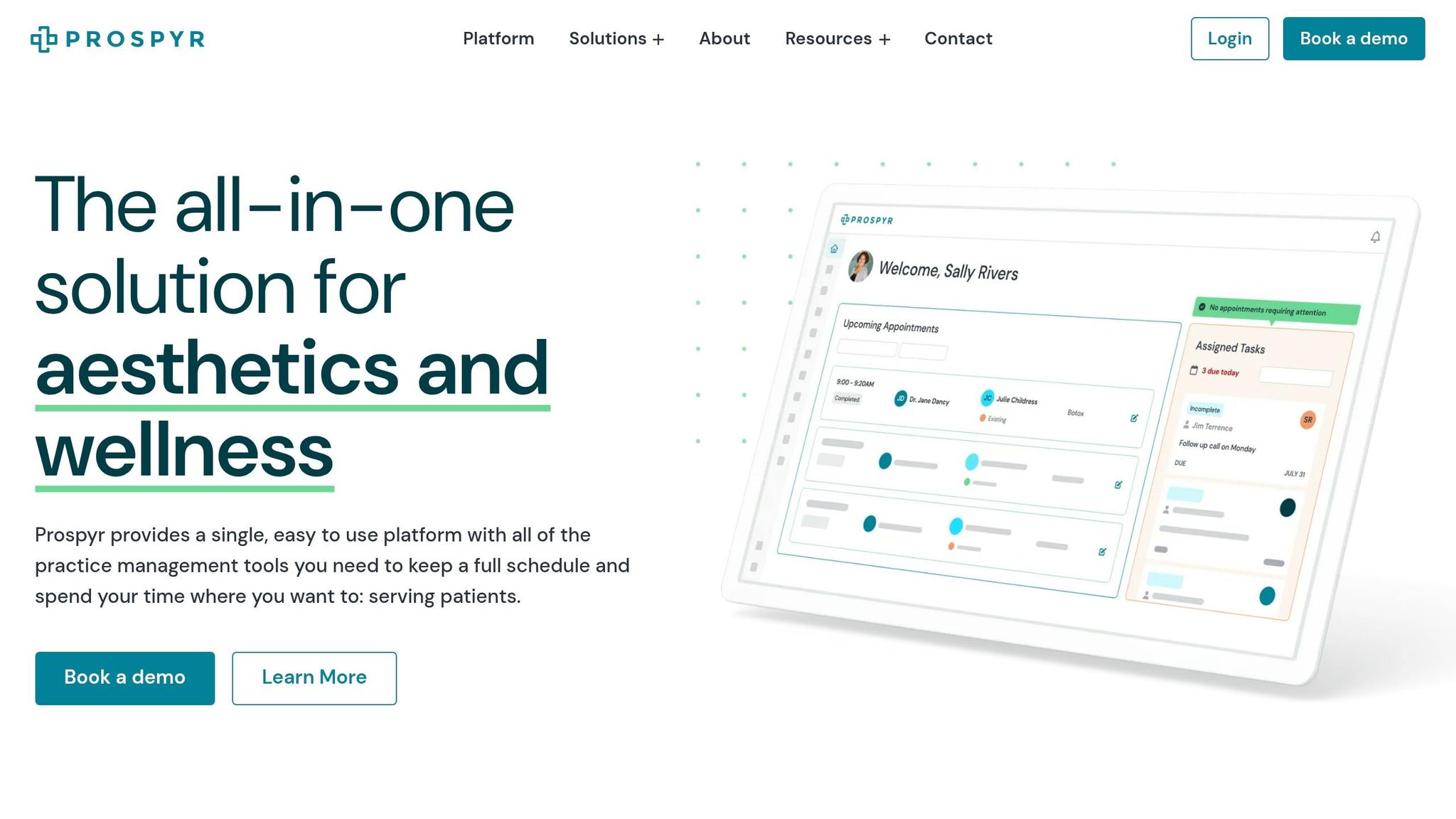
Prospyr can help standardize the handoff from scheduling to signed ABN storage. At scheduling, Prospyr's digital intake forms can require patients to enter insurance details and answer structured questions about the reason for the visit.
Its CRM/EMR integration can flag Medicare patients with cosmetic or mixed appointments and create a task for clinical or billing review before treatment. Task management then routes those cases to the right staff member before the day of service.
Prospyr's document storage lets staff upload signed ABNs and self-pay notices straight into the patient record, linked to the specific encounter. That gives billing a clear way to confirm compliance before any claim goes out. Payment processing tools can also be set up to collect self-pay amounts at check-in, while analytics can show where the workflow is breaking down.
Conclusion: A simple rule set clinics can apply every day
Once the workflow is set, the day-to-day call is pretty simple: classify the service before treatment.
Use a mandatory ABN only for services that may be covered but are likely to be denied. For purely cosmetic services - Botox, fillers, and laser treatments - Medicare never covers them, so an ABN is not required. Instead, make the patient’s self-pay responsibility clear before the visit. For mixed visits, classify the service at scheduling or check-in, and separate the cosmetic and medical parts before treatment begins.
Use the same rule at scheduling, check-in, and billing:
| Service type | ABN required? | Patient communication |
|---|---|---|
| Purely cosmetic, statutorily excluded | Not mandatory | Explain self-pay responsibility upfront |
| Covered in principle, likely to be denied | Mandatory | Complete ABN before service; document reason and cost |
| Mixed medical-cosmetic visit | Depends on each component | Separate and document each service early |
Front desk and billing teams should follow the same classification rule. Classify early, separate cosmetic from medical services, and document the decision before billing.
FAQs
What counts as a mixed visit?
A mixed visit is a single appointment that includes both medically necessary services and elective cosmetic procedures.
For compliance, clinics should document each part separately. The medical portion needs a clear clinical reason, and the cosmetic portion should be marked as self-pay.
Does Medicare Advantage use the same ABN rules?
No. Medicare Advantage does not follow the same ABN rules as Original Medicare.
Your clinic should follow the specific Medicare Advantage plan’s billing and denial requirements instead of assuming the Original Medicare ABN process applies. Put simply, don’t treat Medicare Advantage like Original Medicare here. Each plan may have its own process, and claim workflows and filing deadlines can differ too.
What happens if a valid ABN is missing?
If a valid Advance Beneficiary Notice is missing for a service Medicare is expected to deny, the clinic usually can’t bill the patient for that charge. If there’s no signed ABN in place before the service, the cost generally falls to the clinic.
To cut down on that risk, make signed financial responsibility waivers a standard part of the process for non-covered services. It also helps to flag missing signatures during pre-visit audits, so staff can catch gaps before the appointment happens.