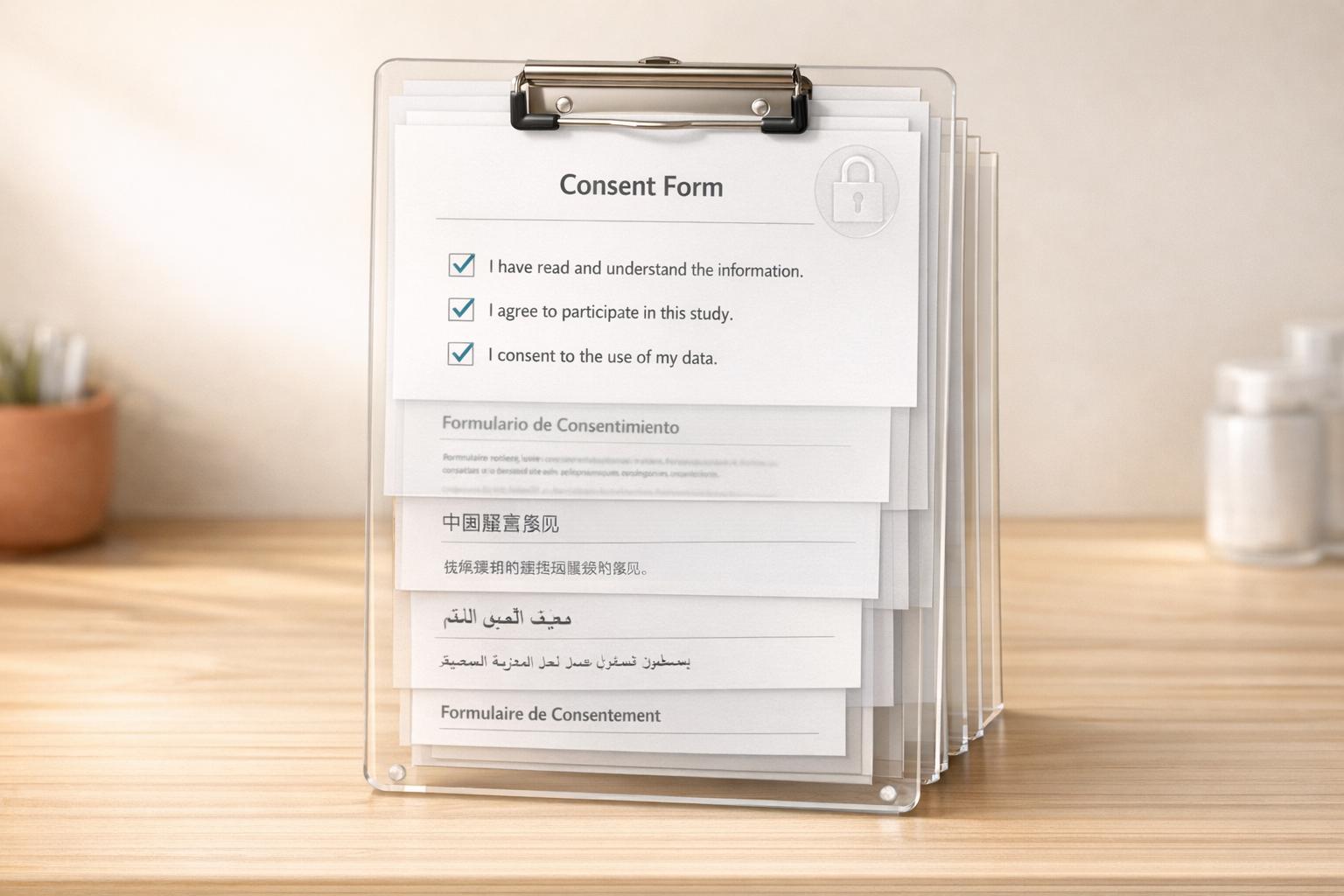

Multilingual consent forms are essential for ensuring patients understand the risks and details of medical procedures, especially when language barriers exist. Without clear communication, clinics risk legal issues, patient dissatisfaction, and non-compliance with federal and state regulations. This guide provides a step-by-step checklist to help you create legally compliant, patient-friendly consent forms in multiple languages.
Key Takeaways:
- Legal Requirements: Federal laws (e.g., FDA, HIPAA) mandate that consent forms be provided in a language the patient understands. State-specific laws, like California's, may add further requirements.
- Translation Process: Use certified medical translators and ensure translations are accurate, legally reviewed, and culturally appropriate.
- Patient Understanding: Verify comprehension through open-ended questions and avoid relying on family members or untrained staff for interpretation.
- Record-Keeping: Store signed forms securely using HIPAA-compliant systems and maintain an audit trail.
Quick Checklist:
- Understand Legal Obligations: Review federal and state guidelines for informed consent.
- Prepare Clear English Forms: Write at a 5th–8th grade reading level to ensure simplicity.
- Translate Accurately: Use certified translators and obtain a Certificate of Accuracy.
- Get Legal Approval: Submit translations for IRB or legal review before use.
- Train Staff: Ensure staff know how to handle multilingual consent processes and work with interpreters.
- Confirm Patient Comprehension: Use open-ended questions to verify understanding.
- Secure Storage: Store all forms in HIPAA-compliant digital intake systems and track usage.
By following these steps, clinics can improve patient trust, reduce legal risks, and meet compliance standards with ease.

7-Step Multilingual Consent Form Compliance Checklist for Medical Clinics
Steps Before Translation
Getting your consent forms right from the start is crucial. It ensures compliance with regulations and safeguards patient understanding. Laying the groundwork before translation helps you avoid unnecessary revisions, legal issues, and confusing documentation.
Review Federal and State Regulations
Start by understanding the legal requirements that apply to your practice. Federal guidelines from the Office for Human Research Protections (OHRP) and the FDA specify that informed consent must be in a language the participant or their representative can understand. If your work involves protected health information, HIPAA mandates translating authorization forms into the patient’s fluent language before obtaining consent.
In California, biomedical studies must include an "Experimental Participants Bill of Rights" in the patient’s primary language. Additionally, the California Consumer Privacy Act (CCPA) requires clear and localized notices for data collection if you handle information for California residents. For clinics working with European residents, the GDPR requires consent to be informed, explicit, and provided in the appropriate language.
Identify Patient Language Needs
Take a close look at your patient demographics to pinpoint which languages are necessary. Your patient management system can provide insights into the most commonly spoken languages among your clients. This targeted approach ensures you focus resources on translations that are truly needed while covering the most relevant languages for your patients.
Regulatory bodies often require a full translation of informed consent documents for any language spoken by more than two enrolled patients. Keep track of these numbers to ensure compliance.
Once the language needs are clear, make sure your English forms are easy to understand.
Create Clear Source Documents
Before translating, your English consent form must be as clear as possible. Writing at a 5th-grade reading level can significantly improve comprehension. Many organizations aim for an 8th-grade level as a standard for plain language.
Simplify your content by removing technical jargon and breaking down complex sentences. As Temple Health points out, "The relatively complex sentence structure and vocabulary of most consent forms makes it difficult for the average adult to interpret the information". Use straightforward language, short sentences, and a logical layout with clearly defined sections and headings.
Make sure to get final approval on your English version before moving forward with translation. As Temple Health highlights, "An added advantage of simplifying and clarifying the consent form is that it will also increase the likelihood of getting a high-quality translation".
sbb-itb-02f5876
Translation and Review Process
Once your English consent form is finalized, the translation process must prioritize precision, legal compliance, and sensitivity to cultural differences.
Use Certified Medical Translators
For accurate translations, work with translators certified by the American Translators Association (ATA) in the required language pair and direction. The ATA certification is one of the most recognized measures of translation skill in the U.S., but it’s worth noting that fewer than 2,000 of the ATA's 10,000 members hold this certification. The certification exam is rigorous, with a pass rate under 20% - a reflection of its high standards.
Keep in mind that ATA certification is specific to the translation direction. For instance, someone certified to translate Spanish into English may not be certified to translate English into Spanish. Your translator should also have specialized knowledge of medical terminology and be familiar with cultural nuances to ensure the consent form resonates with your audience.
Always request a Certificate of Accuracy from your translator or agency. This signed document confirms that the translation is complete and accurate, meeting both legal and regulatory requirements. The certificate should include essential details such as your study number, the name of the original English document, and the protocol version date.
Once the translation is ready, the next step is securing legal approval.
Get Legal Approval
After completing the translation, submit the documents for legal and Institutional Review Board (IRB) review. Translated consent forms must be approved by an IRB before being used, typically as part of an "administrative modification" or "modification request". It’s critical that the versioning matches across three documents: the IRB-approved English form, the translated form, and the Certificate of Accuracy.
"The versioning on all three documents (the CIRB-approved English consent form(s), other language consent form(s), and the Certificate of Accuracy) must match." - NCICIRB
To avoid unnecessary rework, begin the translation only after receiving final IRB approval. Additionally, maintain a clear audit trail by documenting every instance where a translated form is used in a participant’s study chart.
Once legal approval is secured, the final step is ensuring the translation aligns with the cultural context of your target audience.
Check Cultural Appropriateness
The translation must be not only accurate but also culturally relevant and easy to understand for the target audience. Perceptions of healthcare, privacy, and informed consent can differ widely across cultures, so translators need to adapt the content to ensure clarity and compliance.
"A qualified translator is a person who is proficient in both the source and target languages, including grammar, vocabulary, cultural contexts and nuances." - UCSF IRB
Be mindful of regional and linguistic variations. For example, Spanish differs significantly between countries, and Chinese has distinct forms like Mandarin and Cantonese. Identifying the specific dialect or regional language of your audience is crucial for proper localization. Additionally, the translation should reflect the appropriate level of formality and politeness, which can vary greatly across languages.
Have bilingual professionals or subject matter experts review the translations to confirm cultural suitability, and seek feedback from individuals within the target community to identify potential areas of confusion or ambiguity.
Consent Form Implementation Checklist
Once you've secured legal approval and ensured the consent forms meet language and cultural standards, the next step is integrating them into your clinic's daily operations. This involves thorough staff training, verifying patient understanding, and securely managing documentation.
Train Staff on Language Support
Establish clear protocols for managing multilingual consent processes. Staff should know who will oversee the consent process and how they’ll communicate with non-English-speaking patients before any interaction begins. This preparation helps maintain consistency and avoids misunderstandings.
Certified medical interpreters are essential for non-English consent discussions. Avoid relying on bilingual staff or family members as interpreters, and never use children for this role.
"The medical and technical information discussed during the consent process and throughout the study can be very complex and should be communicated through an interpreter with training and understanding in medical terminology." - UCSF Human Research Protection Program
Plan for extra time when working with interpreters to ensure accurate communication. Pre-consent briefings with interpreters are a good practice, allowing everyone to align on the process and ensuring that all spoken content is translated accurately. Staff should also ask interpreters how they plan to address cultural nuances during the discussion, ensuring the patient feels the information is relevant and understandable.
Once these protocols are in place, the focus shifts to ensuring patients fully understand what they’re consenting to.
Confirm Patient Comprehension
To uphold compliance and prioritize patient safety, it’s crucial to confirm that patients truly understand the consent details. A signature alone doesn’t guarantee comprehension; informed consent is an ongoing dialogue, not just a signed form.
"The responsibility of ensuring that a potential subject understands the research and the risks and benefits involved falls primarily upon the investigator, not the potential subject." - UCSF Human Research Protection Program
Train staff to ask open-ended questions that encourage detailed responses instead of simple yes/no answers. For example, instead of asking, "Do you understand?" they could ask, "Can you explain in your own words what this procedure involves?" or "What risks do you think might be involved?". These questions help reveal whether the patient has genuinely understood the information or is merely agreeing out of politeness.
| Effective Open-Ended Questions | Ineffective Closed-Ended Questions |
|---|---|
| "What are the possible risks to you?" | "Do you understand the risks?" |
| "Explain to me what you will have to do." | "Do you have any questions?" |
| "Describe the purpose of this procedure in your own words." | "Do you understand what we are asking you to do?" |
| "Whom should you contact if you have concerns?" | "Do you know who to call?" |
Once comprehension is confirmed, the final step is managing the signed forms securely.
Store Signed Forms Securely
Proper storage of signed consent forms is essential for both compliance and smooth operations. Use a HIPAA-compliant system to protect patient privacy while ensuring authorized staff can access the forms when needed.
Maintain an audit trail by documenting each instance where a translated form is used. Clearly indicate in the patient’s chart which language version they signed. Keep the English version, the translated form, and any certificates of accuracy together, ensuring they’re easy to retrieve when necessary.
Storage and Record-Keeping Requirements
Keeping accurate and secure records is a cornerstone of the multilingual consent process and compliance efforts. Proper storage practices must protect Protected Health Information (PHI), ensure compliance with regulations, and allow for easy access when needed. HIPAA outlines specific safeguards for handling PHI, which includes sensitive details like patient names, birth dates, and medical record numbers.
Implement HIPAA-Compliant Storage
For physical documents, secure storage is a must. Keep forms in locked areas with controlled access, using tools like mechanical keys, ID swipe cards, or keypad codes. Access should be revoked immediately when an individual’s role changes.
"Medical records and PHI must be stored where there is controlled access." - Yale University HIPAA Policy
For digital records, choose HIPAA-compliant platforms that track and log all access. These platforms, such as Prospyr, provide features like automatic access logging and audit trails. These platforms often integrate with telehealth services to ensure secure remote consultations. When transporting forms between locations, ensure they are covered so personal details remain hidden.
A well-organized system for storing and tracking records is equally important for maintaining compliance.
Set Up an Organized Filing System
Group all related documents - such as the English version of a consent form, its translation, and the Certificate of Accuracy - together in the patient’s record. Maintain a master copy with clear version numbers and dates for reference. Additionally, log the location of records during use, transfer, and storage. For research purposes, keep direct identifiers separate from other consent documents and dispose of them responsibly when they are no longer needed.
Common Compliance Errors and How to Avoid Them
Even clinics with the best intentions can stumble into compliance issues that lead to regulatory violations or legal trouble. Understanding where these mistakes happen can help you create stronger, more reliable processes from the beginning.
Poor Translation Quality
When translations are poorly handled, the risks are significant - patients may not fully understand the risks, procedures, or purposes of their treatments. As one source puts it:
"Errors in informed consent form translations could lead to inadequate risk disclosure, inaccurate procedure descriptions, or misunderstandings about the activity's purpose and implications." - MotaWord
These issues often occur when translations are left to non-specialists. On top of that, language differences - like the variations in Spanish used in Mexico, Puerto Rico, and Spain, or the distinctions between Mandarin and Cantonese - can lead to localized inaccuracies. The solution? Work with professional translation services and include a bilingual review process to catch potential missteps.
It’s equally important to ensure patients truly understand the translated information. A translation alone isn’t enough without comprehension. Providing access to documents through a secure patient portal allows patients to review forms at their own pace.
Skipping Comprehension Verification
A patient’s signature on a consent form doesn’t always mean they fully grasp the details. If patients later claim they didn’t understand the procedure, it can lead to ethical dilemmas and legal challenges. Cultural differences can also require additional communication to bridge understanding gaps. MotaWord highlights this point:
"Translators should prioritize clarity and readability in the translation of consent forms... avoid complex medical or legal jargon and use plain language." - MotaWord
To ensure patients understand, use the teach-back method - ask them to explain the key details in their own words. Testing your translated forms with your target audience can also help identify unclear phrasing. Additionally, having bilingual staff or interpreters on hand for complex procedures can provide much-needed support. Confirming patient comprehension isn’t just a best practice - it’s a critical step in staying compliant and protecting your clinic from potential legal issues.
Using Practice Management Software
Digital platforms simplify the process of handling multilingual consent forms, building on secure storage and structured documentation. Managing these forms manually - tracking translations, storing signed copies, and ensuring compliance - can quickly become overwhelming. Practice management software takes the hassle out of these workflows, cutting down on administrative tasks while improving accuracy and security.
Digitize Consent Form Workflows
Tools like Prospyr bring consent management into one HIPAA-compliant system. With these platforms, you can create and customize digital consent forms, generate multilingual versions from templates, and share them with patients through secure portals, email, or SMS. The system even auto-fills forms based on patient profiles - for example, defaulting to Spanish if that’s the patient’s preferred language - and supports legally compliant e-signatures.
Centralized storage replaces the need for filing cabinets or scattered PDFs. According to a 2024 HIMSS survey, 65% of ambulatory clinics using digital consent tools reported 95% or higher compliance with HIPAA multilingual standards, compared to only 42% for clinics sticking to paper-based methods. Features like version control ensure you're always using the most up-to-date translations, while role-based permissions allow staff to securely access forms during patient visits. These digital tools not only help meet compliance standards but also elevate the overall patient experience.
Improve Patient Satisfaction
Digital workflows simplify the consent process for patients, making it quicker and less stressful. Patients can review and sign forms in their preferred language on their own device in under two minutes. Studies show that satisfaction scores are 78% higher when forms are available in the patient’s native language. Additional features like video explanations, multilingual real-time chat support, and SMS confirmation receipts help build trust and reduce anxiety.
A 2023 study revealed that digital workflows cut consent-related errors by 72% in multilingual environments, while clinics experienced a 40% drop in no-show rates when forms were completed in advance. These workflows not only meet compliance standards but also make it easy for patients to access information in their language of choice. Patients appreciate having 24/7 portal access and receiving instant copies of their signed forms, which contributed to 92% of patients reporting ease of use and stronger loyalty to their clinic.
Conclusion
Having multilingual consent forms isn't just about compliance - it’s about building trust and improving patient care. When patients can read and sign forms in their own language, they better understand the risks, feel valued, and are more likely to stay loyal to your clinic. As Valentino, Founder of Aesthetic Launch Lab, wisely states:
"Transparency is the currency of trust in the aesthetics industry".
Failing to secure clear, timestamped consent can leave providers vulnerable in legal disputes. Properly documented multilingual consent, however, reduces risks and aligns with legal standards, such as the Montgomery ruling. These requirements highlight the importance of adopting effective, modern solutions.
Digital tools make compliance easier than ever. Platforms like Prospyr simplify the process by managing translations, securely storing signed forms, and creating reliable audit trails. With features like HIPAA-compliant storage, automated workflows, and multilingual templates, you can spend less time on paperwork and more time focusing on patient care.
Take a moment to review your current consent process. Use a checklist to identify gaps in areas like translation accuracy, staff training, or record-keeping. Consider hiring certified translators, improving how you verify patient understanding, or investing in a digital consent platform. Clear communication in your patients' preferred language isn’t just a courtesy - it’s a necessity for their safety and your practice’s protection.
FAQs
Which laws require multilingual consent forms in the U.S.?
In the United States, Title VI of the Civil Rights Act of 1964 and Section 1557 of the Affordable Care Act mandate providing language access and assistance for individuals with limited English proficiency (LEP). These laws ensure that healthcare providers and organizations offer multilingual consent forms to comply with accessibility requirements and legal regulations.
How do I choose the right languages (and dialects) to translate?
To choose the appropriate languages and dialects, think about the makeup of your patient population and the areas you serve. Pay attention to linguistic demographics, like the most commonly spoken languages in your region or specific community data. It's essential that translations are both accurate and respectful of cultural nuances to meet compliance requirements. While tools with multilingual capabilities can help simplify the process, the main goal should always be to provide consent forms that are clear and easy to understand in the languages your patients prefer.
What proof should I keep to confirm a translation is accurate and approved?
Maintaining proper records is essential. Keep signed approvals or confirmations of the translated content on file. Additionally, document the review and approval process to validate both the accuracy of the translation and its approval. These records play a key role in ensuring compliance and promoting accountability.