
If your med spa handles patient data in digital systems, HIPAA may apply even if you don’t run a hospital or a large clinic. In plain terms, if you create medical records, store treatment photos, send health data by email or text, or use software tied to billing or care, you need rules for privacy, security, and breach response.
Here’s the short version:
- PHI includes more than charts. It can include intake forms, treatment notes, and identifiable before-and-after photos.
- ePHI is PHI in digital form. That covers software, cloud storage, email, and text messages.
- HIPAA usually applies when licensed clinicians provide care and the practice handles health data in covered electronic transactions.
- Med spas need three sets of rules in place: Privacy, Security, and Breach Notification.
- Staff access must be limited by role. Front desk staff should not see the same data as injectors or medical directors.
- Every vendor that handles PHI needs a BAA before data is shared.
- Risk reviews, staff training, and records must be documented and kept for six years.
A few numbers make the stakes clear:
- In 2024, OCR collected $12.8 million in penalties and settlements.
- Fines for willful neglect can reach $73,011 per violation.
- The average healthcare data breach cost hit $7.42 million in 2025.
- Early compliance setup often costs about $3,000 to $10,000, which is far less than a breach or investigation.
What I take from this is simple: HIPAA at a med spa is not just about forms. It comes down to how your team books visits, stores photos, sends reminders, uses software, and controls access every day.

HIPAA Compliance for Med Spas: Costs, Penalties & Key Stats
When Does HIPAA Apply to a Med Spa?
HIPAA doesn't cover every med spa service by default. It comes into play when a med spa handles PHI as part of covered transactions like billing, eligibility checks, or claims. That line matters because it tells you which records, systems, and day-to-day workflows need HIPAA controls.
Covered Entity Status and Electronic Transmission of Health Information
A med spa will often count as a covered entity when licensed clinicians create records, order treatment, or bill electronically. Common covered transactions include electronic insurance billing, health plan eligibility checks, and electronic claims.
A cash-only model doesn't automatically put a med spa outside HIPAA. If the business electronically sends health data for other standard transactions, or uses vendors that process ePHI, HIPAA can still apply.
If those workflows support covered transactions, they're inside HIPAA.
Cosmetic Services vs. Medical Services: Where the Line Falls
Medical services usually trigger HIPAA. Purely cosmetic services often don't. The key point is clinical involvement, not just the name of the service.
| Service Type | Licensed clinician involved | Clinical record created | HIPAA Likely Applies? |
|---|---|---|---|
| Basic facial / esthetic treatment | No | No | No |
| Botox / neurotoxin injections | Yes | Yes | Yes |
| Laser resurfacing | Yes | Yes | Yes |
| IV therapy / vitamin drips | Yes | Yes | Yes |
A simple way to think about it: if a service involves both identifiable health data and licensed clinical care, the workflow should be treated as HIPAA-covered. Once a service lands in that bucket, the next step is making sure the practice protects the data it creates.
sbb-itb-02f5876
HIPAA Rules and Safeguards Med Spas Must Follow
If HIPAA applies to your med spa, you need to follow three rules: the Privacy Rule, the Security Rule, and the Breach Notification Rule. Each one handles a different part of compliance.
Privacy, Security, and Breach Notification Rules Explained
The Privacy Rule governs how your practice uses and shares PHI. At the center of this rule is the minimum necessary standard. In plain English, staff should only see the patient data they need to do their job.
This rule also gives patients clear rights. They can:
- View and get copies of their records within 30 days
- Ask for amendments
- Receive an accounting of disclosures
Marketing is one of the easiest places to slip up. For example, posting identifiable before-and-after photos without written authorization can lead to a HIPAA violation.
The Security Rule requires administrative, physical, and technical safeguards for ePHI. The Breach Notification Rule sets deadlines when something goes wrong. If a breach affects 500 or more individuals, you must notify those patients, HHS, and relevant media outlets within 60 days. Smaller breaches still need to be logged and reported to HHS each year.
In day-to-day terms, these rules affect who can open patient records, how data is stored, and what outside vendors are allowed to do with it.
Administrative, Physical, and Technical Safeguards
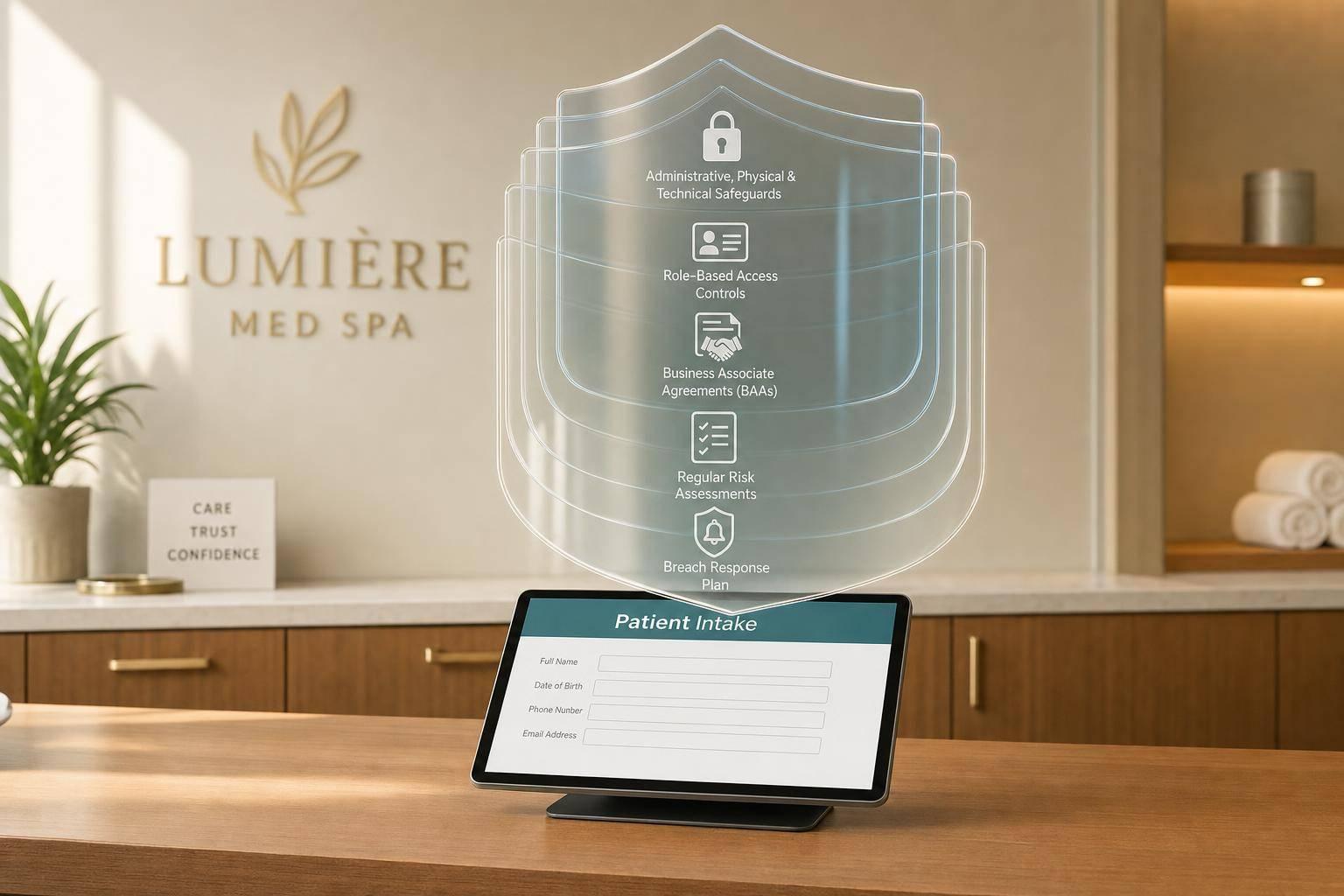
The Security Rule requires administrative, physical, and technical safeguards for ePHI. If your med spa handles ePHI, you need all three. Not just one or two.
| Safeguard Type | Med Spa Example | Why It Matters |
|---|---|---|
| Administrative | Appointing a Privacy Officer; conducting annual staff training | Establishes accountability and ensures staff understand PHI handling rules |
| Physical | Privacy screens on front-desk monitors; automatic screen locks | Prevents waiting patients or visitors from seeing sensitive records |
| Technical | Multi-factor authentication (MFA) for EHR access; unique user logins; audit logs | Protects against unauthorized access and tracks exactly who viewed which record |
You also need to assign a specific person to serve as your Privacy Officer and Security Officer as part of your documented compliance framework. And don’t skip BAAs. Any vendor that handles PHI, whether it’s your software provider, IT support, or cloud storage service, must have a signed Business Associate Agreement on file before you share PHI.
That matters because policies on paper don’t do much if your software and vendors don’t follow the same rules.
Risk Assessments, Documentation, and Ongoing Review
HIPAA compliance is not a one-and-done setup. The Security Rule requires a documented Security Risk Analysis (SRA) every year, and also any time something major changes, like a new software platform, a new location, a new service line, or a security incident.
Documentation matters too. Training logs, authorization forms, risk assessments, and BAAs must be kept for six years.
"Documented HIPAA training is required." - Steve Alder, Editor-in-Chief, The HIPAA Journal
A solid review rhythm helps keep gaps from piling up. Review access quarterly, run vulnerability scans twice a year, and test backups and incident response each year.
Software Features That Help Med Spas Stay HIPAA Compliant
The right software lowers compliance risk by limiting access, tracking activity, and locking down PHI. In a med spa, HIPAA controls can't live on paper alone. They need to be built into the tools your team uses every day.
Core Security Features for Patient Data Protection
Start with role-based access control (RBAC). Put simply, your front desk team should be able to see scheduling details without getting access to clinical notes or before-and-after photos.
You should also look for unique user IDs, multi-factor authentication (MFA), and automated audit logs. Audit logs create a timestamped record of who opened, edited, or exported a patient file. That's a must for audit readiness.
Encryption matters just as much. ePHI needs protection both at rest and in transit. And under recognized encryption standards, if encrypted data is lost and the decryption key wasn't compromised, your practice may qualify for a safe harbor exemption from breach notification rules.
For med spas, before-and-after photo storage is one of the most common weak points. Clinical images should stay in an encrypted, access-controlled repository that is separate from marketing assets.
Communication, Intake, and Recordkeeping Tools
Digital intake forms can send a patient's health history straight into their chart as soon as it's submitted. That means no unsecured email attachment and no manual re-entry. It keeps ePHI contained from the first touchpoint.
Messaging is another area where med spas often get into trouble. Sending an appointment reminder that names a procedure through unencrypted SMS can be a HIPAA violation. A compliant platform sends those messages through encrypted channels covered by a BAA, so automated reminders don't create extra risk.
Business Associate Agreements and HIPAA-Compliant Platforms
Any software vendor that stores, processes, or transmits PHI for you is legally a business associate. That means you need a signed Business Associate Agreement (BAA) before that vendor handles patient records.
This rule applies to tools across your stack, including:
- EHR systems
- Scheduling software
- Email marketing platforms
- Cloud storage providers
- Payment processors tied to medical procedures
No PHI should go to a vendor without a signed BAA.
Use this checklist to review any platform against HIPAA rules:
| HIPAA Control | Software Capability | Why It Matters for Med Spas |
|---|---|---|
| Access Control | Role-based permissions & unique user IDs | Prevents front-desk staff from viewing clinical notes or patient photos |
| Audit Controls | Automated access logs | Creates a verifiable record of who accessed each patient file |
| Transmission Security | TLS/SSL encryption & secure portals | Protects intake forms and clinical images during upload or submission |
| Integrity | Digital signatures & version history | Helps ensure consent forms and treatment notes aren't improperly altered |
| Authentication | Multi-factor authentication (MFA) | Blocks unauthorized access even if a staff password is compromised |
| Vendor Management | Signed BAA | Helps ensure software providers are contractually required to protect PHI |
When scheduling, intake, charting, messaging, and payment processing all sit inside one HIPAA-compliant environment, you cut down the number of data handoff points between separate tools. And those handoffs are exactly where PHI is often most exposed. Prospyr keeps CRM/EMR, scheduling, digital intake forms, payment processing, and email/SMS communication in one HIPAA-compliant system, which cuts down on handoffs and access gaps.
How Med Spas Can Build HIPAA Compliance Into Daily Operations
HIPAA compliance isn't a policy binder you update once a year. It's a set of habits your team repeats every day - at the front desk, in the treatment room, and at checkout.
Set Up Role-Based Access and Train Your Staff
Software controls only help if your team uses them the right way. Start with unique logins and role-based access. Each staff member should have access tied to their job - and nothing beyond that.
| Staff Role | What They Can Access | What Should Be Restricted |
|---|---|---|
| Front Desk / Reception | Scheduling, contact info, payment processing | Clinical notes, medical history, before-and-after photos |
| Clinical Staff / Injectors | Treatment plans, medical history, clinical photos | Full financial records, billing-only data |
| Billing / Admin | Payment data, claims info | Detailed clinical treatment notes (unless required for claims) |
| Medical Director | Admin access | MFA required |
Access rules fall apart fast without training and routine follow-through. Documented HIPAA training is a required control, not just office paperwork. Train every new hire before they handle PHI. Run annual refreshers for the full team. Keep training records for six years.
It also helps to lock down devices in day-to-day use. Set all workstations and tablets to auto-lock after inactivity, especially in busy treatment areas where screens may be visible to other patients.
Review Connected Systems and Standardize Secure Workflows
Once access is in place, look at every connected system that could expose PHI. A text reminder that names a procedure, clinical photos stored on a personal phone, or PHI sent to a vendor without a BAA can all create risk.
Review each system that touches PHI, including your EHR, booking platform, email, storage, and payment tools. Make sure you have a signed BAA on file for each one. For devices, set a clear policy: no clinical photos on personal phones, no shared passwords, and MFA turned on for every system that handles PHI.
Centralizing scheduling, intake, charting, communication, and payments in Prospyr cuts down on handoffs and makes compliance easier to manage.
Conclusion: Key HIPAA Takeaways for Med Spas
If there's one point to take from this article, it's simple: HIPAA compliance is operational, not just administrative. The rules matter, but so does what your team does at 9:00 a.m. on a Tuesday.
Here are the main points to keep in view:
- Confirm covered entity status early.
- Build workflows around Privacy, Security, and Breach Notification rules.
- Use administrative, physical, and technical safeguards.
- Vet every PHI-handling platform for access control, encryption, MFA, and a BAA.
- Standardize secure daily workflows for scheduling, intake, charting, billing, and follow-up.
The average healthcare data breach cost reached $7.42 million in 2025, and a single OCR investigation can cost a clinic between $50,000 and $500,000 in legal fees and remediation, even without a maximum penalty. By comparison, the cost of getting compliance set up early - typically $3,000 to $10,000 for initial setup - is a small share of what a breach or enforcement action could cost your practice.
"HIPAA compliance for medspas isn't paperwork. It's brand protection." - Atlantic Computer Systems
FAQs
Does HIPAA apply to cash-only med spas?
Yes. HIPAA often applies to cash-only med spas. What matters is the data you collect and the work you do - not whether you take insurance or how big your business is.
If your med spa collects health histories, keeps treatment records, takes clinical photos, or prescribes medications, you may be a covered entity. And if you send health information electronically for e-prescribing, referrals, or lab orders, HIPAA compliance is required.
Are before-and-after photos considered PHI?
Yes. Before-and-after photos are PHI when they’re tied to a patient’s identity or clinical record. And identification isn’t limited to a face. Tattoos, scars, birthmarks, and even details in the background can point back to a specific person.
These photos can be used for treatment, payment, or healthcare operations without separate authorization. But if you want to use them for marketing or social media, you need valid, written patient authorization.
What software features help with HIPAA compliance?
Med spas should put Business Associate Agreements (BAAs) near the top of the list when choosing software vendors that handle protected health information.
A few features matter most here: encryption for data at rest and in transit, audit trails that log who accessed records and what they did, role-based access controls, and secure photo storage that keeps clinical images out of personal device galleries.
Prospyr includes these features in one HIPAA-compliant platform.