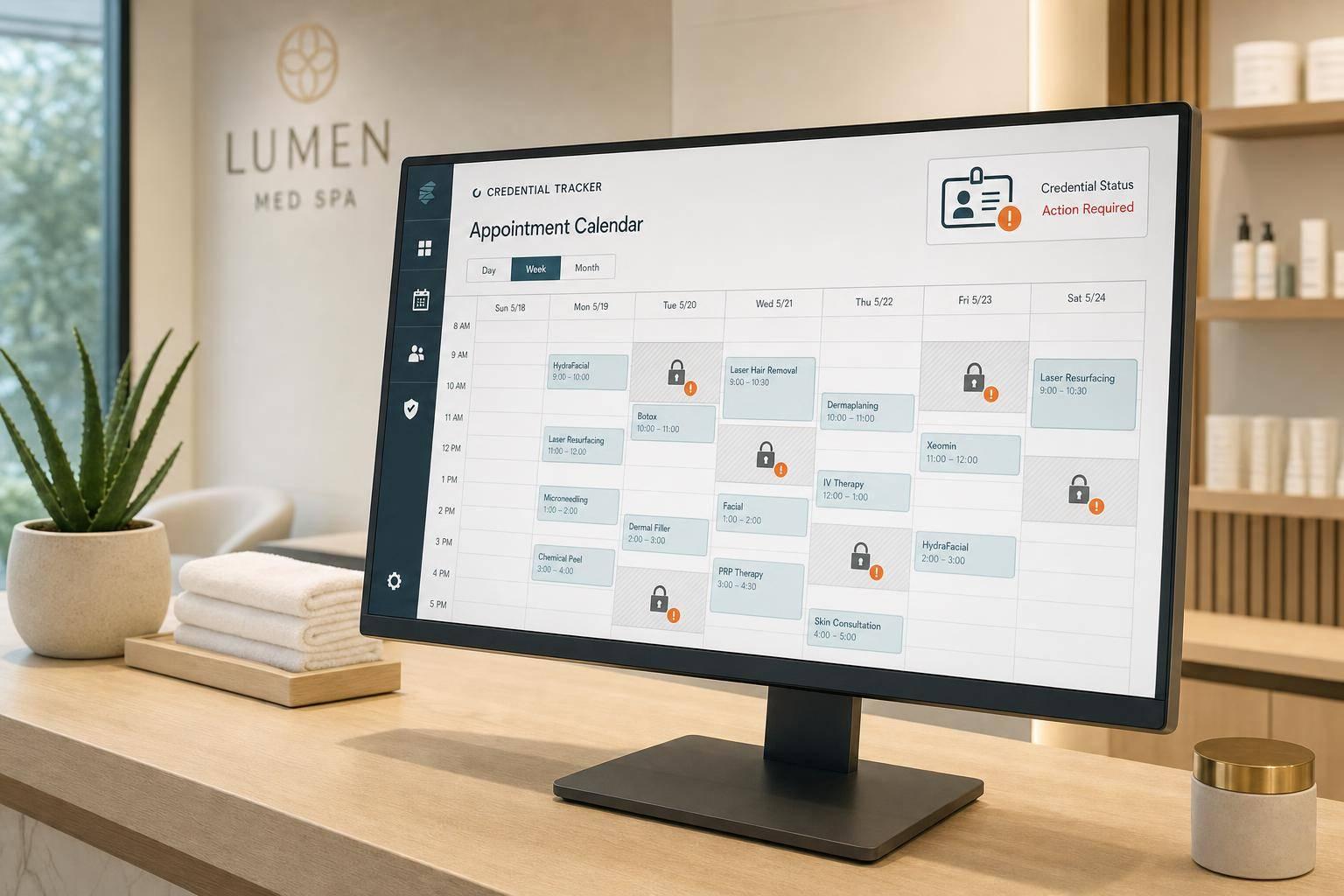

If one provider’s credential slips, a med spa can lose $1,000 to $5,000 per day, face claim denials, stop services, or issue refunds.
I’d sum it up like this: credentialing risk is money risk. When licenses, payer enrollment, malpractice coverage, DEA records, supervision documents, training records, or NPIs are missing or expired, the damage can hit fast. Hiring and expansion often move in weeks, but payer enrollment can take 90 to 120 days. And incomplete CAQH files can add 30 to 60 more days, affecting 35% to 40% of first-time submissions.
Here’s the short version of what matters:
- Late payer enrollment can make visits unbillable
- Expired licenses or malpractice coverage can stop scheduling
- Missing training or supervision records can trigger board action
- Wrong NPI or enrollment dates can lead to denials and takebacks
- Manual spreadsheets often miss deadlines until cash flow is hit
- Scheduling rules tied to credential status help stop bad bookings before they happen
A few numbers stand out:
- 90 to 120 days: common payer credentialing timeline
- 30 to 60 days: extra delay from incomplete CAQH data
- 61% of practices: had at least one active credentialing lapse
- 78% of lapses: stayed missed for more than 60 days
| Risk area | What can happen |
|---|---|
| License or malpractice lapse | Provider removed from schedule |
| Payer enrollment delay | Visits cannot be billed |
| Missing supervision or training | Fines, audits, or service suspension |
| NPI or claim mismatch | Denials, recoupments, write-offs |
| Poor tracking | Delays found after revenue is lost |
If I were reviewing this topic with a med spa team, I’d focus on one thing first: check every provider file before it affects the schedule or billing.
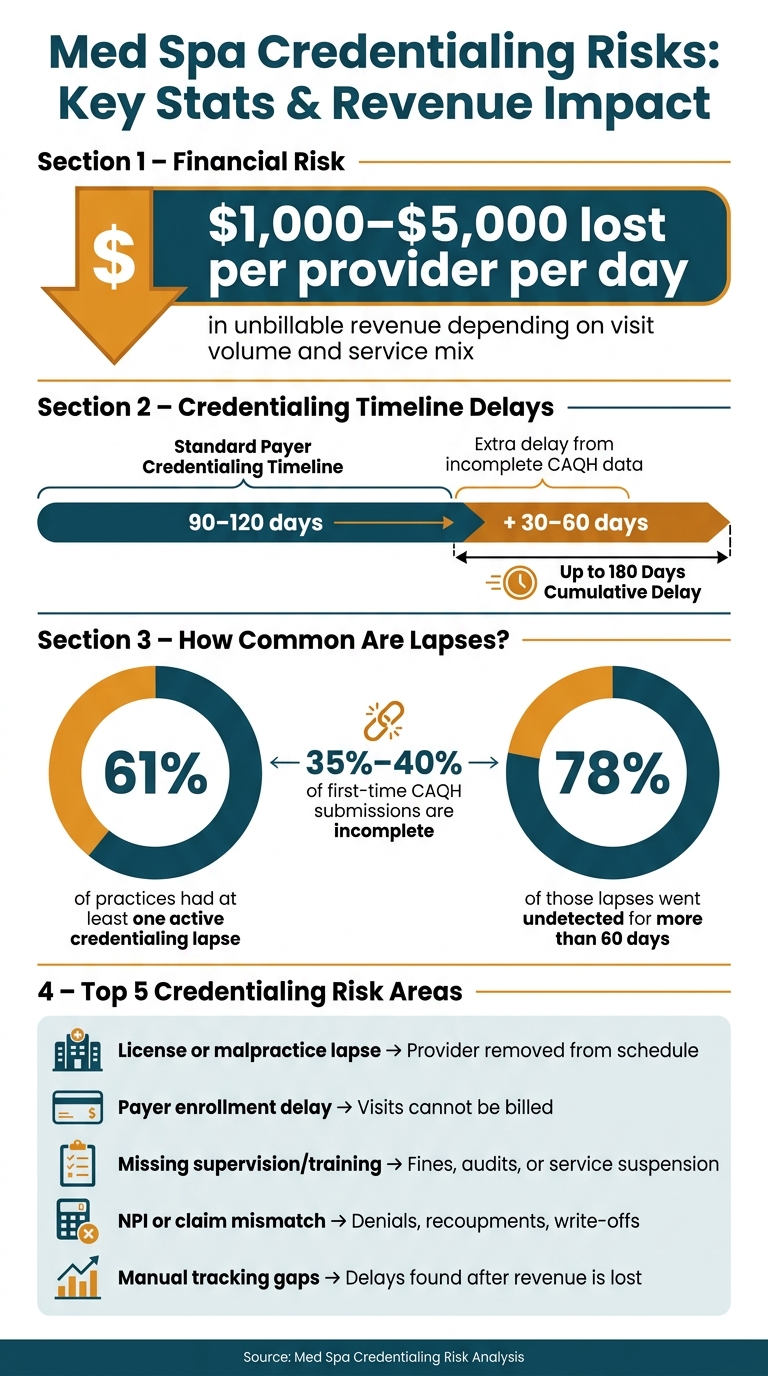
Med Spa Credentialing Risks: Key Stats & Revenue Impact
Where credentialing problems start
Credentialing problems usually begin well before the denial, delay, or write-off shows up. In many med spas, the trouble starts weeks or months earlier, when hiring plans, launch dates, and growth move faster than the workflow built to support them. Those early misses are what later turn into lost revenue. The risk climbs fastest during hiring and expansion, when credentialing falls behind growth.
Hiring and expansion timelines that move faster than credentialing
When a med spa hires a new provider, the goal is often simple: get that person on the schedule as soon as possible. But credentialing and payer enrollment with commercial payers often take 90 to 120 days. If the clinic sets the launch date first and handles enrollment second, the provider may be seeing patients before the practice can bill for those visits.
The same pattern shows up when a clinic opens a second location or adds a new service line. On paper, it can look like one move. In practice, it often triggers several separate tasks. Payer records may need updates. Malpractice coverage may need changes. Site-specific approvals may also be required. If those steps do not start months ahead of time, the opening date can slide. And each lost day can mean revenue the practice may never get back, because payers rarely allow retroactive billing to the hire date.
Manual tracking creates hidden gaps
Manual tracking systems tend to hide problems until they hit operations. A spreadsheet or shared inbox might list deadlines, but it does not reliably catch an expiring license or lapsed malpractice policy at the right moment. The gap often becomes clear only after a denial, an audit, or a scheduling mistake.
CAQH is a good example. Incomplete CAQH profiles affect 35% to 40% of initial payer submissions and can add 30 to 60 days to enrollment. That kind of delay can sit quietly in the background while the schedule fills up. And if the spreadsheet has not been updated since the provider was hired, no one sees the problem until it spills into claims or patient visits. Things get even messier when service permissions differ by state and by procedure.
State rules and services offered add complexity
Licensure alone does not settle everything. A provider may be fully licensed and credentialed for one service, yet still not be cleared to perform another service at the same clinic. In other words, a provider can be licensed and still be blocked from a specific service or site.
Injectables, laser treatments, and RF microneedling can each call for different documentation, and those rules change by state. Some states require documented competency training. Others require a certain supervision setup or delegation paperwork. Those details are easy to miss if the process checks only for an active license instead of service-specific permissions.
Once a provider is placed on the schedule outside the scope they are approved for, the issue stops being a paperwork problem. It becomes a billing and compliance problem. By the time that gap reaches the schedule or claims desk, it often turns into delays, write-offs, and service stoppages.
sbb-itb-02f5876
How non-compliance leads to fines, delays, and lost revenue
Once the gaps described above hit the schedule or claims desk, the cost shows up fast. When credentialing problems move out of the back office and into day-to-day operations, the impact is immediate: canceled appointments, denied claims, and cash flow issues that can take months to sort out.
Fines, sanctions, and service stoppages
State boards have stepped up enforcement around scope of practice, supervision structures, and medical director documentation. If an inspection, audit, or complaint reveals a missing supervision agreement, an expired license, or training records that do not line up with the services being offered, the clinic may face a corrective action plan, a temporary service suspension, or civil penalties, depending on the violation and the state.
Scope of practice violations can bring fines, license revocation, or criminal charges in severe cases. Unlicensed practice can also lead to fines and, in severe cases, permanent practice closure. And when services stop, patient volume drops right away.
Those penalties are only one part of the damage. Delays in care and billing hit revenue next.
Expansion delays and idle provider capacity
A newly hired provider who still cannot bill is one of the costliest credentialing issues a med spa can face. The clinic may already be paying for payroll, room time, equipment, and marketing before that provider sees a single billable patient. If payer enrollment is not complete, those costs just sit there without bringing money in.
Credentialing often takes 90 to 120 days, and payers usually will not reimburse services delivered before the effective date. In plain terms, credentialing delays can drain about $1,000 to $5,000 per provider per day in lost billable revenue, depending on visit volume and service mix. Once enrollment clears, that lost revenue is usually gone for good.
Denied claims, refunds, and cash flow pressure
Services billed under an uncredentialed provider are often denied or recouped. Sometimes the claim is denied outright. Other times, it gets paid at first and then pulled back after review. Either way, the clinic takes the hit through write-offs, patient refunds, or reversed charges, while staff spend more time on appeals and rescheduling affected visits.
That is why credentialing lapses can throw off cash flow forecasting far beyond a single claim. Denials and recoupments increase accounts receivable aging and make monthly forecasting and analytics less reliable. In one analysis, 61% of practices had at least one active credentialing lapse, and 78% of those lapses went undetected for more than 60 days.
How med spas track credential gaps before they affect daily operations
The goal is simple: catch credentialing gaps before a provider gets booked for a service they are not cleared to perform. To do that, med spas need one shared view of each provider’s license, training, enrollment, and site permissions.
Set one credentialing standard across providers, services, and locations
The main reason gaps slip by is inconsistency. One staff member checks one set of items. Another checks something else. That usually depends on who handled the hire or which location is growing.
A single checklist, built by role and service type, fixes that problem.
For each provider, the checklist should include:
- An active state professional license
- DEA registration, if the provider prescribes controlled substances
- NPI
- Malpractice insurance
- Payer enrollment or network status, when the practice bills insurance
- Sanctions and exclusion screening
- Documented training for each aesthetic procedure offered
- Supervised hours, if the state requires them
- Site-specific approval
That checklist also needs clear rules. Who reviews each item? What counts as accepted documentation? At what point is the provider cleared for booking? If those answers change by person or by location, mistakes creep in fast.
Without one standard, a provider can end up billed, scheduled, or supervised one way at one location and a different way at another.
Use dashboards, alerts, and task queues instead of spreadsheets
As a practice grows, manual tracking stops helping and starts causing problems. Spreadsheets break down once you add more locations, more services, and more provider types. Files get out of sync. Manual updates get missed. Ownership gets fuzzy. Then an expired license or missing training certificate sits unnoticed for weeks.
A centralized digital system gives the team one source of truth. It also turns each gap into a task with an owner and a due date, which is a lot better than hoping someone remembers to circle back.
Set automated alerts for 90, 60, 30, and 15 days. If an item is still unresolved at 15 days, escalate it. At that point, the provider may need to be removed from certain schedules until the file is current.
That setup lowers the odds that expired credentials turn into denials, stoppages, or idle capacity.
| Area | Manual tracking | Centralized digital tracking |
|---|---|---|
| Visibility | Limited to whoever maintains the file; easy to miss updates | Shared, real-time view across teams and locations |
| Audit readiness | Harder to prove timely review and follow-up | Easier to show status, history, and completed tasks |
| Alert timing | Often depends on memory or calendar reminders | Automated 90-, 60-, 30-, and 15-day alerts |
| Scalability | Becomes messy as providers and locations grow | Handles more providers, services, and sites with less manual work |
Connect credential status to scheduling and reporting
This is where credentialing either holds up or falls apart: the schedule.
If the scheduler can’t see that a provider is approved for injectables but not laser treatments, or approved at one location but not another, the booking error still happens. And once it hits the calendar, the clinic is already dealing with the fallout.
The scheduling system should block or flag appointments when a provider’s credentials for a specific procedure or site are incomplete or expired. That one link helps prevent same-day cancellations and keeps the clinic from logging revenue that may later be recouped.
A HIPAA-compliant platform like Prospyr can centralize scheduling, task management, patient records, and analytics so staff can spot credential gaps before they hit the calendar or show up in revenue reports.
Conclusion: The controls that protect compliance and revenue
Once you can see credential gaps, the next move is simple: stop them before a provider ever hits the schedule.
This kind of risk tends to build quietly during hiring, expansion, and new service rollouts. Then it surfaces where it hurts most: denials, stoppages, refunds, or penalties. Maybe a provider gets booked before payer enrollment is approved. Maybe a supervision or delegation agreement expires. Maybe a new service goes live before the paperwork is updated.
The fix isn't complicated. Use one credentialing standard across every provider, service, and location. Set automated renewal alerts. Add scheduling blocks based on credential status. A platform like Prospyr can keep provider files, task queues, scheduling, and analytics in one place.
From there, the team's job is pretty direct: audit every file and clear every deadline before it spills into booking or billing.
This week, review every provider file before it can interrupt scheduling or payment. Check:
- current license
- malpractice coverage
- DEA registration, if applicable
- supervision documentation
- payer approvals
Then map every expiration in one view and assign one owner to each item.
The controls are simple. The cost of skipping them is high.
FAQs
What documents should every provider file include?
Every provider file should include the core documents inspectors and medical directors expect to see: primary-source license verification, current board certification, DEA registration when needed, liability insurance, CPR/BLS certification, OSHA and HIPAA training records, and any disciplinary or sanction history.
It should also include signed physician-approved SOPs, delegation or collaborative agreements, clinical competency records, CME/CE certificates, I-9 forms, and a photo ID.
Putting all of this in one centralized, HIPAA-compliant system like Prospyr makes the job a lot easier. Your records stay organized, easy to review, and ready when an audit or inspection comes up.
Can a med spa bill before payer enrollment is active?
No. A med spa should not bill for services before payer enrollment is active.
Letting providers see patients or file claims before credentialing is done can trigger billing issues, payment delays, and possible legal penalties, including exclusion from Medicare and Medicaid. Clinics should confirm payer effective dates in writing before a provider starts clinical work.
How can scheduling help prevent credentialing mistakes?
Scheduling helps stop credentialing slipups before they turn into bigger problems. Think of it as the gate between cleared and booked.
When appointments are tied to a procedure-to-credential matrix, only verified and approved providers can get on the schedule. That means clinical work starts only after license verification, signed supervision or delegation agreements, and documented competency are done.
You can also use scheduling to kick off onboarding tasks and send 90/60/30-day reminders with clear ownership. That way, expiring or missing records get flagged early, before they lead to stoppages, refunds, or penalties.