
Workplace violence is a growing concern in clinics, with healthcare workers facing significantly higher risks than other professions. Verbal abuse is the most common issue, but physical assaults are also reported. Many incidents go unreported, making the problem even harder to address. Clinics, especially those in aesthetics and wellness, face unique challenges due to factors like handling cash, isolated locations, and staff working alone.
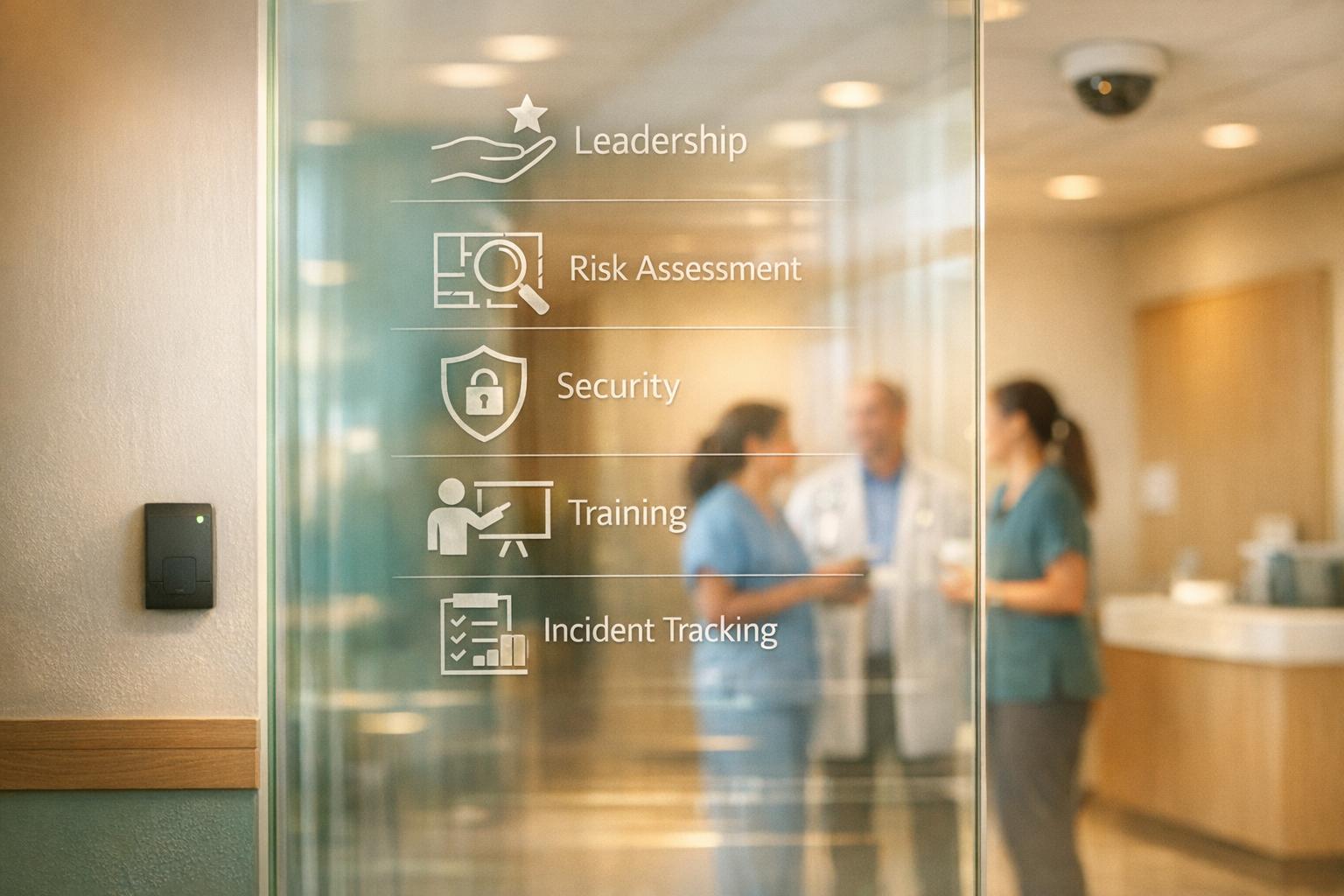
To create a safer environment, follow these 5 key steps:
- Leadership and Staff Commitment: Secure leadership support, establish a zero-tolerance policy, and set up a safety committee to oversee prevention efforts.
- Assess Risks: Identify physical and behavioral risks, review clinic layouts, and train staff to spot warning signs of violence.
- Implement Security Measures: Use video surveillance, panic buttons, and access controls while enforcing strict visitor policies.
- Train Staff: Focus on de-escalation techniques, recognizing aggression, and running practice drills for emergency scenarios.
- Track and Review Incidents: Set up a clear reporting system, analyze patterns, and refine your safety program based on incident data.
These steps help protect staff and patients while promoting a safer, more secure clinic environment.

5 Steps to Prevent Workplace Violence in Clinics
Step 1: Get Leadership and Staff Commitment
Preventing workplace violence starts with leadership taking a firm stand. When executives commit to this cause, they provide the authority, resources, and unified direction needed to protect staff. A strong leadership presence helps foster a workplace culture where violence is unacceptable, and employees feel safe reporting incidents without hesitation. Barbara Morgan, Associate Chief Nursing Officer of Emergency Services at Cleveland Clinic, highlights this idea:
"Our success in providing a safe, nurturing work environment is largely dependent on our ability to implement a consistent response to violent incidents. It's critical for everyone to be on the same page, and preparedness is critical."
Leadership commitment isn't just about words - it requires action. This means allocating funds for security systems, staff training, and adequate staffing levels. Leaders also play a key role in post-incident recovery. For example, in late 2025, OU Health, under the guidance of CMO Carolyn Kloek, MD, introduced a "blame-free" debriefing process. This process brings together staff and leadership immediately after an incident to gather insights and reduce future risks. Such initiatives reassure employees that their safety and well-being are a top priority, laying the groundwork for the steps that follow.
Create a Zero-Tolerance Policy
Once leadership is aligned, the next step is to formalize a zero-tolerance policy for workplace violence. This policy should clearly define what constitutes violence, including verbal harassment, which is often overlooked. Mary R. Sauer, Chief Nursing Officer at Avon Hospital, sheds light on this issue:
"Nurses have traditionally regarded certain aspects of workplace violence – such as verbal harassment from patients – as an unavoidable part of the job. Fortunately, that is beginning to change. No one should have to work in an environment that makes them feel mentally or physically vulnerable."
The policy should outline specific consequences for violent behavior, including the potential for administrative discharge for patients who pose ongoing threats. For instance, Denver Health introduced a multi-step intervention process in 2025 for dealing with violent patients. Before a discharge decision is made by leadership, patients go through documented discussions with a nurse manager, an attending physician, and security staff, giving them opportunities to adjust their behavior. To reinforce this policy, display clear signage throughout the facility and incorporate the zero-tolerance stance into new employee onboarding.
Form a Safety Committee
Establishing a safety committee is another crucial step. This cross-functional team should include representatives from various areas such as nursing, front desk operations, security, human resources, and risk management. The committee oversees the violence prevention program, assigns responsibilities, and ensures accountability. By involving staff from all levels, you create what experts call "collective leadership", where employees are empowered to identify risks and recommend solutions. Regular meetings allow the committee to review incidents, update protocols, and organize training sessions. This collaborative approach ensures that safety becomes a shared responsibility across the entire organization.
sbb-itb-02f5876
Step 2: Assess Workplace Violence Risks
Once leadership has committed to a safety-first approach, the next step is to evaluate where your clinic may be vulnerable to workplace violence. This involves identifying both physical and behavioral risks. The American Academy of Family Physicians highlights the importance of awareness, stating, "The first and most important tool in preventing a violent patient encounter is heightened awareness, which can help you spot behavior that may develop into future violence so that you can attempt to defuse the situation." By identifying risks early, you can take action to address them before they escalate into serious incidents. This evaluation lays the groundwork for improving safety measures and behavioral protocols.
To get a complete picture, involve staff from various roles - nurses, front desk workers, security personnel, risk managers, and even local law enforcement. This diverse input helps uncover risks that might otherwise go unnoticed. It’s important to examine risks in four key areas: violence from patients, visitors or family members, coworkers, and strangers or non-employees.
Review Clinic Layout and Workflows
Begin by assessing your clinic's physical environment. Walk through the facility as if seeing it for the first time, paying close attention to areas that could pose security risks. Look at entrances, parking lots, hallways, and office layouts. Are security devices like cameras and panic buttons in place? Are exits clearly visible and accessible? Is there sufficient lighting in all areas, particularly in parking lots and lesser-used spaces?
Inside the clinic, check whether video surveillance covers all entry points and high-risk zones. Office layouts should allow for clear escape routes. Denise Neal, Assistant Vice President of the Risk Management Group at AWAC Services Company, advises: "Avoid having your back to the exit, and turn your body sideways to allow a clear path to the exit if a quick escape is necessary." Additionally, confirm that safety devices like panic buttons are functional and that visitor access protocols and digital intake processes are strictly followed.
Assess whether employees are ever working alone, especially during evenings, and consider implementing a buddy system for tasks like walking to vehicles or closing the clinic. Don’t overlook digital spaces - review social media policies to ensure staff maintain professional boundaries online.
Once you’ve addressed physical vulnerabilities, shift your focus to identifying behavioral risks.
Identify Warning Signs of Violence
Spotting behavioral warning signs is just as important as securing the physical environment. The National Institute for Occupational Safety and Health points out that "Without [a standardized scale], we are left to rely on best guesses and gut reactions." Using a standardized Danger Assessment Scale (e.g., Low/Medium/High) can help evaluate risks, particularly for patients with a history of threats or violence.
Train staff to recognize behavioral red flags, such as sudden changes in mood, clenched fists, aggressive gestures, or damage to property. Past incidents of harassment or boundary violations should also be noted, as they can signal potential risks. Encourage a "see something, say something" culture, where employees feel safe reporting suspicious behavior or individuals without fear of retaliation.
It’s also important to know that HIPAA allows the disclosure of nonclinical information to prevent or lessen serious threats to health or safety. Lastly, designate a "safe room" within the clinic where staff can retreat if they cannot escape during a violent situation. By addressing both physical and behavioral risks, your clinic can take meaningful steps toward creating a safer environment for everyone.
Step 3: Add Security Controls and Safety Measures
To protect your clinic's staff and patients, it's essential to implement safety measures that combine clear administrative policies with effective technology. The aim is to create multiple layers of protection that safeguard your team while maintaining a welcoming environment for patients. This approach reinforces your commitment to a zero-tolerance policy and proactive safety planning. The U.S. Department of Labor emphasizes:
"Violence or threats of violence - in all forms - is unacceptable behavior. It will not be tolerated and it will be dealt with appropriately."
Your security measures should reflect this zero-tolerance stance while remaining practical for everyday clinic operations. These steps build on earlier risk assessments to ensure a safer workplace.
Set Up Administrative Safety Controls
Administrative controls are the backbone of daily operations and safety. Start by enforcing strict access control policies that limit public access to restricted areas. For example, regularly update door keypad codes, especially after staff changes, to prevent unauthorized entry.
A visitor management system can help monitor access. Require visitors to check in, state the purpose of their visit, and register before entering clinical areas [10, 13]. Use the reception desk as a physical barrier between staff and the waiting area, and make sure employees wear uniforms or name badges for easy identification.
To further enhance safety, implement buddy systems or team staffing during late shifts, when dealing with challenging situations, or when walking to vehicles after dark. Conduct thorough reference checks before hiring to identify candidates with histories of violent or intimidating behavior. Given that domestic violence accounts for 27% of workplace violence incidents, encourage employees to share any restraining or protective orders so that safety plans can be tailored accordingly.
Install Security and Alert Systems
Technology can significantly improve safety measures. Install video surveillance to monitor all entry points, reception areas, hallways, parking lots, and nurse stations. Be mindful to exclude private areas like exam rooms and bathrooms. Clearly display signs indicating video monitoring, and ensure the clinic's exterior is well-lit to eliminate hiding spots.
Incorporate multiple alert systems to respond quickly to threats. The Institute at MagMutual advises:
"Using wireless panic buttons, a messaging/call system that alerts others or a security system connected to a third party can provide an additional layer of security."
These tools allow staff to call for help without leaving their position. Use staff-only doors with key access and automatic locks to separate waiting areas from treatment rooms, creating a physical barrier against unauthorized access. Provide scripts to guide staff in addressing visitor policy violations, and remind everyone to call 911 immediately if they feel threatened - this helps de-escalate potential incidents.
Step 4: Train Staff on Violence Prevention
Now that you've fortified your security measures, it's time to focus on preparing your staff. Even the most advanced systems can't fully protect your team if they aren't trained to recognize and respond to threats effectively.
Your training program should center on two key areas: spotting early signs of aggression and mastering de-escalation techniques. Staff need to recognize physical cues like clenched fists, flushed faces, throbbing veins, pacing, excessive sweating, or changes in breathing patterns. Additionally, verbal signals - such as profanity, inappropriate remarks, paranoid or delusional statements, and direct threats - should immediately raise red flags. The earlier these signs are identified, the better the chance of intervening safely.
Teach De-Escalation Methods
De-escalation training provides your team with tools to calm tense situations before they spiral out of control. One effective approach is the STOPP acronym, which lays out actionable steps:
- Stabilize the situation by staying calm and composed.
- Transfer the location by identifying nearby exits.
- Observe the individual's actions for signs of potential aggression.
- Proximity: maintain a safe distance, ideally two to three arms' lengths.
- Provide opportunities to appease by offering small comforts.
Simple gestures can go a long way in calming someone down. Security consultant Sean A. Ahrens, CPP, CSC, CHPA, explains:
"It is difficult for many people to maintain anger when they are being given something."
Offering a bottle of water, a snack, or even acknowledging someone's frustration with empathy can significantly reduce tension. Reception staff, in particular, play a critical role as they are often the first point of contact. Managing these interactions effectively starts with streamlined online scheduling to reduce wait-time frustrations. Training them to use a firm yet calm tone, to let individuals express their concerns, and to show genuine understanding is essential - they are, as Ahrens puts it, "the true first line of defense in managing patient frustration".
If aggression escalates despite these efforts, staff should know how to set clear boundaries by referencing patient care agreements and explaining the consequences, such as involving security. These techniques, combined with regular practice, ensure that staff are ready to manage challenging scenarios effectively.
Run Practice Drills
Training shouldn't stop at theory - practical drills are vital. Scenario-based exercises help staff build muscle memory and overcome the natural freeze response triggered by adrenaline in high-stress situations. Sean A. Ahrens highlights the importance of these exercises:
"Scenario-based training transforms theoretical policies into actionable strategies that can be recalled under stress, strengthening both personal safety and organizational resilience."
Drills should include the use of discreet code words - like "Dr. Strong to the waiting room" - to call for assistance without alarming the aggressor. Assign clear roles to receptionists, nurses, and security staff, and rehearse emergency protocols such as "Run, Hide, Fight" for active shooter scenarios. With nearly 50% of active shooter incidents ending before law enforcement arrives, your team's preparedness could make all the difference.
Incorporate this training into new employee orientations and schedule mandatory annual refresher courses to keep skills sharp and ensure everyone is ready to act when it matters most.
Step 5: Track Incidents and Review Your Program
Your violence prevention program isn't something you can set up and forget about - it needs constant attention and improvement. Without regular tracking, you won’t have a clear picture of the risks you're facing or the progress you're making. Monitoring incidents helps validate the efforts you’ve put into leadership involvement, risk assessments, security upgrades, and staff training. With 2 million American workers reporting workplace violence each year, keeping detailed incident records is essential. These records not only highlight your clinic’s specific vulnerabilities but also measure the success of your safety measures. By combining this tracking with earlier steps, you create a well-rounded approach to preventing workplace violence.
Create an Incident Reporting System
Set up a clear and formal process for documenting every incident, whether it’s a verbal threat or a physical assault. Many violent situations start with warning signs that often go unnoticed or unreported. Make it clear to your team: every report counts.
A strong reporting system should have three key elements:
- Detailed Record-Keeping: Capture all relevant details about each incident.
- No-Reprisal Policy: Assure employees they won’t face negative consequences for reporting incidents.
- Assigned Responsibility: Designate trained staff or a safety committee to oversee the process.
As OSHA advises:
"Require records of incidents to assess risk and measure progress".
These records aren’t just for internal use - they're also helpful when working with law enforcement. Build a relationship with local police to share trends and get their input on prevention strategies. Their expertise can help you identify risks you might have overlooked and stay ahead of potential threats.
Review Program Performance
Use your incident logs to identify patterns and refine your protocols. Schedule regular reviews, ideally every quarter, to analyze the data. The Joint Commission mandates that healthcare organizations collect and review this kind of information to guide violence prevention efforts.
Turning raw data into actionable steps is where the real value lies. For instance, if your logs show an increase in incidents in the parking lot after dark, you might install better lighting or increase security patrols during those hours. If patients frequently become agitated due to delays, you could streamline workflows to reduce wait times. OSHA emphasizes:
"A well-written and implemented workplace violence prevention program, combined with engineering controls, administrative controls, and training, can reduce the incidence of workplace violence".
After any major incident, bring your team together for a debrief. Support affected staff, review what happened, and pinpoint areas for improvement. These discussions provide practical insights that help your program adapt and grow based on real-world experience.
How Prospyr Supports Workplace Safety
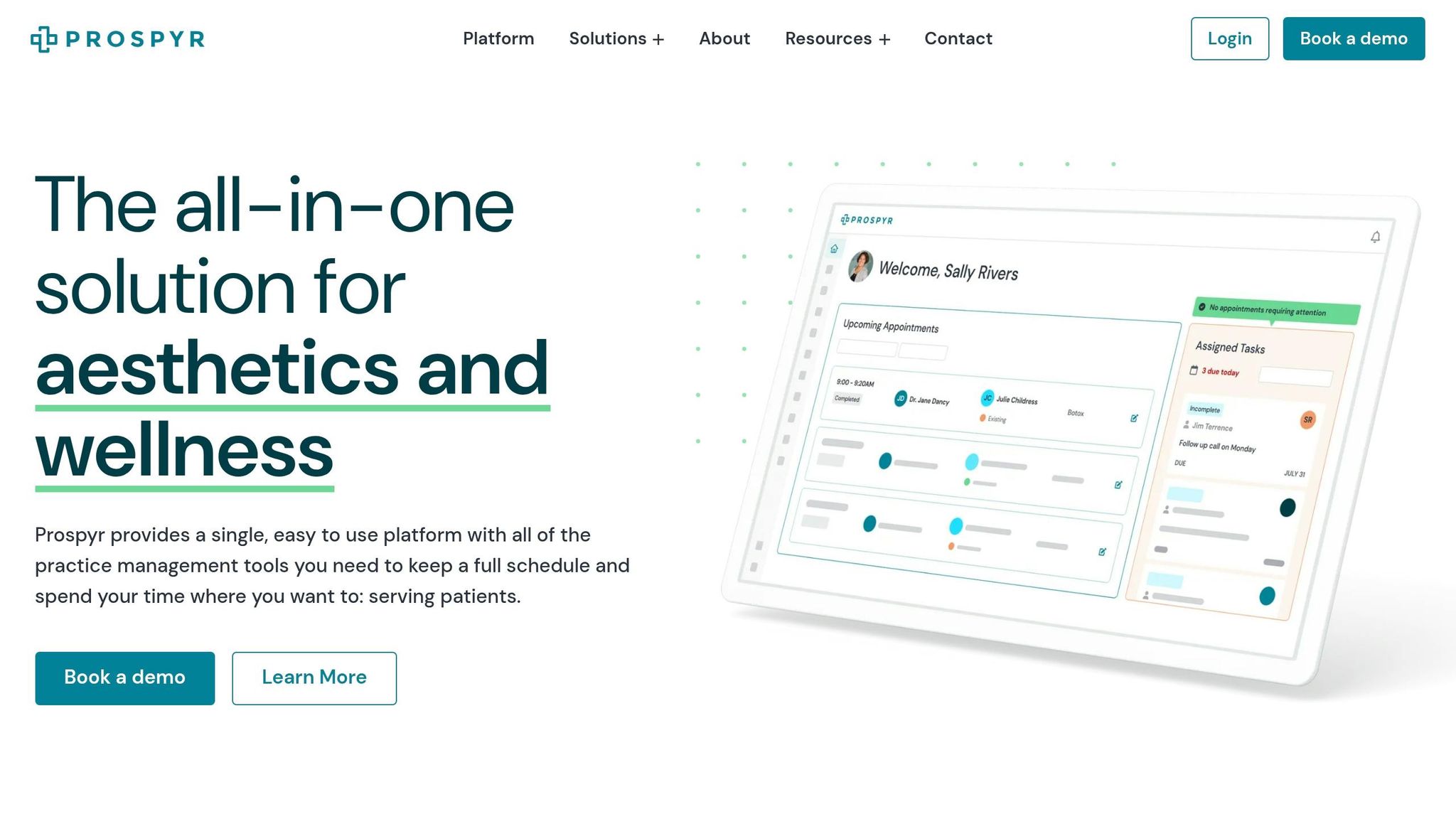
Once preventive measures are in place, the next step is making sure safety efforts are managed, monitored, and communicated effectively. Managing a workplace violence prevention program means keeping track of training sessions, monitoring safety trends, and staying prepared for compliance audits. Prospyr's HIPAA-compliant platform simplifies this process by letting clinic administrators assign tasks, track training updates, and maintain digital records. It’s designed to make safety management more efficient for clinics.
Manage Tasks and Training
OSHA recommends assigning safety responsibilities to individuals or teams who have the right training and skills. Prospyr's task management system allows you to assign safety-related duties to specific staff members and track their progress. For training updates - like de-escalation techniques or policy reviews - you can set tasks with deadlines and receive notifications when they're completed. Plus, it keeps digital records ready for audits.
The platform also ensures your zero-tolerance policy is communicated effectively to managers and supervisors, promoting consistency across teams.
Use Analytics to Monitor Safety
Prospyr's analytics tools turn incident data into actionable insights. You can identify trends - like increases in verbal threats or recurring problems - so you can address risks before they grow.
The analytics dashboard provides a full view of workplace safety metrics. By tracking things like incident frequency, response times, and staff compliance, you can measure how well your prevention efforts are working and adjust your strategy as needed.
Improve Communication and Reporting
OSHA stresses the importance of encouraging employees to report incidents quickly. Prospyr’s secure email and SMS tools make it easy for staff to report issues from anywhere in the clinic. These HIPAA-compliant messaging features ensure sensitive information stays protected while allowing for swift coordination during safety events.
When incidents happen, you can document every detail in the system, creating the records OSHA requires to evaluate risks and track progress. By combining communication, reporting, and documentation, Prospyr supports the thorough approach outlined in this guide.
Conclusion
Preventing workplace violence in clinics requires an ongoing, well-coordinated effort. The five steps outlined here form a continuous cycle: leadership commitment lays the groundwork, risk assessments pinpoint specific vulnerabilities, security measures and staff training provide essential defenses, and incident tracking allows for evaluation and improvement. This approach emphasizes the importance of staying alert and proactive.
With nearly 2 million American workers experiencing workplace violence each year, regular safety evaluations are a must. These reviews - conducted at least annually or after any incident - help adapt your program to workplace changes and new safety risks.
"A well-written and implemented workplace violence prevention program, combined with engineering controls, administrative controls, and training, can reduce the incidence of workplace violence." - OSHA
Consistency is the key to success. A zero-tolerance policy, combined with robust security measures and ongoing training, works best when maintained over time. Employee involvement is equally important for identifying weaknesses and ensuring that reporting systems are trusted and effective.
Prospyr’s HIPAA-compliant platform can simplify this process by centralizing safety management. It offers tools for task tracking, incident documentation, and analytics, making it easier to maintain an organized and accessible prevention program. This not only keeps your staff and patients safe but also allows your clinic to focus on delivering quality care.
FAQs
What should our clinic do first if we don’t have a formal violence prevention program?
If your clinic doesn’t have a formal violence prevention program, it’s time to address the increasing risk of workplace violence. Start by recognizing the importance of preparation and committing to action. Build a prevention plan that includes clear safety protocols, effective administrative measures, and comprehensive staff training. These steps can go a long way in minimizing risks and ensuring a safer workplace for everyone.
How can we reduce risk when staff members work alone or close the clinic at night?
To help keep staff safe when they’re working alone or closing up at night, it’s crucial to start with a detailed risk assessment. This helps pinpoint potential hazards and lays the groundwork for effective safety measures.
Some practical steps include offering personal safety training to employees, implementing check-in systems or emergency alert tools, and making sure they have access to reliable communication devices. It’s also important to regularly revisit and update your safety policies to address new risks. Finally, establish clear and actionable emergency procedures to give employees the confidence they need in these situations.
What’s the best way to document and report verbal threats without violating HIPAA?
When documenting and reporting verbal threats while adhering to HIPAA guidelines, focus on recording objective and non-identifiable details. This includes noting the date, time, location, and a clear description of the threat's nature. Avoid including any protected health information (PHI) or details that could identify a patient.
Stick to your clinic's incident reporting procedures, ensuring that all documentation is factual and free from personal opinions or assumptions. Maintain secure logs that are accessible only to authorized personnel. Regular staff training is essential to ensure everyone understands how to document incidents without risking HIPAA violations.